


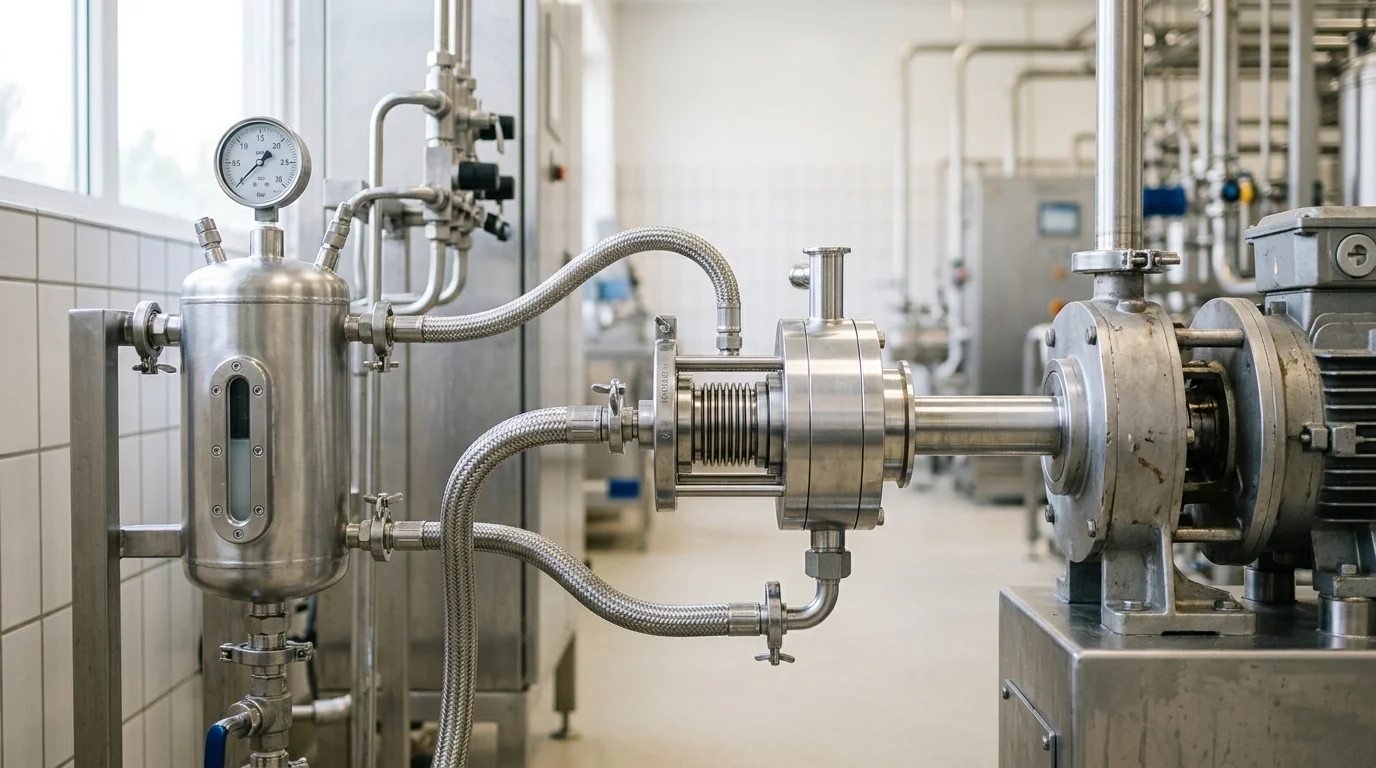
Why Food Plants Need Hygienic Mechanical Seal Systems
Industrial food processing demands rigorous containment strategies to protect both the product and the plant environment. Historically, facilities relied on compression packing or basic lip seals to isolate fluids within pumps and mixers. However, conventional packing is designed to weep, typically leaking 10 to 15 drops per minute to maintain lubrication. In a modern food plant, this baseline leakage translates to severe contamination risks, wasted product, and hazardous pooling on plant floors. Hygienic mechanical seal systems have become the definitive standard for isolating process fluids, ensuring hermetic containment while satisfying stringent sanitary mandates.
The transition to engineered mechanical seals represents a critical upgrade in plant hygiene and operational efficiency. By utilizing spring-loaded, precision-lapped faces rotating against one another, these systems eliminate the operational leakage inherent to older sealing technologies. For food manufacturers operating high-capacity lines, mitigating leakage prevents the loss of thousands of gallons of process fluid annually and drastically reduces the biochemical oxygen demand (BOD) load on wastewater treatment systems.
How hygienic seals reduce contamination risk
Hygienic seals primarily reduce contamination risk by eliminating dead zones and harbor points. Standard mechanical seals often feature exposed coil springs, sharp internal angles, and deep O-ring grooves where stagnant product can accumulate. In food processing, any residual organic matter provides a breeding ground for pathogens such as Listeria monocytogenes and Salmonella. Hygienic seals utilize open, self-draining profiles and smooth geometries to ensure that no process fluid becomes trapped during operation or cleaning cycles.
Surface finish plays an equally vital role in microbial control. Hygienic mechanical seals are manufactured with highly polished surfaces, typically achieving a roughness average (Ra) of less than 0.8 micrometers (32 microinches), with premium electropolished components reaching Ra values below 0.4 micrometers. This microscopic smoothness prevents bacterial adhesion and allows cleaning agents to sweep away proteins and fats efficiently.
Where sanitary seals matter most in food processing
Sanitary seals are indispensable in applications involving high-shear mixers, centrifugal pumps, and positive displacement pumps handling sensitive or perishable media. Dairy processing, for instance, requires absolute sterility due to the rapid proliferation of bacteria in milk and whey products. Similarly, viscous applications like syrup blending, meat extrusion, and dough mixing rely on robust sanitary seals to handle varying pressures and abrasive particulate loads without compromising the hygienic boundary.
The operating parameters in these critical zones often push the limits of equipment design. Positive displacement pumps handling high-viscosity food pastes can generate internal pressures exceeding 300 psi (20.6 bar). In these environments, standard lip seals would fail instantaneously or extrude into the product stream. Engineered hygienic mechanical seals provide the structural integrity required to withstand these pressures while maintaining the strict sanitary envelope necessary for food-safe production.
How Hygienic Mechanical Seals Differ from Standard Industrial Seals

While standard industrial seals and hygienic seals operate on the same fundamental principles of fluid dynamics and face tribology, their architectural execution differs profoundly. Standard seals prioritize pressure handling, chemical resistance, and dimensional standardization for the oil, gas, and chemical sectors. Conversely, hygienic seals prioritize cleanability, biological safety, and compliance with food-grade standards. This divergence in design philosophy mandates specific engineering modifications to ensure the seal does not become a vector for contamination.
The most significant difference lies in the fluid path. Standard API or ANSI seals often immerse complex mechanisms, including multiple springs and bellows, directly into the process fluid. In a food plant, this configuration is unacceptable. Hygienic designs isolate the dynamic components from the product stream, ensuring that only smooth, crevice-free surfaces contact the food media.
Key hygienic design features
Hygienic seals are engineered with exposed, self-draining geometries. Stationary springs are located entirely outside the product boundary, utilizing a smooth rotary unit that sheds particulates. Furthermore, dynamic O-rings in standard seals are prone to micro-movements that can draw bacteria into the seal cavity—a phenomenon known as O-ring hang-up. Hygienic designs often employ specialized elastomers or statically mounted secondary seals to prevent this ingress.
To illustrate the fundamental differences between standard and hygienic configurations, consider the following structural comparisons:
| Design Element | Standard Industrial Seal | Hygienic Mechanical Seal |
|---|---|---|
| Spring Location | Often internal (immersed in fluid) | External (isolated from product) |
| Surface Finish | Standard machined (Ra > 1.6 µm) | Highly polished (Ra < 0.8 µm) |
| O-Ring Grooves | Standard rectangular grooves | Radiused, open, or flush designs |
| Cleanability | Requires manual teardown | Fully CIP/SIP compatible |
Single, double, and tandem seal options
The selection between single, double, and tandem seals depends heavily on the process fluid’s characteristics and the required level of isolation. Single hygienic seals are the most common and cost-effective choice for non-hazardous, lubricating fluids like water, milk, and light oils. However, single seals rely on the process fluid for lubrication; if the fluid is sticky, crystallizing, or highly abrasive (such as liquid sugar or chocolate), a single seal will experience rapid face wear and premature failure.
Dual or double mechanical seals resolve this by introducing a barrier fluid between two sets of seal faces. In a pressurized double seal configuration, the barrier fluid is maintained at a pressure of 15 to 30 psi (1 to 2 bar) above the product pressure. This ensures that if the inboard seal face incurs microscopic damage, the clean, food-grade barrier fluid leaks into the process rather than allowing the sticky or abrasive product to enter the seal chamber. Tandem seals operate similarly but utilize an unpressurized buffer fluid, primarily serving to quench the seal faces and detect inboard leaks.
When CIP-compatible seals are the better choice
Clean-in-Place (CIP) and Sterilize-in-Place (SIP) compatibility is non-negotiable for modern food processing lines aiming to minimize downtime. CIP-compatible seals are designed to be cleaned thoroughly without requiring equipment disassembly. They feature flow-optimized profiles that allow cleaning solutions to achieve the necessary turbulent flow velocities—typically a minimum of 1.5 meters per second (5 feet per second)—to scour away organic residues effectively.
Choosing a CIP-compatible seal is highly advantageous when production schedules demand frequent changeovers between different food products, such as switching from a dairy base to an allergen-containing flavoring. Seals lacking true CIP compatibility will harbor trace allergens, forcing maintenance teams to perform labor-intensive manual teardowns. By investing in EHEDG-certified CIP-compatible seals, facilities drastically reduce turnaround times and eliminate the human error associated with manual cleaning protocols.
Compliance and Sanitary Design Requirements
Operating a food processing facility requires strict adherence to international and regional sanitary regulations. Mechanical seals, as direct food-contact surfaces, fall under heavy scrutiny during safety audits and regulatory inspections. Installing a seal that lacks the proper certifications can lead to immediate compliance failures, product recalls, and severe reputational damage. Therefore, understanding the regulatory landscape is a critical responsibility for plant engineers.
The primary frameworks governing sanitary design include the FDA (Food and Drug Administration) in the United States, the 3-A Sanitary Standards, and the EHEDG (European Hygienic Engineering & Design Group). These organizations dictate acceptable materials, construction geometries, and testing protocols. Compliance is not merely a box-ticking exercise; it represents a scientifically validated assurance that the seal system will not contaminate the food supply.
Material and elastomer compatibility
The materials used in hygienic seal faces must be chemically inert, non-toxic, and resistant to both process wear and harsh cleaning chemicals. Silicon Carbide (SiC) and Tungsten Carbide (TC) are the industry standards for hard faces, offering exceptional durability and thermal conductivity. For mating faces, FDA-approved carbon graphite is frequently utilized due to its excellent self-lubricating properties, which are critical during brief dry-running conditions.
Elastomer selection is equally critical and often the most common point of failure if specified incorrectly. O-rings and gaskets must comply with FDA CFR 21.177.2600 and USP Class VI standards. EPDM is widely used for water and aqueous products, withstanding temperatures up to 150°C (300°F). However, EPDM swells aggressively in the presence of fats or oils. For high-fat dairy or cooking oil applications, FKM (Viton) or perfluoroelastomers (FFKM) are required, with FFKM offering unmatched chemical resistance and thermal stability up to 260°C (500°F).
Documentation and traceability needs
In the event of a contamination incident, rapid and accurate traceability is the only way to isolate the source and limit the scope of a recall. Modern food plants must demand comprehensive documentation packages from their seal suppliers. This includes EN 10204 3.1 material certificates for all metallic components, proving the exact metallurgical composition of the stainless steel (typically 316L) used in the seal’s construction.
Additionally, FDA compliance declarations and batch traceability codes for all elastomers and carbon faces must be kept on file. Many premium hygienic seals now feature laser-etched serial numbers on the gland plates, allowing maintenance personnel to cross-reference the exact manufacturing date, material batch, and original dimensional specifications directly with the manufacturer’s database. This level of rigorous documentation is a standard expectation during Global Food Safety Initiative (GFSI) audits.
Support for cleaning-in-place processes
The thermal and chemical stresses induced by CIP and SIP processes are often more severe than the actual food processing conditions. CIP regimens typically involve circulating highly aggressive chemicals, such as 2% to 5% caustic soda (sodium hydroxide) for fat removal, followed by nitric or phosphoric acid washes to eliminate mineral scale. The seal materials must withstand these daily chemical assaults without degrading, blistering, or leaching compounds into the fluid stream.
SIP processes introduce extreme thermal shock. During sterilization, the system is flooded with live steam at temperatures reaching 135°C (275°F) for 30 to 45 minutes. Mechanical seals must be engineered to accommodate the rapid thermal expansion of metallic components and the corresponding stress on elastomer secondary seals. Failure to account for SIP thermal shock can lead to fractured silicon carbide faces or extruded O-rings, instantly compromising the sterile boundary.
Specification, Installation, and Maintenance Best Practices
The most advanced hygienic seal will fail prematurely if it is specified incorrectly, installed with poor alignment, or subjected to inadequate maintenance routines. Bridging the gap between sanitary design and mechanical reliability requires a disciplined approach to rotating equipment management. When executed correctly, the industry average Mean Time Between Failures (MTBF) for a well-specified hygienic mechanical seal should comfortably exceed 24 to 36 months of continuous operation.
Achieving this longevity demands collaboration between process engineers, maintenance technicians, and seal manufacturers. Every application is unique, and applying a one-size-fits-all approach to seal specification inevitably leads to chronic pump failures, unexpected downtime, and increased maintenance budgets.
Practical specification steps for engineering teams
The specification process must begin with a comprehensive analysis of the operating environment. Engineers must document the exact shaft diameter, rotational speed (measured in RPM or surface speed in meters per second), fluid viscosity in centipoise (cP), and the maximum dynamic pressure the seal will face. Viscosity is particularly crucial; pumping a 10,000 cP dough requires drastically different face loading and torque transmission mechanisms than pumping 1 cP water.
Furthermore, the condition of the rotating equipment itself must be assessed before a seal is specified. Even the best seal cannot compensate for severely degraded pump bearings or bent shafts. Engineering teams must ensure that shaft runout (the deviation from a true circular rotation) does not exceed the maximum tolerance of 0.05 mm (0.002 inches) Total Indicator Reading (TIR). Excessive vibration and runout will shatter brittle seal faces and accelerate elastomer wear.
Installation, flush plans, and barrier fluids
Proper installation requires strict adherence to cleanliness and torque specifications. Seal faces are lapped to a flatness measured in light bands; even a microscopic particle of dust or a fingerprint can disrupt the fluid film between the faces, leading to immediate leakage upon startup. Installation must be performed in a clean environment, using appropriate food-grade lubricants on O-rings to prevent rolling or shearing during assembly.
For double seal configurations, the environmental control plan (flush plan) is critical. While petrochemical plants use complex API piping plans, food plants typically rely on simplified, highly cleanable barrier fluid systems. The barrier fluid itself must be food-grade and FDA-approved, such as USP white mineral oil, glycerin, or purified water. The flush system must maintain a steady flow rate—typically 1 to 2 liters per minute—to adequately remove heat generated by seal face friction and prevent the barrier fluid from boiling.
Inspection and preventive maintenance routines
Transitioning from reactive maintenance (fixing seals after they break) to preventive and predictive maintenance is essential for maximizing uptime. Condition monitoring technologies, such as vibration sensors and temperature probes mounted on the pump casing, can detect the early warning signs of bearing degradation or seal face dry-running long before a catastrophic failure occurs.
Maintenance routines should include daily visual inspections for trace leakage and regular checks of the barrier fluid level and pressure in double seal support systems. To aid in standardizing these inspections, facilities should implement structured troubleshooting protocols:
| Failure Symptom | Probable Cause | Recommended Action |
|---|---|---|
| Continuous heavy drip | Damaged or cracked seal face | Remove and replace seal; check for dry-running |
| Squealing noise | Inadequate lubrication / Dry running | Verify process fluid flow and flush plan pressure |
| Black dust near seal | Carbon face wear due to abrasives | Upgrade to hard-face material (e.g., SiC/SiC) |
| Elastomer extrusion | High pressure or thermal shock | Review operating temperatures and upgrade elastomer |
Supplier Selection and Lifecycle Cost Evaluation
Procuring hygienic mechanical seals based solely on the lowest initial purchase price is a common and costly error in plant management. Mechanical seals are highly engineered consumable components, and their true financial impact is measured over their operational lifecycle. Evaluating the Total Cost of Ownership (TCO) provides a much more accurate picture of a seal’s value, encompassing upfront costs, utility consumption, maintenance labor, and the financial impact of production downtime.
Typically, the initial purchase price of a mechanical seal accounts for only 10% to 20% of its total lifecycle cost. The remaining 80% to 90% is driven by the utilities required to support the seal (such as flush water), the cost of replacement parts, and the lost revenue associated with pump outages. Partnering with the right supplier is critical to minimizing these hidden operational expenses.
Comparing upfront price, seal life, and utility use
The disparity in utility costs between different seal support systems can be staggering. A traditional flow-through water flush system used to cool a double seal can consume 1 to 2 gallons of water per minute. Over a year of continuous operation, a single pump can waste over 500,000 gallons of treated water, incurring significant municipal water and wastewater treatment costs.
Conversely, investing in a premium closed-loop thermosyphon system requires a higher upfront capital expenditure but reduces water consumption to near zero. When evaluating TCO, a seal that costs 30% more upfront but doubles the MTBF and eliminates continuous water flushing will pay for itself within the first few months. Engineering and purchasing departments must collaborate to calculate these long-term utility savings rather than focusing exclusively on the unit price.
Supplier capabilities that matter most
The expertise and support infrastructure of the seal manufacturer are just as important as the hardware itself. Food plants should evaluate suppliers based on their local inventory levels, technical support availability, and ability to provide rapid failure analysis. When a critical pump goes offline, waiting weeks for a replacement seal or a specialized elastomer is unacceptable.
A top-tier supplier will offer detailed teardown reports and failure analysis within 48 to 72 hours of receiving a damaged seal. This forensic engineering approach helps plants identify whether a seal failed due to chemical attack, dry running, or mechanical misalignment, allowing for corrective actions that prevent recurring failures. Additionally, suppliers capable of custom-engineering solutions for older, legacy equipment provide immense value for facilities undergoing modernization.
When to retrofit existing equipment
Upgrading legacy equipment from traditional packing or rudimentary lip seals to advanced hygienic mechanical seals is one of the highest-ROI projects a food plant can undertake. Retrofitting is highly recommended when a specific pump is identified as a chronic bad actor—frequently leaking product, requiring weekly packing adjustments, or causing repeated hygiene audit non-conformances.
The ROI calculation for a mechanical seal retrofit is often compelling, typically yielding a payback period of 6 to 12 months. This rapid return is generated by the immediate cessation of product loss, the elimination of daily maintenance labor to adjust packing glands, and the reduction in housekeeping costs. By systematically retrofitting outdated sealing technology, food plants achieve higher sanitary compliance, improve environmental sustainability, and drastically enhance overall equipment effectiveness (OEE).
Key Takeaways
- Replace compression packing in food pumps because its normal leakage rate of 10 to 15 drops per minute can create contamination, product loss, and floor safety issues.
- Specify hygienic seal designs with open, self-draining profiles and smooth geometries to eliminate dead zones where organic residues can accumulate.
- Use polished seal components with surface roughness below 0.8 micrometers Ra, or below 0.4 micrometers Ra for premium electropolished hygienic applications.
- Prioritize engineered mechanical seals in dairy, viscous mixing, meat extrusion, syrup blending, and high-shear processes where microbial control is critical.
- Select robust hygienic seals for positive displacement pumps that may exceed 300 psi, rather than relying on lip seals that can fail under high pressure.
Frequently Asked Questions
What makes a mechanical seal hygienic?
A hygienic mechanical seal uses smooth, self-draining geometry, minimal dead zones, polished surfaces, and food-compatible materials to prevent product buildup and microbial growth during operation and cleaning.
Why is packing unsuitable for modern food plants?
Compression packing is designed to leak about 10 to 15 drops per minute for lubrication, which can waste product, create slippery floors, increase wastewater load, and raise contamination risk.
What surface finish is recommended for sanitary seal components?
Hygienic seals typically target Ra values below 0.8 micrometers, while premium electropolished parts may reach below 0.4 micrometers to reduce bacterial adhesion and improve cleanability.
Where are hygienic mechanical seal systems most important?
They are critical in dairy, syrup blending, meat extrusion, dough mixing, high-shear mixers, centrifugal pumps, and positive displacement pumps handling sensitive, viscous, or perishable products.
Can hygienic seals handle high-pressure food processing?
Yes. Engineered hygienic mechanical seals can support demanding applications, including positive displacement pumps where pressures may exceed 300 psi, while maintaining a sanitary sealing boundary.

Post time: Sep-08-2026