


Why O-Ring Seal Lifespan Matters
Industrial fluid power and containment systems rely heavily on elastomeric O-ring seals to maintain system integrity, isolate incompatible media, and prevent hazardous emissions. While these components are often the least expensive parts of an assembly, their failure frequently results in disproportionately high costs. In critical processing plants, unscheduled downtime driven by a single blown seal can incur losses exceeding $50,000 per hour, excluding the costs of environmental remediation, hardware damage, and safety liabilities.
Understanding the operating factors that dictate O-ring seal lifespan is essential for transitioning from reactive maintenance to predictive reliability engineering. Elastomeric seals do not operate in a vacuum; their functional longevity is governed by a complex matrix of thermodynamic, mechanical, and chemical variables. By systematically analyzing these operational stressors, engineers can optimize gland design, specify resilient polymer compounds, and establish precise maintenance intervals that maximize mean time between failures (MTBF).
How Engineers Define Service Life
Engineers do not define the service life of an O-ring merely by catastrophic physical rupture; rather, end-of-life is reached when the seal can no longer maintain a specified barrier threshold under operational conditions. This functional definition varies significantly across industries. In standard hydraulic applications, service life may be defined by a permissible volumetric fluid loss, whereas high-vacuum systems require seals to maintain leak rates stricter than 1.0 × 10^-4 mbar L/s.
Service life is mathematically modeled through a combination of shelf life and active operational life. Aerospace specifications, such as SAE ARP5316, provide baseline shelf-life limits for elastomers in ideal storage—ranging from 15 years for Nitrile (NBR) to unlimited for Fluoroelastomers (FKM). However, active service life is determined by the compound’s degradation rate when subjected to cross-sectional compression, dynamic friction, and environmental exposure. An O-ring is considered to have failed its service life when its compression set exceeds 80%, meaning it has permanently lost the elastic memory required to exert sealing force against the mating hardware.
Where Premature Failures Create the Highest Risk
Premature seal degradation poses severe operational and safety hazards, particularly in sectors where system pressures, aggressive media, and extreme environments converge. In deepwater oil and gas extraction, blowout preventers (BOPs) and subsea control modules operate at pressures ranging from 10,000 to 15,000 psi. A premature seal failure in these environments risks catastrophic hydrocarbon release, necessitating highly specialized explosive decompression-resistant (EDR) compounds.
Similarly, in pharmaceutical manufacturing and semiconductor fabrication, seal degradation introduces particulate contamination into high-purity process streams. A shedding or blistering O-ring can compromise an entire production batch, resulting in millions of dollars in scrapped product. In aerospace actuators, where temperatures can cycle from -50°C at altitude to over 150°C near engine nacelles, a compromised seal directly threatens flight control authority. In these high-risk nodes, understanding the exact failure mechanisms—whether chemical attack, thermal degradation, or extrusion—is non-negotiable for system safety.
Temperature and Thermal Cycling Effects
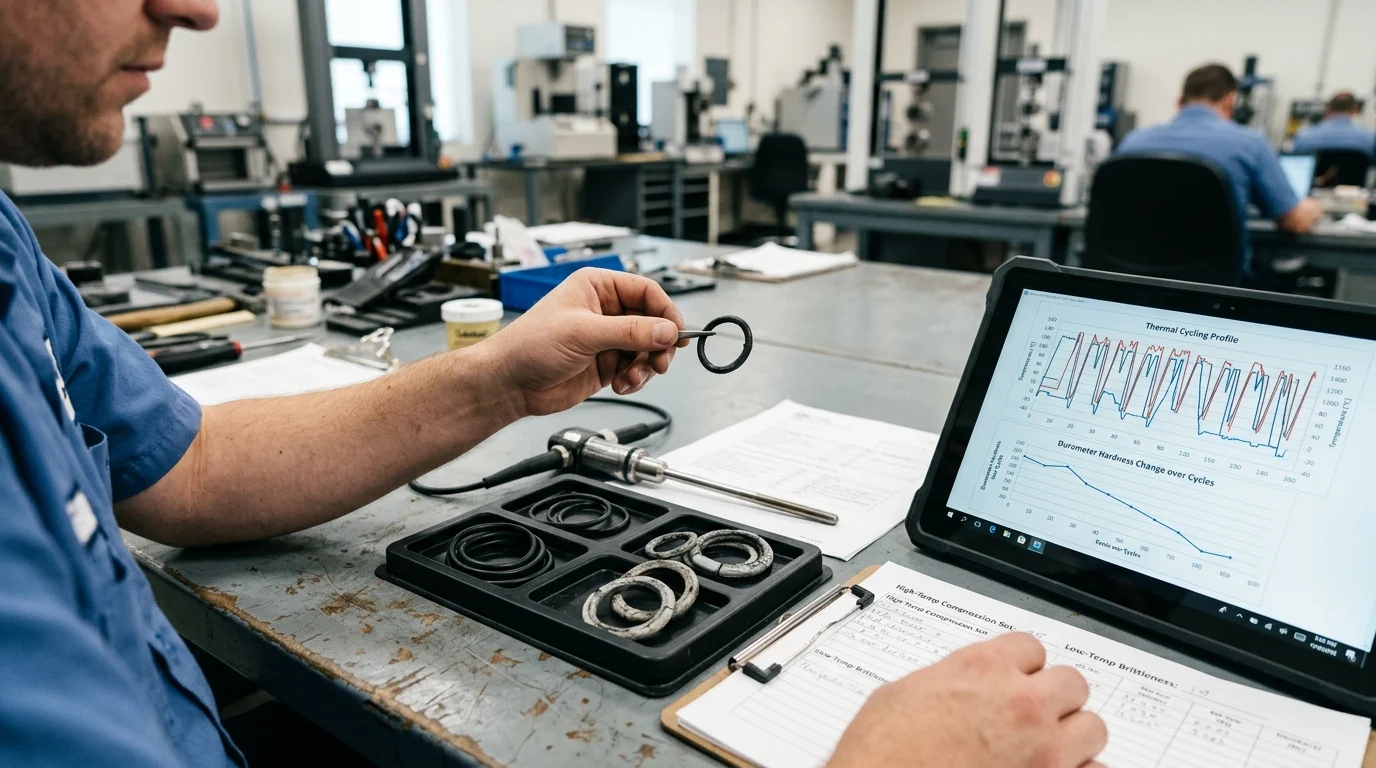
Temperature extremes represent one of the most pervasive threats to elastomeric seal integrity. Thermodynamics directly dictate the behavior of polymer chains; excessive heat accelerates chemical reactions that break down the elastomer backbone, while extreme cold restricts molecular mobility, causing the material to transition from a flexible rubber to a brittle, glass-like state.
When an O-ring operates outside its designated thermal envelope, its physical properties alter rapidly. The coefficient of thermal expansion (CTE) for most elastomers is roughly ten times greater than that of the surrounding metal hardware. Consequently, temperature fluctuations not only degrade the material chemically but also cause dramatic volumetric changes that can overfill a seal gland or induce severe mechanical stress.
Thermal Aging and Compression Set
Thermal aging alters the fundamental molecular structure of elastomers, typically by inducing additional cross-linking or by causing chain scission. Over time, elevated temperatures cause the O-ring to harden, lose tensile strength, and undergo compression set. Compression set is the percentage by which an elastomer fails to return to its original cross-sectional thickness after being compressed at a specific temperature for a specified duration.
A widely accepted heuristic in polymer engineering, derived from the Arrhenius equation, states that the chemical degradation rate of an elastomer roughly doubles for every 10°C increase in operating temperature. Therefore, an O-ring rated for 10,000 hours of continuous service at 100°C may only last 5,000 hours at 110°C, and a mere 1,250 hours at 130°C. Once an O-ring’s compression set approaches 80% to 100%, it effectively becomes a hard plastic ring, entirely dependent on system pressure to maintain a seal, rendering it highly susceptible to leakage during thermal cycling or pressure drops.
Comparing High-Temperature O-Ring Materials
Selecting the correct high-temperature elastomer requires balancing peak thermal exposure against continuous operating limits, while also factoring in low-temperature retraction (TR-10) requirements. Specifying a material with a higher thermal ceiling often demands compromises in mechanical strength, abrasion resistance, or material cost.
The table below outlines the thermal characteristics and primary operational strengths of standard high-temperature O-ring materials used in industrial applications:
| Material Compound | Continuous Temp Limit (°C) | Low Temp Limit (°C) | Primary Operational Strength |
|---|---|---|---|
| Nitrile (NBR) | 100°C to 120°C | -30°C to -40°C | Excellent abrasion and tear resistance. |
| Ethylene Propylene (EPDM) | 150°C | -50°C | Superior resistance to steam and UV degradation. |
| Fluoroelastomer (FKM) | 200°C to 205°C | -20°C to -26°C | Broad chemical resistance at elevated temperatures. |
| Silicone (VMQ) | 230°C | -60°C to -115°C | Exceptional low-temperature flexibility and purity. |
| Perfluoroelastomer (FFKM) | 327°C | -15°C | Near-universal chemical resistance and ultimate heat limit. |
While Perfluoroelastomer (FFKM) offers the highest thermal stability, its exorbitant cost—often 50 to 100 times that of standard FKM—restricts its use to the most severe environments. Conversely, Silicone excels in extreme temperature bandwidths but suffers from poor tensile strength, making it generally unsuitable for dynamic applications involving friction or high pressure.
Pressure, Extrusion, and Motion Factors
Mechanical forces generated by system pressure and kinetic motion introduce physical stress to O-ring seals, often leading to structural failure long before chemical or thermal degradation occurs. An O-ring functions by deforming under pressure to block the leak path; however, this same pressure can force the elastomeric material into the micro-clearances of the mating hardware.
The interaction between fluid pressure, hardware extrusion gaps, and the durometer (hardness) of the O-ring determines the seal’s mechanical survivability. Furthermore, the introduction of motion—whether rotary, reciprocating, or oscillating—adds friction and shear forces that dramatically accelerate physical wear.
Pressure Spikes, Vacuum, and Rapid Gas Decompression
High-pressure environments force the elastomeric material toward the low-pressure side of the gland. If the clearance gap between the hardware components is too large for the system pressure and the O-ring’s hardness, the material will extrude into the gap. Extrusion manifests as a physical nibbling or tearing away of the seal’s outer diameter. For systems operating above 1,500 psi (103 bar), standard 70-durometer O-rings will rapidly extrude unless the clearance gap is virtually zero. Engineers must counter this by specifying higher durometer compounds (e.g., 90 Shore A) or integrating PTFE backup rings to bridge the clearance gap.
Conversely, vacuum applications and sudden pressure drops introduce a different failure mode: Rapid Gas Decompression (RGD), also known as Explosive Decompression (ED). In high-pressure gas systems, gas molecules permeate the elastomer over time. If the system pressure is vented abruptly, the trapped gas expands faster than it can diffuse out of the polymer matrix, causing the O-ring to blister, fissure, and rupture from the inside out. Mitigating RGD requires specifying high-modulus materials that comply with strict industry standards, such as NORSOK M-710 or NACE TM0297, which dictate precise depressurization rates and acceptable damage thresholds.
Static vs. Dynamic O-Ring Applications
The distinction between static and dynamic applications dictates entirely different design parameters, particularly regarding initial seal squeeze and hardware surface finish. In a static application, where the mating surfaces do not move, engineers typically design the gland to apply a 15% to 30% cross-sectional squeeze to the O-ring. This high compression ensures a robust seal even under pressure fluctuations and minor hardware deflection.
Dynamic applications, involving reciprocating pistons or rotating shafts, require a delicate balance. Excessive squeeze generates immense friction, leading to rapid frictional heating, spiral failure (where the O-ring twists within the groove), and accelerated abrasive wear. Therefore, dynamic gland designs limit initial squeeze to 10% to 16%.
Surface finish is equally critical. Static glands can tolerate rougher machining, often up to 63 microinches Ra (Roughness Average). Dynamic surfaces, however, must be polished to a strict 8 to 16 microinches Ra. If the dynamic surface is too rough, it will abrade the O-ring like sandpaper; if it is too smooth (below 4 microinches Ra), the surface will fail to retain a microscopic lubricating fluid film, resulting in dry running, severe friction, and premature seal failure.
Chemical Media and Contamination Risks
Elastomers are fundamentally porous at a molecular level, making them highly susceptible to chemical interaction with the media they are designed to seal. When an O-ring compound is incompatible with the system fluid, the resulting chemical attack can destroy the seal’s structural integrity within hours.
Chemical compatibility is not a binary state; it is heavily influenced by the Hildebrand solubility parameter, system temperature, and the concentration of the media. Even trace contaminants in a fluid stream—such as cleaning solvents, corrosion inhibitors, or specialized fluid additives—can initiate complex chemical reactions that drastically reduce the lifespan of an otherwise correctly specified O-ring.
Swelling, Hardening, and Chemical Degradation
Chemical degradation generally manifests through three primary mechanisms: volume swell, extraction of plasticizers (shrinkage), and polymer chain scission (embrittlement). Volume swell occurs when fluid molecules permeate the elastomer matrix, pushing the polymer chains apart. While a minor swell of 5% to 10% is often acceptable and can even improve sealing force, excessive swell exceeding 15% to 20% causes the O-ring to overfill its gland. This leads to severe extrusion, increased friction in dynamic applications, and a drastic loss of tensile strength.
Conversely, certain aggressive fluids can extract the soluble plasticizers compounded into the rubber formulation. This extraction results in volumetric shrinkage and an increase in hardness. An O-ring that shrinks by more than 3% to 5% will lose its critical squeeze, resulting in an immediate leak path. Furthermore, chemical attack on the polymer backbone itself—often caused by ozone, strong acids, or amines—will break the cross-links, causing the material to undergo significant hardness shifts (e.g., changes greater than +/- 5 Shore A points) and ultimately cracking under stress.
Comparing NBR, HNBR, EPDM, FKM, Silicone, and PTFE
Navigating the complex landscape of polymer compatibility requires rigorous evaluation of the specific media environment. A compound that performs flawlessly in hydraulic oil may disintegrate rapidly when exposed to steam or automotive brake fluid.
The following table compares the chemical resistance profiles and maximum acceptable swell thresholds of common industrial O-ring elastomers:
| Elastomer Type | Excellent Compatibility | Poor Compatibility / Attack Vectors | Typical Max Swell in Compatible Media |
|---|---|---|---|
| Nitrile (NBR) | Aliphatic hydrocarbons, petroleum oils | Ozone, ketones, strong acids | < 10% in standard mineral oils |
| Hydrogenated Nitrile (HNBR) | Sour gas (H2S), hot oils, refrigerants | Chlorinated solvents, strong esters | < 8% in high-temp oils |
| Ethylene Propylene (EPDM) | Steam, hot water, Skydrol (phosphate esters) | Petroleum oils, mineral-based fluids | > 100% in petroleum (Failure) |
| Fluoroelastomer (FKM) | Aromatic hydrocarbons, fuels, acids | Amines, hot steam, low molecular weight esters | < 5% in synthetic fuels |
| Polytetrafluoroethylene (PTFE) | Nearly universal chemical resistance | Molten alkali metals, gaseous fluorine | 0% (Inert thermoplastic) |
Engineers must carefully match these profiles to the application. For example, while EPDM is the industry standard for high-pressure steam and automotive cooling systems, exposing an EPDM O-ring to standard petroleum-based grease during installation will cause catastrophic swelling. Similarly, while PTFE offers unparalleled chemical resistance, it lacks the elastomeric memory of true rubber, requiring spring-energized designs to function effectively in dynamic seals.
How to Extend O-Ring Seal Lifespan
Maximizing the operational lifespan of an O-ring seal is not solely a matter of specifying the correct polymer and designing an optimized gland. The lifecycle of a seal is heavily influenced by external procedural factors, ranging from how the component is stored in a warehouse to how it is physically manipulated during machine assembly.
By standardizing handling procedures and recognizing the operational thresholds that dictate a necessary design upgrade, organizations can significantly reduce infant mortality in their sealing systems. Shifting from rapid-replacement cycles to long-term reliability requires strict adherence to international standards and a willingness to perform root-cause analysis on failed components.
Storage, Handling, and Installation Best Practices
The service life of an O-ring begins long before it is installed. Improper storage conditions can induce premature aging, ozone cracking, and permanent deformation. According to ISO 2230 and SAE ARP5316 guidelines, elastomeric seals must be stored in environments where the ambient temperature remains below 25°C and relative humidity is kept below 75%. Crucially, O-rings must be shielded from direct sunlight, ultraviolet (UV) radiation, and ozone-generating equipment such as high-voltage electrical motors or fluorescent light ballasts, which accelerate polymer chain degradation.
During installation, mechanical damage is a leading cause of early failure. O-rings are frequently rolled over sharp hardware threads, splines, or unchamfered bore edges, causing microscopic cuts that propagate under operational pressure. Installation stretch must also be strictly controlled. As a rule of thumb, an O-ring’s inner diameter should never be stretched by more than 50% during the installation process, and its final installed static stretch must remain below 5%. Stretching an elastomer excessively reduces its cross-sectional diameter (the Gow-Joule effect), resulting in an immediate loss of designed squeeze and pre-tensioning the material to fail under thermal load.
When to Upgrade Materials or Redesign the Seal
Despite rigorous maintenance protocols, certain applications fundamentally outgrow their original sealing solutions. Upgrading materials or redesigning the seal gland becomes mathematically necessary when the cost of MTBF intervals outpaces the capital expenditure of a system overhaul. If a standard NBR seal requires replacement every three months due to thermal hardening, upgrading to an FKM compound—despite being five times the initial component cost—will yield a massive return on investment by extending the maintenance interval to two years.
Redesigning the hardware is required when failure modes indicate systemic geometric flaws. If extrusion occurs consistently despite using 90-durometer O-rings and backup rings, the hardware tolerances must be tightened to reduce the clearance gap. Furthermore, engineers must evaluate gland fill volume. An optimized gland should only be filled to 75% to 85% of its total volumetric capacity by the O-ring. If a post-mortem analysis of a failed seal indicates severe volumetric overfill due to thermal expansion or chemical swell, the gland dimensions must be increased to provide the elastomer with sufficient space for volumetric displacement without blowing out the assembly.
Key Takeaways
- Select O-ring materials according to the real operating temperature range, chemical media, pressure level, and motion profile rather than relying on general-purpose compounds.
- Treat compression set as a critical end-of-life indicator because an O-ring that has permanently lost elastic recovery can no longer maintain sealing force.
- Control pressure spikes and clearance gaps to prevent extrusion, nibbling, and rapid decompression damage in high-pressure hydraulic, gas, and subsea applications.
- Review chemical compatibility before installation because fluid attack can cause swelling, shrinkage, hardening, blistering, or cracking that shortens seal life.
- Use proper gland design, lubrication, and installation practices to reduce friction, twisting, abrasion, and assembly-related cuts.
- Move from reactive replacement to planned inspection intervals in critical systems where a failed low-cost O-ring can trigger expensive downtime or safety risks.
Frequently Asked Questions
What is the most common reason an O-ring seal fails early?
Premature failure is usually caused by a mismatch between the O-ring material and operating conditions, such as temperature, chemical exposure, pressure, or dynamic motion. Poor gland design and installation damage can accelerate the problem.
How does temperature reduce O-ring seal lifespan?
High temperatures harden or crack elastomers, while low temperatures reduce flexibility and sealing force. Repeated thermal cycling can also increase compression set, causing the O-ring to lose its ability to rebound and maintain contact.
What does compression set mean for an O-ring?
Compression set is the permanent deformation of an O-ring after being squeezed in service. When compression set becomes excessive, often around 80%, the seal may no longer generate enough contact pressure to prevent leakage.
Can pressure cause an O-ring to fail?
Yes. High pressure can force the O-ring into clearance gaps, causing extrusion, nibbling, or tearing. In gas service, rapid pressure drops may also cause explosive decompression damage if the compound is not designed for it.
Why is chemical compatibility important for O-ring selection?
Incompatible fluids can make an O-ring swell, shrink, soften, harden, blister, or crack. Selecting the right elastomer, such as NBR, EPDM, FKM, or specialized compounds, is essential for reliable sealing.

Post time: Oct-03-2026