


How O-Ring Selection Causes Chemical Pump Leakage
Chemical processing environments demand precise fluid containment. When a chemical pump leaks, the root cause frequently traces back to the primary sealing element. An improperly specified O-Ring Seal compromises the entire pump housing, leading to hazardous chemical spills, volatile organic compound (VOC) emissions, and unplanned operational downtime.
Why O-Ring selection should be checked first
In chemical pump diagnostics, the elastomer seal is the component most vulnerable to environmental mismatch. According to fluid control experts at John Crane, mechanical seal failure frequently occurs due to incorrect seal selection and unexpected operating conditions. Before investigating complex mechanical misalignments or shaft deflections, engineers must verify that the specified O-Ring Seal aligns perfectly with the application’s chemical, thermal, and pressure parameters.
Material incompatibility is the primary driver of premature seal degradation. For instance, deploying a standard Nitrile (NBR) O-Ring Seal in a pump handling aggressive solvents like methyl ethyl ketone (MEK) or highly concentrated sulfuric acid will cause rapid elastomer breakdown. Expert applications require advanced compounds, such as Perfluoroelastomers (FFKM) or Polytetrafluoroethylene (PTFE) encapsulated seals, to withstand severe chemical attacks.
Furthermore, failing to account for maximum system pressure during the selection phase often results in choosing an elastomer with an inadequate durometer (hardness). Without the correct hardness or the addition of backup rings, high-pressure chemical fluids will force the O-Ring to extrude into hardware clearance gaps, breaking the seal entirely.
Common leakage symptoms linked to seal failure
When an incorrect O-Ring Seal is deployed, the physical degradation of the elastomer presents distinct symptomatic patterns. As highlighted by Vulcan Seals, identifying these failure modes is critical to preventing recurring fluid leaks, severe equipment damage, and costly maintenance downtime. Additionally, Gmors identifies several primary causes of elastomeric failure that directly correlate with improper initial specification.
By examining the failed O-Ring Seal during pump disassembly, maintenance professionals can diagnose the exact specification error. The table below outlines the most frequent leakage symptoms and their corresponding selection failures:
| Failure Symptom | Physical Appearance of the O-Ring Seal | Root Cause in Selection Process |
|---|---|---|
| Chemical Swelling | Dimensions expand beyond groove tolerance, resulting in a spongy texture and loss of tensile strength. | Elastomer material is chemically incompatible with the pumped fluid. |
| Extrusion and Nibbling | Edges are chipped, chewed, or forced into the microscopic clearance gaps of the pump housing. | Selected durometer is too low for the system’s operating pressure, or clearance gaps are too large. |
| Thermal Degradation | Radial cracking, severe hardening, or charring of the elastomer surface. | Operating temperature exceeds the material’s maximum thermal threshold. |
| Compression Set | Cross-section becomes permanently flattened, losing all elastic memory and sealing force. | Material lacks sufficient resilience for the application or was subjected to excessive heat. |
Recognizing these symptoms confirms whether the pump leakage is an installation issue or a fundamental flaw in the O-Ring Seal specification. Addressing these selection errors ensures optimal chemical compatibility, extends the mean time between failures (MTBF), and secures the chemical pump’s overall operational integrity.
Key O-Ring Failure Modes in Chemical Pumps
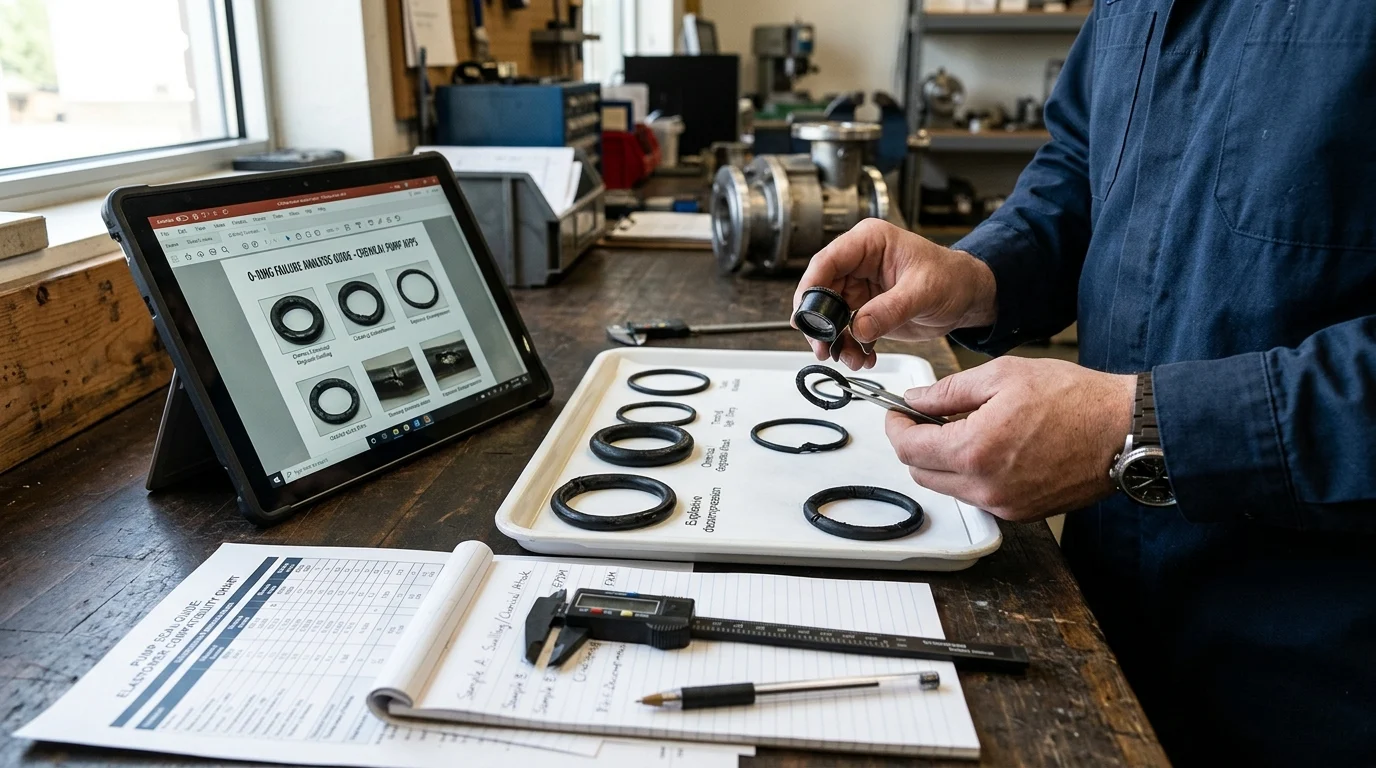
Understanding how and why elastomeric seals fail within chemical pumps requires distinguishing between mechanical damage, thermal degradation, and chemical attack. Failure analysis of an O-ring provides a forensic roadmap to the underlying operational issues. By examining the physical state of the compromised elastomer, engineers can categorize the failure mode and implement precise corrective actions to prevent recurrence.
Chemical pumps utilize O-rings in various capacities, each subjected to distinct stress profiles. The operational environment and the seal’s proximity to the primary fluid dynamics dictate the specific failure mechanisms it will likely encounter. Analyzing these modes involves evaluating dimensional changes, durometer shifts, and surface integrity.
Static vs dynamic seal failures
Static seals, such as those sealing the main pump casing or flange connections, remain stationary and are primarily subjected to constant compression. The dominant failure modes for static O-rings include extrusion, where high internal pressure forces the elastomer into the microscopic clearance gap between mating metal surfaces, and compression set, where the O-ring loses its elastic memory and flattens permanently. Static seals are typically designed with a cross-sectional squeeze of 15% to 30%; if they suffer a compression set exceeding 80% of their original profile, they will inevitably leak when system pressure fluctuates.
Dynamic seals, conversely, are utilized in areas involving relative motion, such as the secondary sealing elements within a mechanical seal assembly sliding along a rotating shaft sleeve. These O-rings are highly susceptible to mechanical wear, abrasion, and spiral failure. Spiral failure occurs when the O-ring rolls and twists within its groove during dynamic cycling, eventually causing deep surface cuts at 45-degree angles. Because dynamic seals require a lighter squeeze (typically 10% to 15%) to minimize friction, they are also more vulnerable to fretting and abrasive wear from suspended solids in the chemical media.
Primary vs secondary leakage paths
In the context of mechanical seals used in chemical pumps, leakage paths are classified as primary or secondary. The primary leakage path is strictly across the highly polished, lapped faces of the mechanical seal itself (e.g., silicon carbide mating with carbon). While some vapor-phase weeping across these faces is necessary for lubrication (typically 1 to 3 grams per hour for a standard ANSI pump), excessive liquid leakage here indicates face distortion, thermal shock, or loss of spring tension, rather than an O-ring failure.
The secondary leakage path involves the elastomeric components—specifically the O-rings that seal the mechanical seal components to the shaft and the pump housing. When secondary leakage occurs, the fluid bypasses the primary faces entirely. This is often an insidious failure because the fluid creeps along the shaft under the sleeve or behind the stationary gland. Secondary leakage is frequently caused by chemical swelling or hardening of the O-ring, which prevents the mechanical seal faces from tracking properly, thereby exacerbating the leak and complicating the diagnostic process.
Visible signs of chemical incompatibility
When an O-ring is exposed to an incompatible chemical medium, the resulting physical transformation is usually visually striking. By examining these forensic clues, operators can confirm whether the secondary leakage paths were triggered by chemical attack and select the appropriate corrective action. The most common manifestation is volumetric swelling. If an elastomer absorbs the process fluid, its volume can increase dramatically; a volume swell exceeding 15% is generally considered unacceptable in dynamic pump applications, as it leads to severe gland overfill, extrusion, and total loss of dynamic mobility. This symptom dictates a switch to a polymer with higher resistance to the specific solvent or hydrocarbon present.
Conversely, chemical incompatibility can result in embrittlement and extraction. In this scenario, the chemical media extracts the plasticizers from the elastomer matrix. The O-ring shrinks, loses its flexibility, and its Shore A durometer hardness may increase by 15 to 20 points, transforming a pliable seal into a brittle ring that fractures under vibration. This requires upgrading to a material with a more stable polymer backbone. Another visible sign is chemical degradation or dissolution, where the O-ring surface becomes tacky, gummy, or visibly pitted, indicating that the polymer is actively being broken down and necessitating a shift to a highly fluorinated elastomer.
Material Compatibility Risks
The fundamental chemistry of an elastomer dictates its resistance to specific fluids. Selecting an O-ring material based solely on initial purchase price rather than chemical compatibility is a primary driver of premature pump failure. Engineers must match the polymer backbone of the seal to the chemical composition of the process fluid, accounting for both the primary chemical and any trace contaminants.
Evaluating elastomeric performance requires referencing detailed compatibility charts and understanding the specific molecular vulnerabilities of each compound. No single elastomer is universally immune to all industrial chemicals, making material selection an exercise in balancing chemical resistance, thermal stability, and mechanical sealing properties.
How to compare elastomers such as FKM, EPDM, NBR, and PTFE
The chemical processing industry relies on a core group of elastomeric materials, each with distinct operational envelopes. FKM (Fluoroelastomer, widely known by the brand name Viton™) is highly valued for its broad resistance to oils, aliphatic hydrocarbons, and strong acids, handling temperatures up to 200°C (392°F). However, FKM is notoriously vulnerable to low-molecular-weight ketones, amines, and hot steam. EPDM (Ethylene Propylene Diene Monomer), by contrast, excels in hot water, steam (up to 150°C / 302°F), and strong caustics, but will swell and fail almost instantly if exposed to petroleum-based oils or hydrocarbon solvents.
NBR (Nitrile) remains the industry standard for general-purpose water and mild oil applications due to its excellent abrasion resistance and low cost, but its maximum temperature limit of 100°C (212°F) and poor resistance to ozone and strong acids restrict its use in aggressive chemical processes. PTFE (Polytetrafluoroethylene) offers nearly universal chemical resistance and can operate across extreme temperature spectrums. However, pure PTFE lacks elastomeric memory (it suffers from cold flow) and requires mechanical energizers or must be used as an encapsulation over an energizing core (like FKM or silicone) to function effectively as an O-ring.
| Elastomer Type | Max Operating Temp | Optimal Media Compatibility | Primary Chemical Vulnerability | Relative Cost Factor |
|---|---|---|---|---|
| NBR (Nitrile) | 100°C (212°F) | Aliphatic oils, water, mild chemicals | Strong acids, ketones, ozone | 1x (Baseline) |
| EPDM | 150°C (302°F) | Caustics, steam, polar solvents | Petroleum oils, hydrocarbons | 1.2x |
| FKM (Viton™) | 200°C (392°F) | Strong acids, aromatic hydrocarbons | Amines, ketones (MEK, acetone) | 4x – 6x |
| PTFE (Encapsulated) | 200°C+ (392°F+) | Universal chemical resistance | Abrasive slurries, high dynamic wear | 10x – 15x |
Effects of acids, caustics, solvents, and oxidizers
Different classes of chemicals attack elastomers through distinct mechanisms. Strong inorganic acids, such as 98% concentrated sulfuric acid or nitric acid, act as severe oxidizing agents. If a standard NBR or EPDM O-ring is exposed to these acids, the polymer chains undergo rapid oxidation, leading to carbonization, surface cracking, and complete structural collapse. In these environments, highly fluorinated polymers like FKM or perfluoroelastomers (FFKM) are mandatory to resist oxidative degradation.
Caustics (alkalies) and solvents present a different challenge. High-concentration sodium hydroxide (e.g., 50% NaOH) can aggressively degrade standard FKM compounds, causing them to embrittle and crack, whereas EPDM provides exceptional resistance to such alkaline attacks. Solvents, particularly aromatic hydrocarbons like toluene or benzene, aggressively permeate standard elastomers. They cause extreme solvation and swelling—often expanding an EPDM O-ring by more than 50% of its original volume—which leads to immediate extrusion and failure of the pump seal.
How mixed chemicals and temperature change seal performance
Chemical compatibility is rarely a static variable; it is profoundly influenced by temperature. As a rough rule of thumb, the Arrhenius equation suggests that the rate of a chemical reaction approximately doubles for every 10°C (18°F) increase in temperature. While actual elastomer degradation kinetics vary significantly depending on the specific polymer and media, elevated temperatures generally act as a catalyst, accelerating permeation, swelling, and polymer chain breakdown. An elastomer that demonstrates acceptable resistance to a specific acid at 25°C (77°F) may suffer catastrophic degradation when the process temperature is elevated to 80°C (176°F).
Furthermore, chemical pumps rarely handle pure, single-component fluids. Mixed chemical streams introduce complex synergistic effects that are difficult to predict. For example, a process fluid primarily composed of water and trace hydrocarbons might seem suitable for NBR. However, if the stream also contains trace amounts of hydrogen sulfide (H2S) and operates at elevated temperatures (sour water applications), the combination will rapidly cross-link and harden the NBR. Because of these unpredictable synergistic effects, standard compatibility charts should be viewed as a starting point rather than definitive guidance; field testing is often necessary to validate seal performance in mixed media.
Design and Operating Factors to Check
Even when the elastomeric material is perfectly matched to the chemical media, premature seal failure will occur if the physical hardware and operating conditions are not optimized. An O-ring is a volumetric sealing device; its success is entirely dependent on the geometry of the gland that houses it and the stability of the pump machinery.
Mechanical design parameters—ranging from the precise machining of the seal groove to the dynamic balance of the pump shaft—dictate how the O-ring will deform, compress, and ultimately perform. Overlooking these design and operational factors frequently leads to misdiagnosing mechanical damage as chemical incompatibility.
Gland dimensions, squeeze, stretch, and fill percentage
The dimensions of the O-ring gland must adhere to strict engineering tolerances to ensure proper seal mechanics. Squeeze is the primary metric: it defines the percentage of compression applied to the O-ring’s cross-section. For static sealing applications in chemical pumps, the target squeeze is typically between 20% and 30%. For dynamic applications, the squeeze must be reduced to 10% to 15% to mitigate friction and heat generation. Insufficient squeeze results in immediate fluid bypass, while excessive squeeze accelerates compression set and stress-induced fracturing.
Stretch is another critical factor, particularly for O-rings installed on a shaft or piston. The internal diameter (ID) stretch should ideally be maintained below 5%. Stretching an elastomer beyond this threshold reduces its cross-sectional diameter (the Gow-Joule effect), compromising the engineered squeeze and leading to premature failure.
Gland fill percentage is equally vital, particularly in high-temperature chemical applications. An O-ring must never occupy 100% of the gland volume. Elastomers possess a coefficient of thermal expansion that is significantly higher—often up to 10 times greater—than that of steel. A correctly designed gland targets a fill volume of 75% to 85%, providing sufficient void space for the O-ring to expand thermally and swell slightly without extruding out of the groove and shearing against mating metal parts.
Pump vibration, shaft runout, and thermal expansion
The mechanical stability of the chemical pump directly impacts the longevity of dynamic O-rings. Excessive pump vibration, often caused by impeller imbalance, cavitation, or pipe strain, transmits high-frequency kinetic energy directly to the mechanical seal components. If vibration levels exceed industrial standards (e.g., API 610 limits of 3.0 mm/s or 0.12 in/s RMS), the secondary O-rings will experience rapid fatigue, fretting, and localized heat buildup, degrading the elastomer long before chemical attack occurs.
Shaft runout and deflection are equally destructive. Radial runout—the deviation of the shaft from its true axis of rotation—must typically be maintained below 0.05 mm (0.002 inches) at the seal chamber. Excessive runout forces the dynamic O-ring to constantly adjust its position to maintain contact, leading to rapid abrasive wear. If the runout exceeds the O-ring’s ability to rebound and track the movement, microscopic gaps will open during each rotation, allowing chemical media to leak and crystallize.
Thermal expansion of the pump components must also be factored into the operational checks. As the pump casing and shaft heat up during operation, differing rates of thermal expansion between dissimilar metals (e.g., a stainless steel shaft and a cast iron housing) can alter the clearance gaps. If these gaps widen beyond the O-ring’s extrusion limits at a given pressure, anti-extrusion backup rings (typically made of PTFE or PEEK) must be incorporated into the gland design to support the elastomer.
Installation and maintenance errors that damage O-Rings
Industry reliability studies suggest that 30% to 40% of premature O-ring failures in chemical pumps originate during the installation and maintenance phases. One of the most common errors is installing the O-ring over sharp threads, splines, or unchamfered edges without the use of an installation cone or protective sleeve. This causes micro-cuts and nicks on the seal surface; under a pressure of 6.9 bar (100 PSI) or more, these microscopic flaws rapidly propagate into catastrophic tears.
The misuse of assembly lubricants is another frequent cause of failure. Maintenance personnel sometimes use hydrocarbon-based greases or petroleum jellies to lubricate O-rings during installation. If the O-ring is made of EPDM—a material strictly incompatible with petroleum—the lubricant will cause localized swelling and degradation before the pump is even commissioned. Only chemically inert lubricants, such as silicone grease or specialized perfluoropolyether (PFPE) oils, should be utilized, and only after verifying compatibility with both the elastomer and the process fluid. Once these mechanical and procedural factors are ruled out or corrected, the focus must shift to procuring the exact polymer formulation required for the process.
How to Specify the Right O-Ring
Specifying the correct O-ring for a chemical pump requires a structured, analytical approach to eliminate guesswork and prevent the costly cycle of replacing failed seals with identical, inadequate components. Engineers must move beyond simply requesting a ‘standard replacement’ and instead evaluate the holistic sealing environment.
By utilizing established specification frameworks and understanding the financial thresholds that justify upgrading to advanced materials, plants can significantly increase the Mean Time Between Failures (MTBF) of their chemical pumps, ensuring reliable, leak-free operation.
Decision framework for chemical, temperature, and pressure conditions
The most reliable methodology for specifying O-ring seals is the STAMPS framework: Size, Temperature, Application, Media, Pressure, and Speed.
For example, applying STAMPS to a toluene transfer pump might yield: Size (2-214 cross-section), Temperature (ambient to 60°C / 140°F), Application (dynamic shaft seal), Media (100% toluene), Pressure (3.4 bar / 50 PSI), and Speed (1750 RPM). This checklist immediately disqualifies EPDM due to the media, and dictates the specification of a PTFE-encapsulated FKM seal, which provides the necessary chemical inertness for toluene while maintaining the dynamic resilience required for a shaft seal.
| STAMPS Parameter | Definition | Typical Chemical Pump Range / Tolerance | Critical Diagnostic Metric |
|---|---|---|---|
| Size | Cross-section and inner diameter (ID) | AS568 standard sizes; ±0.05 mm to ±0.10 mm tolerance | Gland fill (target 75% to 85%) |
| Temperature | Operating and excursion thermal limits | -40°C to 327°C (-40°F to 620°F) depending on polymer | Arrhenius effect (degradation doubles per 10°C rise) |
| Application | Static vs. |
Key Takeaways
- Check O-ring material compatibility first when investigating chemical pump leaks, because elastomers are usually more vulnerable than the pump’s metal casing or shaft components.
- Do not underestimate low-cost seal failures, since an O-ring costing under $10 can trigger 24 to 72 hours of downtime, remediation costs above $50,000, and major regulatory penalties.
- Verify actual operating pressure against the seal specification, because pressure spikes above typical 10 bar pump ratings can cause O-ring extrusion in poorly matched designs.
- Treat slow weeping of 2 to 5 milliliters per hour, crystallized deposits, or corrosive scaling near joints as early indicators of seal degradation.
- Use VOC monitoring for solvent services, because vapor leakage from a compromised O-ring may occur without visible liquid pooling and can exceed alarm thresholds around 500 ppm.
Frequently Asked Questions
Can the wrong O-ring seal cause chemical pump leakage?
Yes. An incompatible O-ring can swell, harden, crack, extrude, or lose compression under chemical, temperature, or pressure stress, allowing liquid or vapor to escape even when pump metal parts remain intact.
Why should O-ring selection be checked early in leak diagnosis?
O-rings are often the weakest sealing interface in a chemical pump. Elastomers have much lower strength and chemical resistance than stainless steel or titanium housings, so they usually fail before major pump components.
What leakage symptoms suggest O-ring seal failure?
Common signs include slow weeping at casing joints, deposits or crystallized residue, corrosion around the gland area, reduced pump performance, solvent odors, or VOC readings above normal baseline levels.
How do temperature and pressure affect O-ring performance?
Excess temperature accelerates elastomer aging, swelling, and hardening. Excess pressure can force the O-ring into clearance gaps, causing extrusion damage, especially if the material or hardness is not matched to the pump duty.
What information is needed to choose the right O-ring material?
Confirm the chemical media, concentration, operating temperature, pressure, pump speed, cleaning fluids, exposure time, groove dimensions, and whether the seal faces liquid, vapor, or intermittent dry-running conditions.

Post time: Oct-08-2026