


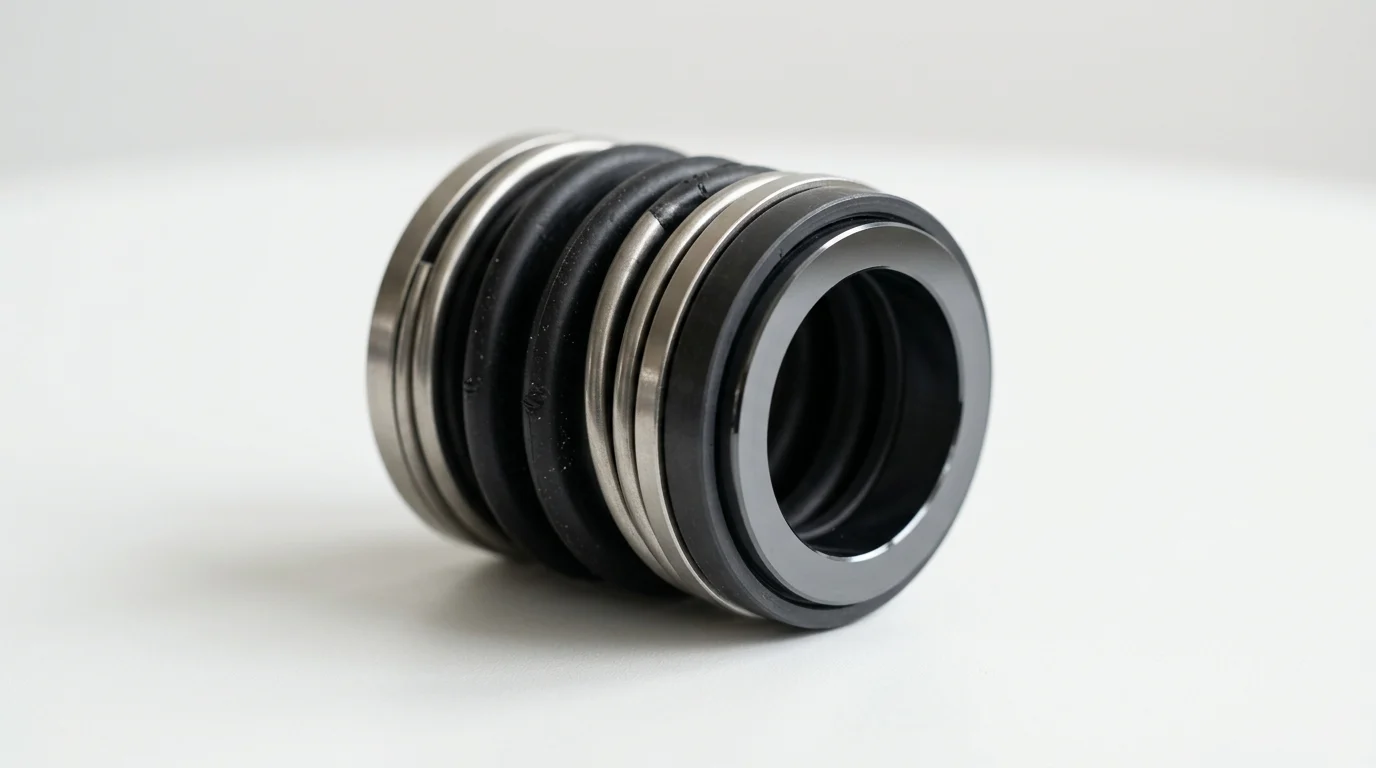
Strategic Value of MG1 Rubber Bellows Seals
The MG1 rubber bellows seal is a practical, widely used component in industrial fluid handling, offering a balance of economical design and operational reliability. Standardized in accordance with EN 12756 (formerly DIN 24960), this non-pusher mechanical seal serves as an industry standard for a vast array of centrifugal pumps, mixers, and rotary equipment. Its fundamental design eliminates the need for a dynamic secondary O-ring, which prevents the common issue of wear and fretting on pump shafts and sleeves.
Industrial facilities with large pump fleets rely on component standardization to minimize downtime. The MG1 profile provides a versatile footprint that fits seamlessly into standard seal chambers without requiring extensive equipment modifications. Understanding the value of this seal involves analyzing its economic impact, its distinct mechanical architecture, and its practical integration into daily maintenance routines.
Commercial Problems They Solve
Equipment operators routinely face escalating operating expenses caused by premature seal failure and frequent replacements. The MG1 seal addresses these challenges by providing a reliable, cost-effective sealing solution that minimizes both direct replacement costs and indirect downtime expenses. Unlike complex cartridge seals that demand high initial capital expenditure, the MG1 offers a low barrier to entry while delivering comparable reliability in compatible applications. Standardizing on this universal profile also simplifies maintenance workflows, laying the groundwork for more efficient inventory management across diverse pump brands.
Definition and Core Design Features
At its core, the MG1 mechanical seal relies on a full-convolution elastomeric bellows that acts as both the secondary sealing element and the rotational drive mechanism. This design features a single, central coil spring that provides the necessary closing force to the primary seal faces. Because the bellows grips the shaft tightly, rotational torque is transmitted directly through the elastomer to the rotary seal face, entirely eliminating the need for drive pins or set screws that can corrode or shear under high-torque starts.
Crucially, the MG1 is classified as a non-pusher seal. By flexing to accommodate wear and thermal expansion rather than sliding a dynamic O-ring axially along the shaft, it prevents the severe shaft fretting and grooving common in traditional pusher designs. Standard MG1 configurations are rated to handle operational pressures up to 1.2 to 1.6 MPa (12 to 16 bar), depending on the specific elastomer and face material combination utilized.
Role in Maintenance Planning
Incorporating MG1 seals into a facility’s maintenance planning enables predictable maintenance intervals. Predictive maintenance programs benefit from the linear wear patterns exhibited by the single coil spring and bellows assembly. Because the bellows inherently accommodates axial shaft movement up to ±2.0 mm, minor misalignments or thermal growth in the pump shaft do not result in immediate catastrophic failure, providing maintenance teams with a wider window to detect minor weeping before a blowout occurs.
Maintenance scheduling is further simplified by the seal’s straightforward installation process. The lack of set screws and complex drive mechanisms reduces the specialized training required for technicians. When standardizing on the MG1, maintenance planners often reference an illustrative Mean Time Between Failures (MTBF) of 8,000 to 12,000 hours in clean water applications. However, actual MTBF varies dramatically based on manufacturer quality, operating conditions, and pump alignment, requiring careful testing for specific applications. This predictability allows for synchronized pump overhauls during planned plant turnarounds rather than reacting to emergency leaks.
Best-Fit Industrial Pump Applications

While the MG1 rubber bellows seal is highly adaptable, its deployment must be strategically aligned with its mechanical limits. The seal excels in environments where fluid dynamics, temperature profiles, and particulate concentrations remain within the moderate spectrum. Matching the MG1 to its best-fit applications ensures maximum reliability, whereas misapplication can lead to rapid elastomer degradation or face blistering.
Common Pump Services for MG1 Seals
The MG1 is the predominant sealing choice for centrifugal pumps operating in municipal water distribution, wastewater treatment, and building services. In circulating pumps for HVAC systems, the seal effectively manages the continuous duty cycles and moderate temperature fluctuations characteristic of chilled or heated water loops. Similarly, submersible pumps heavily utilize the MG1 due to its compact axial length and reliable performance in submerged, inaccessible environments.
Beyond standard water applications, the MG1 is highly effective in mild chemical processing and food and beverage manufacturing. When equipped with appropriate elastomer grades, these seals routinely handle glycol solutions, weak acids, and cleaning-in-place (CIP) fluids. The smooth profile of the outer bellows also prevents the excessive accumulation of fibrous materials, making it a preferred choice for paper mill back-water pumps and light agricultural slurry applications.
Performance in Industrial Pumps
In terms of dynamic performance, the MG1 is engineered to sustain peripheral surface speeds up to 10 meters per second (m/s). This speed threshold covers the vast majority of 1450 RPM and 2900 RPM centrifugal pumps used in industrial settings. The single-spring design is inherently self-cleaning; the centrifugal force generated by the rotating spring helps to fling away suspended solids from the immediate vicinity of the seal faces, maintaining a clean fluid film at the interface.
Thermal performance is dictated by the elastomer, but standard industrial applications typically see the MG1 operating continuously between -20°C and +120°C. In these environments, the elastomeric bellows maintains its critical flexibility. The seal’s ability to maintain face contact during transient cavitation events—where pressure fluctuations cause momentary shaft deflections—is vastly superior to rigid multi-spring designs, ensuring continuous performance even in sub-optimal pumping conditions.
Applications to Avoid
Despite its versatility, specific operational envelopes fall strictly outside the MG1′s capabilities. High-pressure boiler feed pumps exceeding 1.6 MPa (16 bar) will cause the rubber bellows to extrude or rupture under the differential pressure. Additionally, highly abrasive slurries containing solid concentrations greater than 10% by weight will rapidly erode the elastomer convolutions and pack the single spring, leading to a loss of face compression.
Aggressive chemical services involving concentrated sulfuric acid, nitric acid, or strong organic solvents should also be avoided. These media will chemically attack standard NBR or EPDM elastomers, causing them to swell, embrittle, or dissolve. For these extreme applications, engineers must pivot away from rubber bellows entirely, typically opting for PTFE wedge seals or metal bellows seals constructed from Hastelloy or Alloy 20.
The following table outlines the suitability of MG1 seals across various common industrial applications, highlighting primary limitations:
| Application Parameter | MG1 Suitability | Primary Rationale / Limitation |
|---|---|---|
| Clean Water / HVAC | Optimal | Predictable wear, low cost, excellent MTBF. |
| Light Wastewater (<5% solids) | High | Self-cleaning single spring resists clogging. |
| High Pressure (>16 bar) | Avoid | Risk of elastomeric bellows extrusion/rupture. |
| Abrasive Slurries (>10% solids) | Avoid | Particulates erode rubber and pack the spring. |
| Strong Acids / Solvents | Avoid | Chemical attack causes elastomer swelling/failure. |
Comparison and Specification Criteria
Specifying the correct MG1 configuration requires a rigorous evaluation of both metallurgical and elastomeric bounds. A mechanical seal is only as resilient as its weakest material component. Consequently, engineers must cross-reference the fluid’s chemical properties, operating temperatures, and shaft dimensions against the available MG1 material matrices to ensure operational integrity.
Comparison Against Alternative Seal Types
When compared against alternative seal types, such as multi-spring pusher seals or PTFE wedge seals, the MG1 offers distinct trade-offs. Multi-spring seals provide highly uniform face loading and are excellent for high-speed, high-pressure applications, but their dynamic O-rings are notorious for causing shaft fretting. The MG1 eliminates shaft fretting entirely via its static shaft grip. However, the multi-spring design can typically handle pressures up to 2.5 MPa, significantly outperforming the MG1′s 1.6 MPa ceiling.
Compared to PTFE wedge seals, which are prized for near-universal chemical resistance, the MG1 is far more forgiving of mechanical misalignment. PTFE is rigid and lacks elastic memory; if the shaft deflects, a PTFE wedge may permanently deform and leak. The elastomeric bellows of the MG1 accommodates axial movement and minor misalignment, maintaining a reliable seal even on aging pumps with worn bearings.
Material and Elastomer Selection
The selection of the elastomer dictates the thermal and chemical boundaries of the MG1. Nitrile (NBR) is the standard baseline, offering excellent resistance to water and oils at temperatures up to 90°C. For elevated temperatures or hot water applications, Ethylene Propylene Diene Monomer (EPDM) is specified, extending the thermal limit to 120°C (and up to 140°C in specific hot water variants), though EPDM is strictly incompatible with petroleum-based oils. Fluorocarbon (FKM/Viton) provides the broadest chemical resistance for mild acids and oils up to 200°C, though its cold-temperature flexibility is limited and it is incompatible with steam or hot water.
Primary seal face materials must be paired based on fluid lubricity and particulate presence. Carbon Graphite against Silicon Carbide (SiC) is the industry standard for clean fluids, offering excellent self-lubricating properties and low friction. If the fluid contains abrasive particles, a hard-on-hard combination such as SiC against SiC, or Tungsten Carbide (TC) against TC, is mandatory to prevent rapid face scoring.
The table below details the thermal ranges and chemical compatibility strengths of the standard elastomers used in MG1 seals:
| Elastomer Material | Temp Range | Chemical Compatibility Strengths | Notable Incompatibilities |
|---|---|---|---|
| NBR (Nitrile) | -20°C to +90°C | Oils, water, mild hydrocarbons. | Ozone, ketones, strong acids. |
| EPDM | -30°C to +120°C | Hot water, steam, weak alkalis. | Petroleum oils, mineral oils. |
| FKM (Viton) | -15°C to +200°C | Solvents, acids, petroleum oils. | Steam, hot water, polar solvents. |
Key Operating and Shaft Size Limits
The MG1 is manufactured to accommodate a wide spectrum of metric shaft sizes, typically ranging from 10 mm up to 100 mm in diameter. For sizes above 100 mm, the centrifugal forces on the large elastomeric mass and the sheer size of the required coil spring usually necessitate a transition to a different seal architecture. The dimensional standards ensure that an MG1 specified for a 38 mm shaft will drop seamlessly into any EN 12756 compliant seal chamber.
Operating limits are strictly governed by the combination of shaft size, speed, and pressure—often referred to as the PV (Pressure-Velocity) limit. For a standard 50 mm MG1 seal operating at 2900 RPM, the maximum allowable pressure is generally capped at 1.2 MPa to prevent vaporizing the fluid film between the seal faces. Exceeding the established PV limits will generate excessive frictional heat, leading to premature elastomer degradation and thermal cracking of the seal faces.
Installation, Commissioning, and Failure Analysis
The lifespan of a mechanical seal is heavily determined during the installation and commissioning phases. Even a precisely engineered MG1 seal will fail prematurely if installed on a compromised shaft or if the pump is improperly vented prior to startup. Following a step-by-step procedure and conducting rigorous failure analysis is critical for achieving maximum reliability.
Pre-Installation Checks
Prior to unpacking the MG1 seal, technicians must verify the dimensional and surface integrity of the pump shaft to ensure the elastomer can seat correctly. The following steps are essential:
- Verify shaft surface finish: The seal area must not exceed a roughness of Ra 0.8 µm. A rougher surface prevents the elastomeric bellows from gripping properly, leading to rotational slippage and leakage.
- Check shaft diameter tolerance: The diameter must be within a tolerance of h6 or h8 to ensure the requisite interference fit.
- Measure radial shaft runout: Using a dial indicator, ensure runout remains strictly below 0.05 mm Total Indicator Reading (TIR).
- Confirm axial end-play: Shaft end-play must not exceed 0.1 mm.
If the bearings are worn and these tolerances are exceeded, the MG1 bellows will be subjected to high-frequency fatigue, leading to premature tearing of the rubber convolutions.
Leakage Reduction During Commissioning
Once the shaft is prepared, achieving the correct working length (often designated as L1K) during installation is paramount. The MG1 relies on precise spring compression to establish the correct face load.
- Verify L1K dimensions: Note that the exact L1K working length can vary by manufacturer. Always verify the required compression against the specific supplier’s datasheet.
- Set the installed length: Maintain the length within a strict tolerance of ±0.5 mm. Over-compression forces out the lubricating fluid film, causing dry running and heat checking, while under-compression allows system pressure to blow the faces apart.
- Vent the system: Commissioning requires thorough venting of the pump casing and seal chamber. The MG1 must never run dry.
- Monitor the break-in period: Prior to motor rotation, wet the seal faces with the process fluid. During the first 15 to 30 minutes of operation, minor weeping (a few drops per minute) is acceptable and often resolves as the Carbon and SiC faces lap together. Persistent leakage indicates an installation geometry error or an improperly seated stationary ring.
Normal Wear vs Misalignment Failures
Analyzing a failed MG1 seal provides critical feedback for system correction. Normal wear is characterized by a smooth, uniform wear track on the primary seal faces and an intact bellows. Over an illustrative 8,000-hour lifecycle, a Carbon face might predictably wear down by 1 to 2 mm (depending heavily on the manufacturer and fluid lubricity), eventually requiring replacement when the spring travel is exhausted. This expected degradation leaves no deep grooves or thermal cracks.
Conversely, failure due to misalignment or dry running presents distinct physical evidence. Dry running causes rapid thermal expansion, often resulting in localized heat checking (fine radial cracks) on Silicon Carbide faces and a heavily blistered Carbon face. If the bellows is torn at the convolution roots, the primary cause is excessive axial vibration or chemical embrittlement of the elastomer. Identifying these failure modes allows engineers to correct the root cause—be it bearing replacement, alignment correction, or upgrading the elastomer material—rather than simply replacing the seal and repeating the failure cycle.
Procurement and Standardization Decisions
Transitioning from technical specification to commercial procurement requires a strategic approach to sourcing and inventory management. Because the MG1 is a high-volume, standardized component, purchasing decisions must balance unit cost against batch consistency and supply chain reliability. Establishing a robust procurement framework ensures that maintenance teams have immediate access to high-quality seals.
Key Sourcing Criteria
When sourcing MG1 seals, supply chain managers must prioritize manufacturers that demonstrate rigorous quality control and material traceability. ISO 9001 certification is a baseline requirement, but buyers should also demand batch testing reports for the elastomers to verify shore hardness and tensile strength. Inconsistent elastomer curing during manufacturing can lead to bellows that either lack the elasticity to grip the shaft or are too soft to withstand system pressure.
Buyers must also account for manufacturer-to-manufacturer dimensional tolerances and quality variance. An “EN 12756 compliant” designation guarantees dimensional fit, but it does not guarantee identical performance or longevity between budget and premium suppliers. Minimum Order Quantities (MOQs) also play a significant role. While standard NBR/Carbon/Ceramic seals can often be purchased in single units, specialized configurations may trigger factory MOQs ranging from 50 to 100 units. Procurement teams must forecast annual consumption accurately to negotiate favorable volume pricing.
Price, Inventory, and Lifecycle Cost Trade-Offs
The unit price of an MG1 seal typically ranges from $15 to $45 for standard metric sizes in basic material configurations. These illustrative estimates highlight the MG1 as an attractive alternative to cartridge seals that frequently exceed $200 per unit. However, purchasing strictly on the lowest unit price introduces lifecycle cost penalties. A substandard seal that fails after 2,000 hours incurs significant maintenance labor and lost production downtime.
Optimizing lifecycle costs requires calculating the Total Cost of Ownership (TCO). Investing in a premium MG1 variant featuring Silicon Carbide faces and high-grade EPDM increases the unit cost but extends the MTBF, lowering overall maintenance expenditures. Furthermore, because the MG1 conforms to universal dimensional standards, plant managers can consolidate their spare parts inventory. Transitioning to a standardized MG1 procurement strategy can reduce mechanical seal inventory holding costs by an estimated 25% to 40% and significantly lower the SKU count in the storeroom, as a single seal size and material configuration can service multiple pump models.
Final Decision Framework
A final decision framework for standardizing on MG1 seals involves a comprehensive, step-by-step audit of the facility’s pump fleet. First, engineering must identify all pumps operating within the 1.6 MPa and 120°C envelope that currently utilize disparate seal designs. Second, the procurement team should consolidate the required shaft sizes to identify overlap across different equipment brands. Third, rather than stocking multiple elastomer and face combinations, plants should establish a streamlined decision matrix that satisfies the majority of the plant’s applications with the fewest possible configurations.
By strictly defining approved material matrices and dimensional standards based on this audit, facilities eliminate the confusion that leads to misapplication. This structured approach streamlines the procurement process, reduces inventory bloat, and ensures that the inherent reliability of the MG1 rubber bellows seal is fully realized across the operation.
Key Takeaways
- Use MG1 rubber bellows seals in compatible centrifugal pumps and rotary equipment when a cost-effective, standardized sealing solution is required.
- Select MG1 configurations according to pressure, elastomer, and face material requirements, since typical operating limits are about 12 to 16 bar.
- Standardize MG1 seals across suitable pump fleets to reduce spare inventory, simplify procurement, and shorten maintenance response time.
- Choose the non-pusher MG1 design when shaft fretting and sleeve wear from dynamic O-ring movement are recurring maintenance problems.
- Account for the bellows’ ability to accommodate axial shaft movement up to ±2.0 mm when planning seal maintenance and monitoring early leakage signs.
Frequently Asked Questions
What is an MG1 rubber bellows seal used for?
An MG1 rubber bellows seal is used in centrifugal pumps, mixers, and rotary equipment to prevent leakage while handling common industrial fluids. Its standardized profile makes it suitable for many pump fleets and replacement programs.
Why is the MG1 considered a non-pusher mechanical seal?
The MG1 uses an elastomer bellows that flexes to compensate for wear and axial movement instead of sliding an O-ring along the shaft. This helps reduce shaft fretting, grooving, and sleeve damage.
What pressure range can MG1 rubber bellows seals typically handle?
Standard MG1 configurations commonly handle about 1.2 to 1.6 MPa, or 12 to 16 bar, depending on the selected elastomer and seal face materials.
How does an MG1 seal simplify pump maintenance?
Its single-spring, bellows-driven design avoids set screws and complex drive mechanisms, making installation faster and reducing the need for highly specialized maintenance procedures.
Can MG1 seals help reduce inventory complexity?
Yes. Because the MG1 follows standardized dimensions such as EN 12756, plants can use one common seal style across compatible pump models, reducing spare parts variety and simplifying purchasing.

Post time: Aug-17-2026