


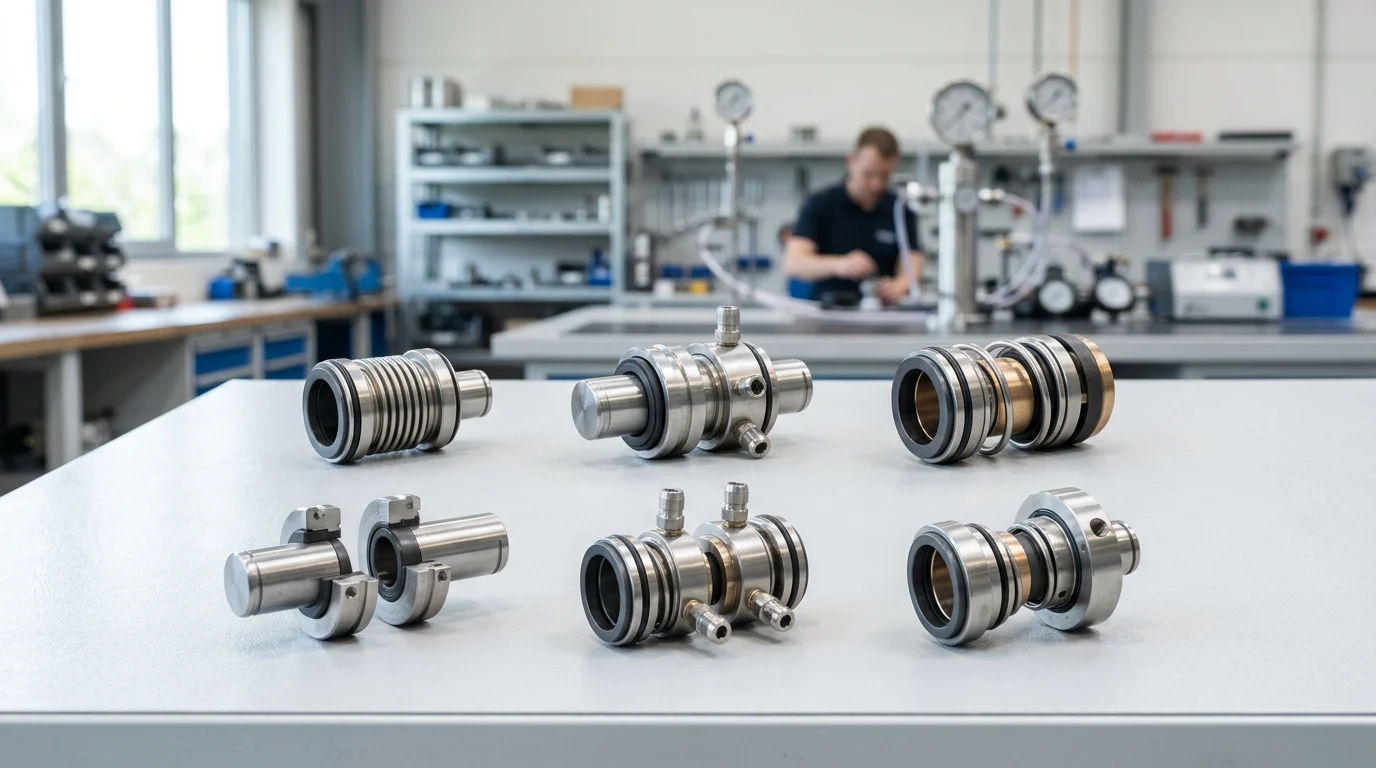
Frame the Corrosive Fluid Challenge
Specifying mechanical seals for corrosive fluid applications represents one of the most demanding engineering challenges in fluid handling. Unlike benign services where standard austenitic stainless steels and general-purpose elastomers suffice, aggressive chemicals—such as strong acids, caustics, and volatile organic solvents—exploit microscopic vulnerabilities in seal metallurgy and face materials. A mechanical seal relies on maintaining a stable fluid film across lapped faces, typically operating with a gap of just 0.5 to 2.0 microns. When corrosive media attack the seal components, they destroy this delicate fluid dynamics balance, leading to rapid, catastrophic failure.
The financial and operational stakes in these environments are exceptionally high. Unplanned pump failures due to compromised seals can halt production lines, with downtime costs in petrochemical and specialty chemical facilities frequently ranging from $10,000 to $50,000 per hour. Furthermore, environmental regulatory bodies strictly govern the containment of hazardous fluids, often mandating volatile organic compound (VOC) leakage rates below 500 parts per million (ppm). Consequently, seal selection in corrosive environments must transition from a basic mechanical procurement task to a rigorous metallurgical and chemical engineering exercise.
Why corrosive fluids complicate seal selection
Corrosive fluids fundamentally alter the operational environment of a mechanical seal by attacking the very materials designed to contain them. Traditional seal selection focuses primarily on pressure, velocity, and lubrication. However, aggressive chemicals introduce variables such as oxidation, localized pitting, and elastomer swelling. For instance, a fluid that is relatively inert at ambient temperatures may become highly reactive when subjected to the localized frictional heat generated at the seal faces, where temperatures can easily exceed the bulk fluid temperature by 10°C to 30°C.
Furthermore, the presence of dissolved solids or the tendency of a chemical to crystallize upon atmospheric exposure complicates the sealing interface. When corrosive fluids vaporize across the seal faces, they can leave behind abrasive crystalline structures. These deposits not only cause severe mechanical wear on the faces but also accelerate localized crevice corrosion in the surrounding metallurgical components. A corrosion rate exceeding 5 mils (0.127 mm) per year is generally considered unacceptable for critical seal components, necessitating highly specialized alloys or non-metallic alternatives.
Key failure modes and business risks
Failure modes in corrosive services rarely manifest as simple mechanical wear. Chemical attack typically presents as elastomer extrusion, chemical embrittlement, or blistering of carbon-graphite seal faces. One of the most prevalent risks in chloride-rich environments is chloride stress corrosion cracking (CSCC), which can rapidly compromise 316 and 316L stainless steel components at temperatures exceeding 60°C. Similarly, strong oxidizers like nitric or sulfuric acid can leach the binder materials out of certain grades of tungsten carbide or carbon faces, leading to sudden, catastrophic face disintegration.
The business risks associated with these failure modes extend far beyond the replacement cost of the seal itself. Sudden seal failure in a hazardous chemical pump poses severe safety risks to plant personnel, including chemical burns or exposure to toxic vapors. Secondary containment failures can lead to environmental contamination, triggering mandatory reporting, severe regulatory fines, and costly remediation efforts. In applications handling highly toxic or flammable media, the failure of a primary seal without an adequate backup system can precipitate plant-wide emergency shutdowns.
Gather Operating Data and Compatibility Limits

A rigorous mechanical seal selection process begins with the comprehensive collection and analysis of operating data. Relying on generalized fluid names or nominal operating conditions is a primary cause of premature seal failure in aggressive applications. Engineers must construct a precise operational profile that accounts for both steady-state conditions and transient operational extremes, such as system flushes, steam-outs, and startup anomalies.
Fluid chemistry, concentration, and temperature
The exact chemical composition of the pumped fluid is the foundational data point for material selection. It is critical to identify not only the primary chemical but also any trace elements, catalysts, or impurities, as contaminants acting as catalysts can radically alter the corrosion profile. For example, pure acetic acid may be handled by standard 316 stainless steel, but the introduction of trace chlorides or bromides necessitates an upgrade to high-nickel alloys like Hastelloy C-276 or titanium.
Concentration and temperature must be evaluated in tandem, as their relationship dictates the aggressiveness of the fluid. The Arrhenius equation provides a useful rule of thumb: the rate of a chemical reaction generally doubles for every 10°C increase in temperature. A 70% concentration of sulfuric acid at 20°C behaves entirely differently than a 98% concentration at 90°C. Engineers must document the minimum, normal, and maximum operating temperatures, ensuring that the seal materials are rated for the absolute maximum temperature, including the localized heat generation at the seal faces.
Equipment, pressure, speed, and duty cycle
Beyond fluid chemistry, the mechanical realities of the rotating equipment dictate the seal’s structural requirements. Stuffing box pressure determines whether an unbalanced or balanced seal design is required. Generally, stuffing box pressures exceeding 400 psig (27.5 bar) mandate a balanced seal design to reduce the closing forces on the seal faces, thereby mitigating excessive heat generation and premature wear. Shaft speed is equally critical; surface speeds exceeding 23 meters per second typically push the limits of standard API 682 Category 1 or 2 seals, requiring stationary spring designs to prevent spring distortion from centrifugal forces.
Duty cycle analysis is heavily scrutinized in corrosive applications. Frequent pump starts and stops can disrupt the protective fluid film, leading to boundary lubrication conditions and dry running. In applications where the pump may briefly run dry or operate dead-headed against a closed discharge valve, the localized temperature in the seal chamber can spike rapidly, accelerating chemical attack and potentially causing thermal shock to brittle face materials like silicon carbide.
Limits for elastomers, faces, springs, and metals
Material compatibility limits establish the absolute boundaries for seal design. Elastomers (O-rings and secondary sealing elements) are often the weakest link in corrosive services. Standard fluoroelastomers (FKM) may swell or degrade rapidly in the presence of strong caustics or amines. Seal faces, while harder, are not immune to chemical limits; standard carbon-graphite can be attacked by strong oxidizing agents, while specific grades of tungsten carbide utilize cobalt binders that are highly susceptible to leaching in mildly acidic water.
| Material Component | Common Industrial Designation | Maximum Temp Limit (°C) | Corrosive Fluid Limitations |
|---|---|---|---|
| Elastomer | FKM (Viton™) | 204°C | Poor resistance to amines, ketones, and steam. |
| Elastomer | FFKM (Kalrez®) | 327°C | Highly universal; vulnerable to certain fluorinated solvents. |
| Elastomer | EPDM | 150°C | Degrades rapidly in petroleum-based oils and non-polar solvents. |
| Seal Face | Silicon Carbide (Reaction Bonded) | 1400°C | Free silicon attacked by strong caustics (pH > 11). |
| Seal Face | Tungsten Carbide (Cobalt Binder) | 400°C | Binder leaches in acids (pH < 6) and pure water. |
| Metallurgy | Alloy C-276 (Hastelloy®) | >1000°C | Excellent broad resistance; susceptible to wet chlorine gas. |
Understanding these hard limits prevents the catastrophic misapplication of materials. When dealing with mixed chemical streams where no single elastomer offers perfect resistance, engineers often must resort to PTFE-encapsulated O-rings or engineered wedge designs, though these sacrifice some elastic memory and require specialized gland designs to maintain optimal sealing pressure.
Compare Seal Designs and Materials
With precise operational data established, the focus shifts to selecting the optimal mechanical seal design and specifying the exact material pairings. The intersection of mechanical configuration and material science determines the seal’s ability to survive the corrosive environment while maintaining strict emission controls.
Single, double, tandem, and cartridge seals
The most fundamental architectural decision is choosing between a single and a dual (double or tandem) seal arrangement. Single seals are cost-effective but rely entirely on the pumped fluid for lubrication. If the fluid is highly corrosive, abrasive, or prone to crystallization, a single seal is highly vulnerable. In contrast, dual seals utilize a secondary barrier or buffer fluid to isolate the critical seal faces from the aggressive process media. Tandem seals (unpressurized buffer) manage leakage and provide backup, while double seals (pressurized barrier) ensure that any leakage across the inner faces consists of the clean barrier fluid entering the process, completely shielding the seal components from the corrosive chemical.
Whether choosing a single or dual configuration, engineers increasingly rely on cartridge seals as the industry standard for aggressive applications. Unlike component seals, which require precise manual setting of spring compression and axial positioning on the shaft, cartridge seals are pre-assembled and preset at the factory. This design eliminates handling of delicate, chemically resistant components on the shop floor and has been empirically shown to reduce installation-related premature failures by up to 70%.
Seal face and elastomer material options
Selecting the optimal face material pairing requires balancing chemical inertness with tribological performance. Silicon Carbide (SiC) is universally favored in corrosive applications due to its extreme hardness and broad chemical resistance. However, engineers must distinguish between Reaction Bonded SiC (which contains free silicon vulnerable to high-pH caustics) and Direct Sintered SiC (which is chemically inert across nearly the entire pH scale 0-14). When handling strong oxidizers, carbon-graphite faces must be avoided or upgraded to specialized antimony-impregnated grades, though dual hard faces (SiC vs. SiC) are often the safest default.
Elastomer selection frequently drives the highest recurring costs in corrosive seal maintenance. Perfluoroelastomers (FFKM), such as Kalrez or Chemraz, provide near-universal chemical resistance comparable to PTFE but maintain the necessary elastomeric properties for dynamic sealing. While a standard FKM O-ring may cost a few dollars, an FFKM equivalent can range from $200 to $500 per O-ring. Despite this capital premium, FFKM is routinely specified in aggressive services because the cost of a chemical breach far outweighs the initial component expense.
Trade-offs between chemical resistance, heat, and wear
Optimizing a mechanical seal for a corrosive environment inherently involves navigating competing engineering trade-offs. Maximizing chemical resistance often requires selecting materials that possess inferior thermal conductivity or poor dry-running capabilities. For example, utilizing PTFE wedges instead of elastomers provides unparalleled chemical tolerance, but PTFE lacks elastic memory, making the seal highly susceptible to failure if shaft runout or vibration exceeds tight tolerances.
| Seal Face Pairing | Friction Coefficient (Typical) | Wear Resistance | Chemical Tolerance Profile |
|---|---|---|---|
| Carbon vs. Ceramic | 0.04 – 0.07 | Low to Moderate | Good for weak acids; poor for thermal shock. |
| Carbon vs. SiC | 0.02 – 0.05 | High | Excellent general use; fails in strong oxidizers. |
| SiC vs. SiC | 0.08 – 0.12 | Very High | Ultimate chemical resistance; vulnerable to dry-running. |
| SiC vs. Tungsten Carbide | 0.05 – 0.09 | Extremely High | Excellent for abrasive/corrosive slurries; pH sensitive. |
As demonstrated in the matrix, deploying dual hard faces (SiC vs. SiC) guarantees maximum chemical resistance but results in a higher friction coefficient. This increased friction generates more localized heat, which must be aggressively removed via seal flush plans to prevent the fluid from vaporizing at the interface. Engineers must weigh whether the process infrastructure can support the necessary cooling or if a softer, more forgiving face material is required at the expense of absolute chemical immunity.
Apply a Practical Selection Process
Theoretical material selection must be translated into a practical, executable specification. This requires a systematic elimination of unsuitable options, the design of appropriate environmental controls (seal support systems), and strict adherence to mechanical tolerances during installation. A methodical process ensures that the selected seal survives both the chemical environment and the physical realities of the plant floor.
Screen compatibility and eliminate weak options
The screening process begins with a strict elimination protocol using established chemical compatibility charts (such as those published by NACE or API). Any material showing a vulnerability to the process fluid at the maximum operating temperature is immediately discarded. For instance, in environments containing aqueous chlorides exceeding 200 ppm, 300-series stainless steels must be eliminated from all wetted components, forcing an upgrade to duplex stainless steels, Alloy 20, or titanium.
Once the metallurgy and elastomers are locked in, engineers evaluate the physical constraints of the pump housing. The seal chamber must offer adequate radial clearance to accommodate the specified seal, particularly if a dual cartridge seal is required. If the existing stuffing box is too restrictive, the pump may require machining to an enlarged bore standard, or the seal selection must be downgraded to a more compact design, which may compromise spring protection or barrier fluid flow.
Select flush plans, barrier fluids, and quench systems
In highly corrosive applications, the mechanical seal is only as reliable as its supporting flush plan. API 682 Piping Plans dictate how the seal environment is controlled. For mild corrosives with suspended solids, a Plan 32 might be utilized to inject a clean, compatible external fluid into the seal chamber, effectively flushing the corrosive media away from the faces. However, this introduces process dilution, which is unacceptable in many chemical manufacturing processes.
For severe corrosives, a dual seal with a Plan 53A or Plan 54 is standard practice. A Plan 53A utilizes a pressurized reservoir to supply a clean barrier fluid between the inner and outer seal faces. Crucially, the barrier fluid must be maintained at a minimum of 1.5 bar (approx. 22 psi) above the maximum stuffing box pressure. This ensures that any pressure differential forces the benign barrier fluid into the process, rather than allowing the corrosive chemical to penetrate the seal cavity. Selecting the correct barrier fluid—often a synthetic oil or water/glycol mixture—is critical; it must be chemically compatible with the process media to prevent violent exothermic reactions in the event of an inner seal failure.
Plan installation, commissioning, and monitoring
Even the most robustly engineered seal will fail prematurely if mechanical tolerances are ignored during installation. Corrosive applications demand strict adherence to alignment specifications. Laser alignment must be utilized to ensure shaft runout and deflection remain below 0.05 mm (0.002 inches) Total Indicator Reading (TIR). Excessive vibration accelerates the wear of the secondary sealing elements, creating dynamic pathways for corrosive fluids to bypass the faces.
Post-installation commissioning requires rigorous monitoring. Operators must verify that barrier fluid pressures in Plan 53 systems are stable and that cooling lines are functioning before introducing the corrosive process fluid. Continuous vibration monitoring is highly recommended, with alarm thresholds typically set for velocities exceeding 3.0 mm/s RMS. Baseline temperature profiles of the seal gland should be recorded; unexplained temperature spikes are often the earliest indicator that the fluid film is failing and a chemical breach is imminent.
Make the Final Seal Decision
The final selection of a mechanical seal for corrosive fluid applications represents a synthesis of technical viability, regulatory compliance, and economic reality. Engineers must transition from evaluating isolated components to assessing the seal as an integrated system that protects plant personnel, satisfies environmental law, and delivers a defensible return on investment.
Safety, emissions, and compliance requirements
Regulatory compliance frequently overrides basic economic considerations in corrosive and toxic services. Agencies such as the EPA enforce strict mandates, such as Method 21, which monitors fugitive emissions from rotating equipment. For certain Hazardous Air Pollutants (HAPs), VOC emission limits are capped strictly below 100 ppmv. A standard single seal, even when perfectly maintained, may struggle to consistently meet these aggressive targets over its lifecycle.
In these heavily regulated scenarios, API 682 Category 2 or 3 dual containment seals become mandatory. These systems not only prevent primary leakage but also incorporate secondary containment mechanisms equipped with pressure or level transmitters. If the primary inner seal fails, the system safely contains the hazardous chemical, triggers a control room alarm, and allows operators to execute a controlled shutdown before any environmental release occurs.
Total cost of ownership and service life
Evaluating the Total Cost of Ownership (TCO) is essential to justify the high initial capital expenditure of specialized corrosive-duty seals. A standard single seal constructed of 316SS and FKM might cost $1,000, while a dual cartridge seal utilizing Alloy C-276, FFKM elastomers, and an accompanying Plan 53A reservoir can easily exceed $5,000 to $8,000. However, the true cost metric is the Mean Time Between Failures (MTBF).
In aggressive acid applications, a basic single seal might fail every 6 months, incurring repeated replacement costs, labor expenses, and devastating production downtime. Conversely, a properly specified dual seal system typically targets an MTBF of 36 to 60 months. When factoring in the avoidance of $20,000-per-hour downtime events and potential environmental fines, the more expensive dual seal consistently delivers a drastically lower TCO over a five-year lifecycle.
Final decision matrix for corrosive services
The final decision culminates in a comprehensive specification matrix that aligns technical requirements with capital budgets. This matrix should explicitly list the fluid chemistry, maximum temperature, required metallurgy (e.g., Hastelloy C-276), elastomer grade (e.g., FFKM), face pairings (e.g., Direct Sintered SiC), and the mandated API flush plan. By quantifying these parameters, engineers can objectively evaluate competing vendor proposals.
Ultimately, the goal is to remove ambiguity from the procurement process. When dealing with corrosive fluids, there is no margin for “equivalent” substitutions without rigorous engineering review. By adhering to a strict, data-driven selection matrix, plant engineers ensure the deployed mechanical seal will provide resilient, leak-free operation, safeguarding both plant profitability and operational safety in the most demanding chemical environments.
Key Takeaways
- Evaluate chemical compatibility before pressure and speed because corrosive media can destroy seal faces, elastomers, and metals even when the mechanical design appears adequate.
- Treat chloride-rich services above 60°C as high risk for 316 and 316L stainless steel due to chloride stress corrosion cracking.
- Account for localized seal-face heat, which can exceed bulk fluid temperature by 10°C to 30°C and change the fluid’s corrosiveness.
- Use double or cartridge seal arrangements for hazardous, volatile, or toxic chemicals when leakage control and operator safety are critical.
- Consider corrosion rates above 5 mils per year unacceptable for critical seal parts and upgrade to more resistant alloys or non-metallic materials.
- Select face and elastomer materials based on the exact chemical, concentration, temperature, crystallization tendency, and solids content.
Frequently Asked Questions
What makes corrosive fluid service different from standard pump sealing?
Corrosive fluids can attack seal faces, metals, springs, and elastomers while also causing swelling, pitting, crystallization, or stress cracking. Selection must consider chemical compatibility, temperature, pressure, leakage limits, and corrosion mechanisms—not just pump size and operating speed.
Which seal materials are commonly used for aggressive chemicals?
Common choices include silicon carbide, carbon graphite, tungsten carbide, PTFE, FKM, FFKM, Hastelloy, Alloy 20, and other corrosion-resistant alloys. The best combination depends on the fluid, concentration, temperature, solids content, and whether the chemical is oxidizing or reducing.
When should a double mechanical seal be used?
A double mechanical seal is often preferred for hazardous, toxic, volatile, or highly corrosive fluids where leakage must be tightly controlled. It provides an added containment barrier and can use a compatible barrier or buffer fluid to protect seal faces from aggressive media.
Why is 316 stainless steel not always suitable for corrosive applications?
316 and 316L stainless steel can perform well in many services, but they are vulnerable to chloride stress corrosion cracking, especially above about 60°C. Chloride-rich, acidic, or high-temperature applications may require duplex stainless steel, Hastelloy, titanium, or non-metallic components.
How do temperature and concentration affect seal selection?
Chemical compatibility can change significantly as temperature or concentration increases. A fluid that is manageable at ambient conditions may become highly reactive at seal faces, where localized temperatures can exceed bulk fluid temperature by 10°C to 30°C.

Post time: Aug-10-2026