


Introduction
Choosing a seal for high-temperature chemical pumps requires more than matching size and pressure ratings. Heat, fluid chemistry, vapor pressure, shaft movement, and emissions limits all influence whether a seal will run reliably or fail early under severe service. This article explains the key operating conditions that drive seal selection and shows how materials, seal arrangement, and support systems should be matched to the process. By the end, readers will be better equipped to evaluate tradeoffs between safety, uptime, maintenance demands, and regulatory compliance before specifying a mechanical seal for demanding chemical applications.
Why Mechanical Seal Selection Matters
Specifying the right mechanical seal for high-temperature chemical pumps is a foundational engineering requirement that directly dictates plant reliability and operational safety. In extreme processing environments where aggressive fluids meet severe thermal gradients, the mechanical seal acts as the primary barrier between volatile process media and the external atmosphere.
How seal failures affect uptime, safety, and emissions
When a mechanical seal fails, the consequences cascade rapidly through a facility. Unplanned pump outages can easily incur downtime costs ranging from $10,000 to $50,000 per day in continuous chemical processing plants. Beyond lost production, catastrophic seal failures present severe safety hazards, exposing personnel to toxic, corrosive, or flammable fluids.
Environmentally, fugitive emissions are strictly regulated by regional and federal authorities. Under EPA Method 21 in the United States, volatile organic compound (VOC) leaks must often be kept below 500 ppm, with some severe service regulations mandating limits as stringent as 50 ppm. Selecting the right mechanical seal ensures these threshold requirements are consistently met without requiring continuous maintenance interventions.
Which operating conditions make seal selection critical
Certain operating parameters elevate seal selection from a routine maintenance task to a critical engineering challenge. High-temperature applications, generally defined in the sealing industry as exceeding 400°F (204°C), induce significant thermal expansion, altering the critical micro-gap between seal faces.
Furthermore, high temperatures accelerate the degradation of secondary elastomers and increase the likelihood of fluid flashing or coking at the atmospheric side of the seal. When combining thermal extremes with high suction pressures or chemically aggressive media, the margin for error in seal selection essentially disappears, demanding highly engineered barrier solutions to prevent premature failure.
What Service Data Is Needed for Seal Specification

Accurate seal specification is impossible without a comprehensive understanding of the process environment. Engineers must capture precise service data to prevent premature face wear, elastomer degradation, or catastrophic barrier failure.
Which fluid, temperature, pressure, vapor pressure, and solids data to collect
The foundation of mechanical seal selection relies on granular fluid data. Essential parameters include the specific gravity, viscosity at operating temperature, and the vapor pressure margin. Maintaining a sufficient margin between the net positive suction head available (NPSHa) and required (NPSHr) prevents cavitation, which can shatter brittle seal faces.
Operating and design temperature ranges, alongside maximum dynamic and static pressures, dictate the mechanical strength required of the seal assembly. Additionally, the concentration of suspended solids is critical; fluids containing greater than 2% solids by weight typically necessitate specialized seal designs or hard-face material combinations to resist abrasion.
| Parameter | Critical Threshold / Metric | Impact on Seal Selection |
|---|---|---|
| Temperature | > 400°F (204°C) | Dictates metal bellows over pusher designs; requires FFKM elastomers. |
| Vapor Pressure | < 5 psi margin to operating | High risk of flashing; necessitates API Plan 11, 13, or 53A. |
| Solids Content | > 2% by weight | Requires silicon/tungsten carbide faces; may need external flush (Plan 32). |
How shaft movement, pump type, and seal chamber conditions affect selection
Mechanical dynamics and pump geometry are equally vital to the specification process. Shaft deflection at the seal faces must be maintained strictly below 0.002 inches (0.05 mm) to prevent face separation and subsequent leakage. The pump’s L3/D4 ratio (shaft length to diameter) provides a reliable indicator of its susceptibility to radial deflection under load.
Furthermore, the standard to which the pump is built—such as API 610 for heavy-duty refinery applications versus ANSI B73.1 for general chemical service—dictates the dimensional envelope of the seal chamber. Standard bore, enlarged bore, and taper bore designs each alter the fluid flow and heat dissipation characteristics around the seal faces, directly influencing the required flush plan and seal profile.
How to Compare Mechanical Seal Designs and Materials
With service data established, the focus shifts to evaluating the myriad of mechanical seal configurations. Matching the design architecture and metallurgy to the process ensures optimal mean time between failures (MTBF).
When to use single, dual, cartridge, metal bellows, and pusher seals
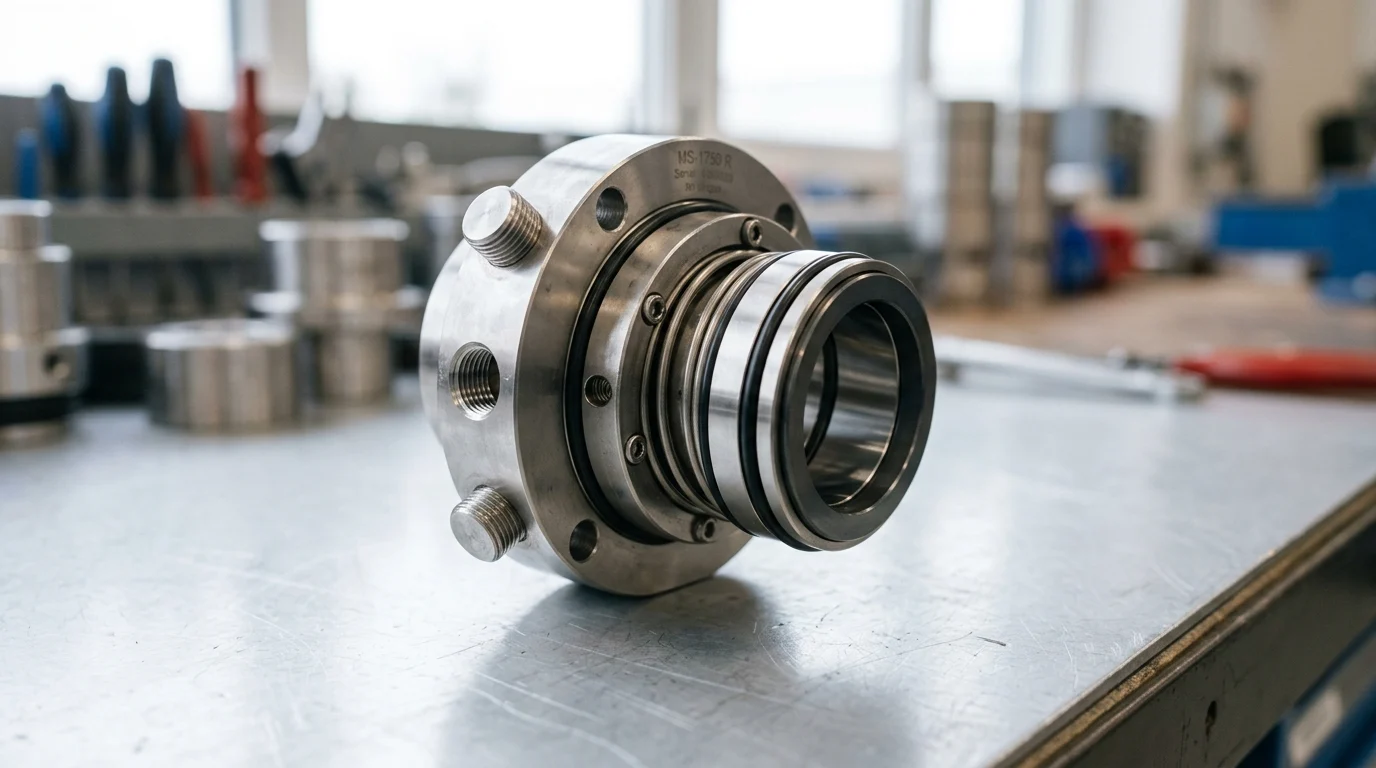
The choice between single and dual seals hinges on fluid toxicity and vapor pressure. Dual pressurized (double) or unpressurized (tandem) seals are mandatory for lethal or highly volatile fluids. Cartridge seals, which pre-assemble the faces, springs, and gland into a single unit, have largely replaced component seals due to the elimination of installation measurement errors.
For high-temperature chemical pumps, metal bellows seals are strongly preferred over pusher seals. Pusher seals rely on a dynamic O-ring that must slide along the shaft; at temperatures above 400°F (204°C), elastomers can degrade or process fluids can coke, causing the O-ring to hang up. Metal bellows eliminate this dynamic elastomer, relying instead on welded metallic convolutions to provide uniform face loading.
Which face materials, secondary seals, metallurgy, and flush plans fit the application
Material selection dictates the chemical and thermal resilience of the seal. Primary face materials typically utilize Silicon Carbide (SiC) against Carbon for general service, or SiC against Tungsten Carbide for abrasive applications. Secondary sealing elements (O-rings) often represent the weakest thermal link.
While standard Fluoroelastomers (FKM/Viton) are limited to approximately 400°F (204°C), Perfluoroelastomers (FFKM/Kalrez) can withstand thermal excursions up to 620°F (327°C). The metallurgy of the seal gland and bellows must match or exceed the pump casing’s corrosion resistance, frequently requiring Alloy 20, Hastelloy C-276, or Titanium in aggressive chemical services. Complementing these materials are API 682 flush plans, such as Plan 53A (pressurized barrier fluid) or Plan 54 (external circulating system), which manage the thermal and tribological environment of the seal chamber.
How to compare options by performance, reliability, and cost
Comparing options requires balancing initial capital expenditure against long-term reliability. A fully engineered API 682 dual cartridge seal in Hastelloy may cost 300% to 500% more than a standard ANSI single seal, but it can extend MTBF from an unacceptable 6 months to a target of 36 to 60 months in severe service.
| Component Type | Material / Design | Max Temp Limit | Relative Cost Multiplier |
|---|---|---|---|
| Secondary Seal | FKM (Viton) | 400°F (204°C) | 1.0x (Baseline) |
| Secondary Seal | FFKM (Kalrez) | 620°F (327°C) | 5.0x – 8.0x |
| Seal Design | Pusher (Standard) | Application Dependent | 1.0x |
| Seal Design | Edge-Welded Metal Bellows | 800°F (426°C) | 2.5x – 4.0x |
| Metallurgy | 316 Stainless Steel | N/A | 1.0x |
| Metallurgy | Hastelloy C-276 | N/A | 3.5x – 5.0x |
Which Compliance and Supply Factors Affect Seal Choice
Regulatory compliance and supply chain logistics introduce external parameters that strictly govern the procurement and implementation of mechanical seals for the chemical processing industry.
How API, ISO, safety, emissions, and hazardous service requirements apply
In the petrochemical and high-temperature chemical sectors, adherence to API 682 (4th Edition) and ISO 21049 standards is frequently non-negotiable. These standards dictate rigorous qualification testing, default material selections, and specific clearance dimensions to ensure maximum safety.
For hazardous services, environmental regulations require strict monitoring of fugitive emissions, forcing operators to utilize dual-seal configurations with sophisticated barrier fluid monitoring. Facilities operating in explosive atmospheres must also ensure their seals and auxiliary flush systems carry the appropriate ATEX certifications. Fulfilling these compliance frameworks legally permits operation while mitigating the risk of catastrophic regulatory fines.
Which supplier qualification, interchangeability, and lead time issues to review
Supply chain factors heavily influence seal selection, particularly when balancing standard versus highly engineered designs. Supplier qualification should assess global support capabilities, localized repair facility access, and inventory management programs. Interchangeability is a major operational advantage; standardizing on a specific cartridge seal platform across multiple ANSI or API pumps reduces spare parts inventory costs.
However, lead times require careful project management. While standard stainless-steel cartridge seals might boast a 1 to 2-week lead time, custom-engineered API seals utilizing exotic metallurgies like Inconel 718 or specialized face treatments can extend lead times to 12 to 16 weeks. Furthermore, minimum order quantities (MOQs) may apply to proprietary elastomer compounds, necessitating strategic stocking programs to prevent extended outages.
How to Finalize the Mechanical Seal Decision
Finalizing the mechanical seal specification requires an objective synthesis of process data, regulatory requirements, and economic constraints to arrive at the optimal sealing arrangement.
What step-by-step process helps match seal arrangement to service conditions
A systematic approach ensures no critical variable is overlooked. First, engineers must define the fluid state, mapping the maximum operating temperature against the vapor pressure curve to determine the risk of flashing. Second, the arrangement is selected: single seals for benign fluids, dual unpressurized for moderate risks, and dual pressurized for hazardous or toxic media.
Third, materials are chosen by matching metallurgy to the corrosion allowance and elastomers to the peak thermal excursions. Finally, the environmental control system (flush plan) is designated to guarantee the seal faces receive adequate lubrication and cooling. Following this sequential matrix standardizes the decision-making process and guarantees alignment with broader plant reliability goals.
Which signs point to under-specification or over-specification
Recognizing the symptoms of improper specification is vital for continuous improvement. Under-specification typically manifests as chronic reliability issues, such as an MTBF falling below 12 months, frequent elastomer extrusion, or thermal distortion of the seal faces (heat checking).
Conversely, over-specification strains project budgets without delivering proportional operational benefits. Installing an API 682 dual pressurized metal bellows seal with a complex Plan 53B accumulator system on a non-hazardous, moderate-temperature water loop can inflate capital expenditures by over 300% and unnecessarily complicate operator maintenance routines. The right mechanical seal operates invisibly, achieving its 36 to 60-month lifecycle target while optimizing both plant safety and total cost of ownership.
Key Takeaways
- The most important conclusions and rationale for Right Mechanical Seal
- Specs, compliance, and risk checks worth validating before you commit
- Practical next steps and caveats readers can apply immediately
Frequently Asked Questions
What seal type is usually best for high-temperature chemical pumps?
Metal bellows seals are often preferred above 204°C because they handle thermal expansion and avoid elastomer hang-up. For toxic or high-vapor-pressure chemicals, consider a dual cartridge seal.
Which process data should I collect before selecting a mechanical seal?
Provide fluid name, operating and max temperature, pressure, vapor pressure, viscosity, solids content, shaft size, speed, and pump model. This lets suppliers like Victor Seals match seal design, faces, and elastomers accurately.
How do I choose seal face materials for hot, aggressive chemicals?
Use hard face combinations such as silicon carbide or tungsten carbide when chemicals are corrosive or solids exceed 2%. They resist wear better than softer faces and improve service life in severe pump duty.
When should I use a dual seal instead of a single seal?
Use a dual seal when the fluid is hazardous, flammable, prone to flashing, or emission control is critical. A dual arrangement with the right support plan gives better leakage control and reliability.
Can Victor Seals supply OEM-compatible replacements for chemical pumps?
Yes. Victor Seals offers OEM-compatible and replacement mechanical seals for brands like Grundfos, Alfa Laval, IMO, Flygt, Lowara, and Allweiler, helping maintenance teams shorten repair time.
Post time: May-29-2026