



Introduction
Wave spring mechanical seals are designed for applications where axial space is limited but reliable face loading still matters. Their compact spring geometry can simplify seal layouts, reduce hardware bulk, and support consistent contact between sealing faces in many pumps, mixers, and rotating machines. But that same design also brings limits: pressure range, contamination tolerance, shaft movement, and operating conditions all affect whether a wave spring seal is a smart choice or a weak point. This article explains how these seals work, where they perform well, and the conditions that make other seal designs a better fit.
What Are Wave Spring Mechanical Seals
Wave spring mechanical seals serve a specialized role in fluid containment, engineered to provide robust face loading within highly constrained spatial envelopes. Unlike traditional sealing mechanisms that rely on bulky coil structures, these seals utilize an undulating, flat-wire profile to generate axial force. Understanding the exact mechanical principles behind this design is critical for specifying the correct seal architecture for industrial rotary equipment.
Definition and core design features
At its core, a wave spring mechanical seal utilizes a continuous, coiled flat wire with multiple waves per turn to exert mechanical pressure against the primary seal faces. This configuration ensures that the mating faces—typically carbon, silicon carbide, or tungsten carbide—remain in constant contact, preventing fluid bypass during dynamic operation.
The defining characteristic of this architecture is its ability to deliver precise, uniform loading across a 360-degree circumference. Standard single-turn wave spring seals are typically rated for operating pressures up to 150 psi (10 bar), though multi-turn nested variants can accommodate higher pressure differentials. The flat wire construction minimizes the radial cross-section, allowing integration into standard stuffing boxes without extensive machining.
How they differ from conventional spring seals
The primary distinction between wave springs and conventional helical coil springs lies in spatial efficiency and load distribution. Standard single-coil springs require significant axial length to compress and generate the necessary sealing force. In contrast, wave springs can achieve equivalent load specifications while reducing the required axial operating space by up to 50%.
Furthermore, multiple-spring designs (which use a series of small coil springs arranged circumferentially) offer uniform loading but are prone to localized stress concentrations if individual springs degrade. Wave springs provide a continuous load path, mitigating the risk of uneven face wear, while presenting a singular, consolidated component that simplifies installation and maintenance.
Key selection factors for industrial buyers
Industrial buyers must evaluate several interdependent variables when specifying wave spring seals. Shaft diameter, rotational speed, and the physical dimensions of the seal chamber dictate the maximum allowable outer diameter and working length of the spring.
Fluid characteristics directly influence metallurgy; standard 316 stainless steel suffices for benign environments, whereas aggressive media may necessitate Hastelloy C-276 or Inconel alloys. Engineers must also calculate the precise spring rate (measured in lb/in or N/mm) required to overcome hydraulic pressure and secondary elastomer friction without inducing excessive face heat.
| Feature | Wave Spring Seal | Single Coil Spring Seal | Multi-Spring Seal |
|---|---|---|---|
| Axial Space Requirement | Very Low (Up to 50% savings) | High | Moderate |
| Load Distribution | Highly Uniform | Asymmetrical | Highly Uniform |
| Component Count | Single Spring | Single Spring | Multiple Springs |
| Clogging Risk | High | Low | Moderate |
Where Wave Spring Mechanical Seals Work Best
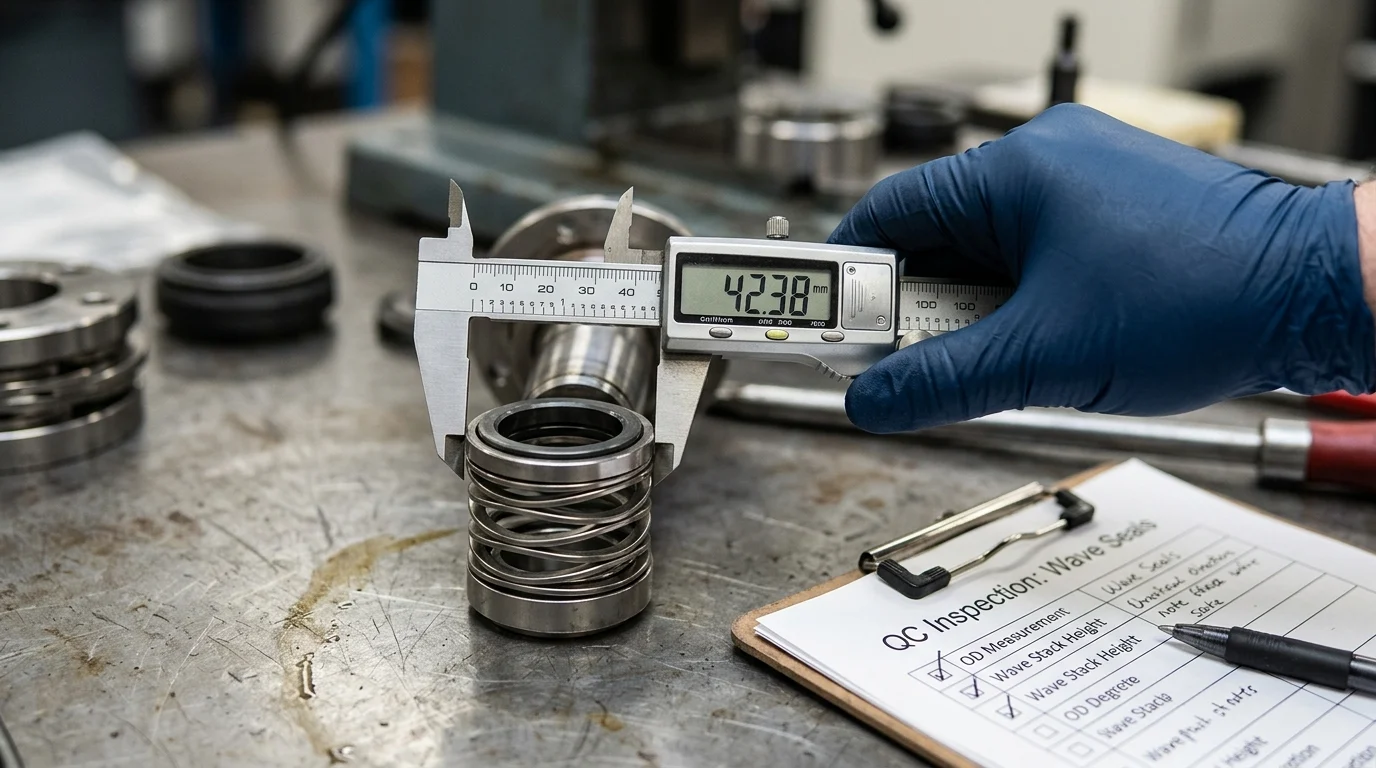
The architectural advantages of wave spring mechanical seals are most pronounced in applications where operational parameters align with their structural strengths. When deployed in the correct fluid environment and equipment envelope, these seals deliver exceptional reliability and extended mean time between failures (MTBF).
Ideal operating conditions and applications
Wave spring seals excel in clean, non-abrasive fluid applications. They are highly effective in water treatment facilities, pharmaceutical processing, and food-grade beverage production where the pumped media lacks heavy particulate matter. Ideal operating conditions involve fluids with low to medium dynamic viscosity, strictly remaining below the 500 cP threshold.
In light hydrocarbon applications and chemical transfer pumps handling solvents, the uniform face pressure prevents the microscopic face separation that leads to fugitive emissions. The absence of heavy solids ensures the wave spring retains its compressive flexibility, allowing the seal faces to track minor shaft runout effectively.
Benefits in compact equipment and limited axial space
The most significant operational advantage of wave spring seals is their utility in compact equipment. Modern pump designs, particularly rotary lobe pumps, gear pumps, and short ANSI centrifugal pumps, often feature severely constrained stuffing boxes to minimize shaft overhang and reduce deflection.
By requiring up to 50% less axial space than traditional single-coil mechanical seals, wave springs allow equipment manufacturers to design shorter, more rigid pump shafts. A shorter shaft reduces the L3/D4 ratio (shaft length cubed over diameter to the fourth power), directly correlating to lower vibration levels and extended bearing life. This compactness also facilitates easier retrofitting of dual-seal arrangements into standard single-seal chambers.
Performance compared with conventional seal designs
Compared to conventional seal designs, wave spring variants demonstrate superior face tracking in tight envelopes. The continuous wave profile ensures that deflection variance remains tightly controlled, typically within ±5% across the entire circumference of the seal face. This precise load distribution prevents the formation of localized hot spots, which frequently cause thermal cracking in brittle face materials like silicon carbide.
Additionally, the reduced mass of the wave spring lowers centrifugal forces at high rotational speeds (often exceeding 3,600 RPM). This stability minimizes dynamic distortion, ensuring that the primary sealing faces remain parallel and fluid film thickness is maintained at optimal microscopic levels.
Where Wave Spring Mechanical Seals Perform Poorly
Despite their spatial and load distribution advantages, wave spring mechanical seals possess structural vulnerabilities that render them unsuitable for specific industrial environments. Deploying these seals outside their optimal operating window inevitably leads to premature component failure and costly unplanned downtime.
Limits for solids, viscosity, pressure, and temperature
The physical geometry of wave springs limits their tolerance for extreme operational parameters. They are highly susceptible to failure in fluids with high total suspended solids (TSS) or abrasive slurries. Furthermore, pumping highly viscous media exceeding 1,000 cP can impede the spring’s ability to compress and recover, leading to face separation.
Pressure and temperature extremes also pose significant threats. Standard wave springs are generally limited to pressures below 300 psi (20 bar). High-pressure environments can cause the flat wire to buckle or permanently deform. Temperature limits are typically dictated by the secondary elastomers, but extreme heat (exceeding 200°C) requires specialized spring metallurgy, such as Inconel 718, to prevent loss of temper and spring relaxation.
Common failure risks such as fouling and spring clogging
The most prevalent failure mechanism for wave spring seals is particulate fouling and spring clogging. The narrow, crest-to-crest gaps inherent in the wave design act as traps for debris, crystallizing fluids, and sticky byproducts. When suspended solids larger than 50 microns infiltrate the spring cavity, they can pack tightly into these gaps.
Once clogged, the spring loses its dynamic flexibility. This condition, known as ‘hang-up,’ prevents the spring from pushing the seal face forward to compensate for normal wear or shaft thermal expansion. Consequently, the seal faces separate, resulting in catastrophic fluid leakage and potential environmental hazards.
When to choose alternative seal types
Plant engineers must specify alternative sealing technologies when encountering heavy slurries, crystallizing chemicals, or highly viscous polymers. Edge-welded metal bellows seals are the preferred alternative for high-temperature or crystallizing applications, as their open-convolution design eliminates the narrow gaps where solids accumulate.
For heavy abrasive slurries found in mining or pulp and paper industries, robust single-coil spring seals with large wire diameters provide the necessary durability. The open structure of a heavy-duty coil spring allows particulates to wash away in the flush fluid, maintaining spring flexibility and ensuring continuous face tracking where a wave spring would immediately bind.
How to Evaluate Specifications and Suppliers
Procuring reliable wave spring mechanical seals requires rigorous evaluation of both the component specifications and the manufacturing capabilities of the supplier. Industrial buyers must implement strict qualification protocols to ensure the seals meet the demanding reliability metrics of modern process plants.
Critical material and design review points
Specification reviews must prioritize metallurgy and face material pairings. The wave spring itself must resist stress corrosion cracking and fatigue; standard applications utilize 316 stainless steel, but aggressive chemical environments require Hastelloy C-276 or AM350. The primary seal faces must be specified for optimal tribological performance, frequently pairing a stationary silicon carbide face against a rotating carbon or tungsten carbide face.
Surface flatness is a critical design metric. Buyers should mandate that seal faces are lapped to a flatness of 2 to 3 helium light bands (approximately 0.58 to 0.87 microns). Additionally, the spring rate tolerance must be specified within ±10% of the nominal design value to ensure the face pressure remains within the safe operating envelope, avoiding excessive heat generation or leakage.
| Component | Standard Material | High-Performance Upgrade | Cost Multiplier (Approx.) |
|---|---|---|---|
| Wave Spring | 316 Stainless Steel | Hastelloy C-276 / Inconel 718 | 2.5x – 4.0x |
| Seal Faces | Carbon vs. Ceramic | Silicon Carbide vs. Tungsten Carbide | 1.5x – 3.0x |
| Elastomers | NBR / EPDM | FKM / FFKM (Perfluoroelastomer) | 3.0x – 10.0x |
Compliance, testing, and documentation requirements
Depending on the industry, wave spring seals may need to comply with specific regulatory and engineering standards. While less common in heavy API 682 Category 3 applications due to their clogging risks, they are frequently utilized in API Category 1 or ANSI/DIN standard pumps. Suppliers must provide material test reports (MTRs) for critical alloys to verify chemical composition and traceability.
Rigorous quality assurance testing is non-negotiable. Qualified suppliers should perform hydrostatic pressure testing of the seal cartridge assemblies at 1.5 times the maximum rated design pressure. Furthermore, static air testing should be documented to confirm zero leakage prior to shipment.
Supplier qualification for OEMs and plant buyers
Auditing a supplier requires evaluating their manufacturing consistency, supply chain resilience, and commercial flexibility. Original Equipment Manufacturers (OEMs) and plant buyers should assess the supplier’s ISO 9001 certification status and their internal scrap rates.
Commercial terms are equally critical. A highly qualified supplier should be capable of offering lead times of under 4 weeks for standard dimensional seals, while accommodating minimum order quantities (MOQs) as low as 10 to 50 units for custom alloy configurations. Evaluating the supplier’s localized inventory and application engineering support ensures rapid response during emergency plant outages.
How to Make the Final Selection Decision
Selecting the optimal wave spring mechanical seal demands a systematic approach, balancing the spatial constraints of the equipment against the physical properties of the process fluid. When specified correctly, these seals offer an elegant solution to complex dimensional challenges.
A practical step-by-step evaluation framework
Engineers should employ a structured, step-by-step framework during the selection process. Step one involves a rigorous dimensional analysis of the stuffing box to confirm that the axial space requires a wave spring configuration rather than a standard coil. Step two requires an analysis of the fluid composition; the process media must be verified as clean, with total suspended solids (TSS) remaining strictly below 1% by volume.
Step three dictates the selection of metallurgy and elastomers based on the maximum anticipated operational temperature and chemical aggressiveness. Finally, step four involves calculating the required spring rate to ensure adequate face closure force without exceeding the PV (Pressure-Velocity) limits of the selected face materials. Following this framework mitigates the risk of misapplication.
Summary of when wave spring seals are the right choice
Wave spring mechanical seals represent the premier sealing choice when engineers are confronted with severe axial space limitations in clean fluid applications. Their ability to deliver uniform 360-degree face loading from a highly compressed profile makes them indispensable for compact rotary equipment, short ANSI pumps, and specialized aerospace fluid transfer systems.
When deployed in optimal environments—specifically those with low viscosity, minimal particulates, and moderate pressures—these seals routinely achieve a Mean Time Between Failures (MTBF) exceeding 24,000 hours. By thoroughly understanding both their spatial advantages and their vulnerability to particulate fouling, industrial buyers can leverage wave spring seals to maximize equipment reliability and streamline maintenance protocols.
Key Takeaways
- The most important conclusions and rationale for Wave Spring Mechanical Seals: Where They Work—and Where They Don’t
- Specs, compliance, and risk checks worth validating before you commit
- Practical next steps and caveats readers can apply immediately
Frequently Asked Questions
What is a wave spring mechanical seal best used for?
It works best in clean, non-abrasive fluids and compact pumps where axial space is limited, such as water treatment, chemical transfer, and food-grade equipment.
When should you avoid a wave spring mechanical seal?
Avoid it in dirty, abrasive, or sludge-like services. Solids can clog the wave spring and reduce face movement, causing heat, wear, and early seal failure.
How much space can a wave spring seal save?
A wave spring design can reduce axial space needs by up to 50% versus conventional coil spring seals, making it useful for short seal chambers and compact pump layouts.
What fluid viscosity suits wave spring mechanical seals?
They are typically better for low- to medium-viscosity fluids, generally below about 500 cP. Higher viscosity or solids-heavy media usually need another seal design.
Can Victor Seals supply wave spring seals for OEM pump replacement?
Yes. Victor Seals supplies wave spring mechanical seals and OEM-compatible replacements for many industrial pump maintenance applications, including selected brand-compatible seal solutions.

Post time: Jun-25-2026