


Introduction
In high-temperature service, a mechanical seal’s lifespan depends on more than its material rating or maximum temperature limit. Real durability comes from how the seal design handles thermal distortion, face lubrication, pressure changes, and support conditions over time. This article compares the seal types commonly used above 200°C, explains why some fail early despite looking suitable on paper, and shows which design features most strongly influence operating life. By the end, readers will have a clearer basis for judging which high-temperature mechanical seal actually lasts longer in demanding pump and process applications.
Why Seal Service Life Matters in High-Temperature Applications
Operating mechanical seals in environments exceeding 200°C (392°F) introduces severe thermodynamic and metallurgical challenges. In these high-temperature applications, determining which seal architecture genuinely delivers a longer service life requires analyzing both the seal’s inherent thermal resilience and the surrounding system dynamics. A seal that lasts longer is not merely a robust component; it is the linchpin of continuous, safe plant operation.
Impact of shutdowns, leakage, and maintenance
The financial and operational consequences of premature seal failure in high-temperature systems are substantial. A single catastrophic seal blowout in a thermal fluid pump can result in immediate plant shutdowns, with downtime costs in petrochemical refineries frequently exceeding $50,000 per hour. Furthermore, high-temperature leakage poses severe safety and environmental risks, including the auto-ignition of volatile organic compounds (VOCs) and violations of stringent fugitive emissions regulations, which often mandate leakage rates strictly below 500 parts per million (ppm). Extended service life directly mitigates these unacceptable financial and environmental risks.
Applications where seal life drives selection
The necessity for extended seal longevity is most pronounced in continuous-process industries. Boiler feed water pumps, operating at temperatures up to 250°C (482°F) and pressures exceeding 150 bar, require seals that can withstand rapid phase changes and fluid flashing. Similarly, heat transfer fluid (HTF) pumps circulating synthetic oils at 350°C to 400°C (662°F to 752°F) demand specialized sealing mechanisms that resist severe thermal degradation. In vacuum distillation bottoms and delayed coking units, where heavy hydrocarbons bake into abrasive solids, the mechanical seal’s ability to survive intense heat without clogging becomes the primary driver of equipment selection.
What Determines Mechanical Seal Life at High Temperature

A mechanical seal’s longevity under extreme heat is dictated by its ability to maintain a stable fluid film, resist severe thermal distortion, and accommodate the differential thermal expansion of its internal components. When temperatures rise, fluid viscosity drops, pushing the seal faces closer to boundary lubrication and accelerating wear.
Seal design factors
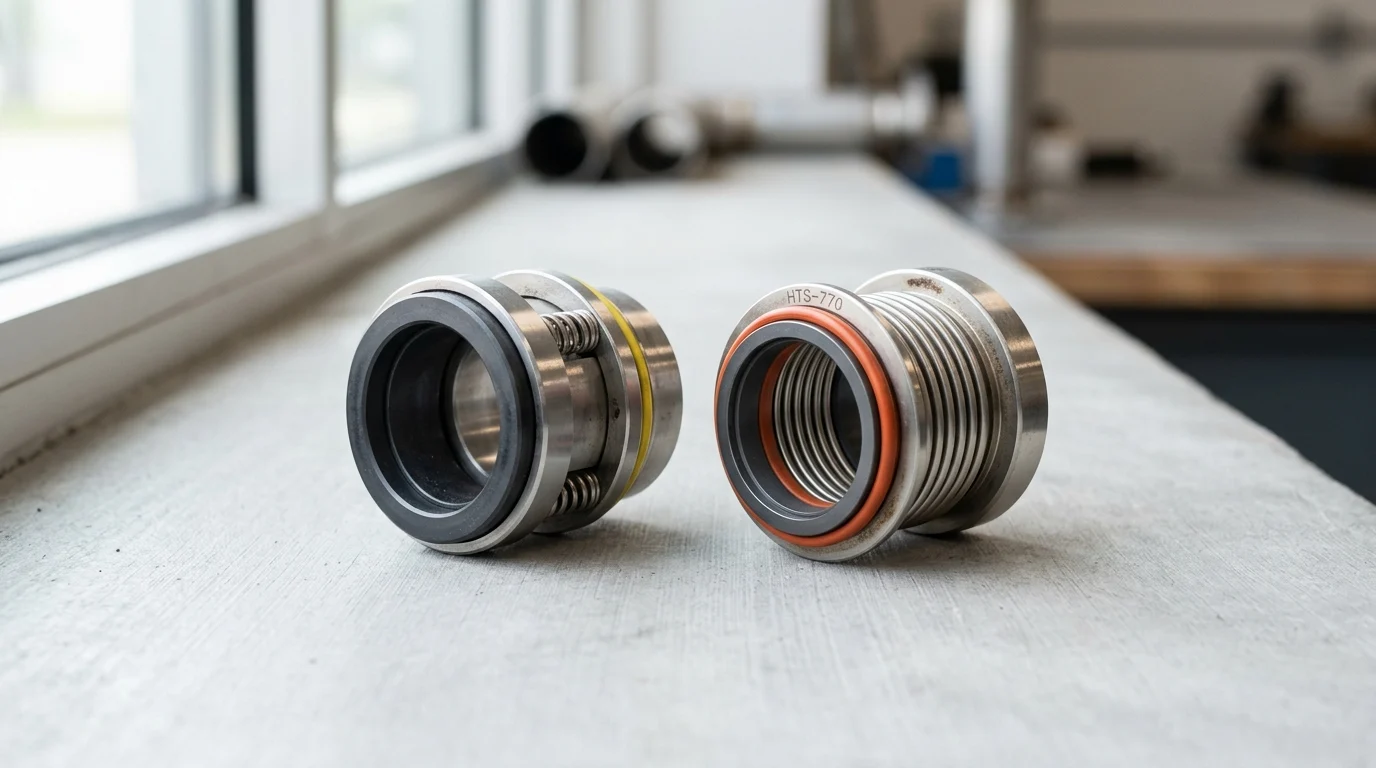
The architectural design of the seal is the primary determinant of high-temperature endurance. Pusher seals, which rely on dynamic O-rings to advance the seal face as it wears, are highly susceptible to “hang-up” when elastomers degrade or when process fluid cokes along the shaft. Conversely, stationary edge-welded metal bellows seals are considered the industry standard for temperatures exceeding 260°C (500°F). By eliminating the dynamic secondary elastomer, bellows seals maintain consistent face loading and accommodate shaft expansion without the risk of O-ring carbonization.
Materials for faces, secondary seals, and metal parts
Material selection is critical for thermal stability. For seal faces, sintered silicon carbide (SiC) offers excellent thermal conductivity and can withstand environmental temperatures up to 1,400°C, though it is susceptible to thermal shock. Tungsten carbide paired with specialized blister-resistant carbon graphite is often preferred for high-heat petroleum applications. For secondary seals, perfluoroelastomers (FFKM) reach their absolute thermal limit near 327°C (620°F). Beyond this threshold, flexible graphite wedges or Grafoil packing—capable of resisting up to 450°C (842°F) in oxidizing environments and over 1,000°C in inert atmospheres—must be utilized. Metallurgy for bellows typically requires high-nickel alloys such as Alloy 718 or Hastelloy C-276 to prevent high-temperature creep and maintain precise spring rates.
Common failure modes under heat
Heat induces specific failure modes that drastically shorten seal life. Thermal distortion, such as coning or camming, alters the microscopic gap between seal faces, leading to heavy leakage or dry running. Coking occurs when hydrocarbons degrade at the hot seal faces, forming abrasive carbon deposits that destroy face flatness. Additionally, elastomer extrusion and heat-checking (micro-cracking of hard faces due to rapid thermal cycling) account for over 40% of premature failures in processes operating continuously above 200°C.
How to Compare High-Temperature Mechanical Seals
Comparing high-temperature seals requires an analytical approach, evaluating dynamic performance limits and long-term economic impact rather than relying solely on the static temperature ratings printed on a specification sheet.
Key performance criteria
Engineers must evaluate the pressure-velocity (PV) limit, which defines the seal’s capacity to handle the frictional heat generated at the mating faces. High-performance high-temperature seals must comfortably support PV values exceeding 50,000 psi-ft/min (17.5 MPa-m/s) without flashing the fluid film. Additionally, face flatness tolerance must be strictly maintained under thermal load, typically requiring optical verification of 2 to 3 helium light bands (approximately 0.58 to 0.87 microns) to ensure uniform load distribution and prevent localized heat checking.
Comparison table for seal evaluation
The following table contrasts the two primary seal configurations used in high-temperature applications, highlighting why specific designs outlast others in extreme heat.
| Feature / Metric | Standard Pusher Seal | Edge-Welded Metal Bellows |
|---|---|---|
| Max Temperature Limit | ~260°C (Elastomer limited) | >400°C (Graphite/Alloy limited) |
| Dynamic Elastomer | Required (O-ring) | Eliminated |
| Susceptibility to Coking | High (Shaft hang-up common) | Low (No sliding along shaft) |
| Typical MTBF (>250°C) | 6 to 12 months | 36 to 60+ months |
| Tolerance to Shaft Expansion | Moderate | Excellent |
Lifecycle cost and MTBF
While an edge-welded metal bellows seal may carry a 150% to 200% higher initial acquisition cost compared to a standard pusher seal, the lifecycle economics heavily favor the high-temperature-specific design. Mean Time Between Failures (MTBF) is the critical metric for true longevity. Upgrading a hot oil pump to a specialized bellows seal can extend MTBF from an unacceptable 8 months to over 48 months. When factoring in the labor, replacement parts, and avoided downtime, the total cost of ownership (TCO) over a five-year period is frequently reduced by 40% or more.
How to Test and Select the Right Seal
Validating a mechanical seal for severe temperature duty requires stringent testing methodologies and an uncompromising approach to quality assurance and documentation before the seal ever reaches the plant floor.
Selection steps to avoid premature failure
Selecting the right seal involves strict adherence to industry standards, most notably API 682 for the oil, gas, and petrochemical sectors. A critical step in avoiding premature failure is selecting the appropriate piping plan. Often, a seal cannot survive extreme process temperatures directly. Implementing an API Plan 23, which recirculates fluid through a seal cooler, or an API Plan 53B barrier fluid system, can reduce the seal chamber temperature from 350°C down to a manageable 150°C. Evaluating the thermal dissipation requirements of the flush plan is just as important as selecting the physical seal.
Manufacturing quality and material traceability
Manufacturing tolerances for high-temperature seals leave zero room for error. Weld integrity on metal bellows is paramount; manufacturers must utilize precise micro-plasma welding and perform helium mass spectrometry leak testing to a threshold of 1 × 10^-8 atm cc/sec to guarantee the bellows will not rupture under severe thermal cycling. Furthermore, material traceability is mandatory, as the exact chemical composition of the bellows alloy directly dictates its high-temperature fatigue life and spring retention.
Compliance and documentation requirements
Compliance documentation provides the proof of quality necessary for critical infrastructure. Engineers should require EN 10204 Type 3.1 material test reports (MTRs) for all pressure-retaining and dynamic metal components. In applications where high temperatures are combined with sour gas or corrosive elements, strict compliance with NACE MR0175/ISO 15156 is required to prevent sulfide stress cracking in the seal’s metallurgical components at elevated temperatures.
How to Choose for Different Operating Conditions
Ultimately, the mechanical seal that lasts the longest is the one precisely matched to the specific thermodynamic properties of the process fluid and the operational extremes of the pumping equipment.
Selection guidance by fluid and temperature range
Fluid characteristics dictate the thermal sealing strategy. High-temperature water (boiler feed) has extremely poor lubricity and flashes to steam instantly upon pressure drops, requiring specialized high-pressure cooler plans. Conversely, thermal oils provide better lubricity but are highly prone to coking and solidifying when exposed to atmosphere.
| Process Fluid | Temp Range | Recommended Seal Architecture | Secondary Seal | API Flush Plan |
|---|---|---|---|---|
| Boiler Feed Water | 160°C – 250°C | High-Pressure Pusher or Bellows | EPDM / FFKM | Plan 23 |
| Heat Transfer Oil | 200°C – 400°C | Edge-Welded Metal Bellows | Flexible Graphite | Plan 62 (Quench) |
| Heavy Hydrocarbons | 250°C – 380°C | Stationary Metal Bellows | Flexible Graphite | Plan 32 or 54 |
| Corrosive Slurry | 150°C – 220°C | Dual Pressurized Pusher | FFKM | Plan 53A / 54 |
Decision framework for final choice
The final decision framework must synthesize temperature, pressure, and chemical compatibility. Engineers must calculate the differential thermal expansion coefficients between the pump casing, the shaft, and the seal gland. If these components expand at significantly different rates during startup, a catastrophic extrusion gap exceeding 0.15 mm can form, leading to immediate seal blowout regardless of the seal’s internal temperature rating. By standardizing on stationary metal bellows with graphite secondary seals for temperatures over 260°C, and supporting them with robust API cooling plans, operators can reliably achieve multi-year service life in the most demanding thermal applications.
Key Takeaways
- The most important conclusions and rationale for Which High Temperature Mechanical Seal Actually Lasts Longer?
- Specs, compliance, and risk checks worth validating before you commit
- Practical next steps and caveats readers can apply immediately
Frequently Asked Questions
Which high-temperature mechanical seal usually lasts longer above 260°C?
A stationary edge-welded metal bellows seal usually lasts longer because it avoids dynamic elastomer hang-up and better handles shaft growth and heat.
Why do pusher seals fail sooner in hot pump service?
Their dynamic O-rings can harden, carbonize, or stick on the shaft, causing poor face tracking, leakage, and faster wear in continuous high-temperature duty.
What face materials are best for long seal life at high temperature?
Common long-life choices are silicon carbide for heat transfer and tungsten carbide with blister-resistant carbon for hot petroleum and hydrocarbon services.
Can Victor Seals supply OEM-compatible high-temperature replacements?
Yes. Victor Seals provides OEM-compatible and replacement mechanical seals for brands like IMO, Alfa Laval, Grundfos, APV, Flygt, Fristam, Lowara, and Allweiler.
How can maintenance teams extend seal life in high-temperature pumps?
Verify flush plan performance, avoid dry running, control thermal shock, match materials to fluid and temperature, and replace seals before coking damages the faces.

Post time: Jun-25-2026