


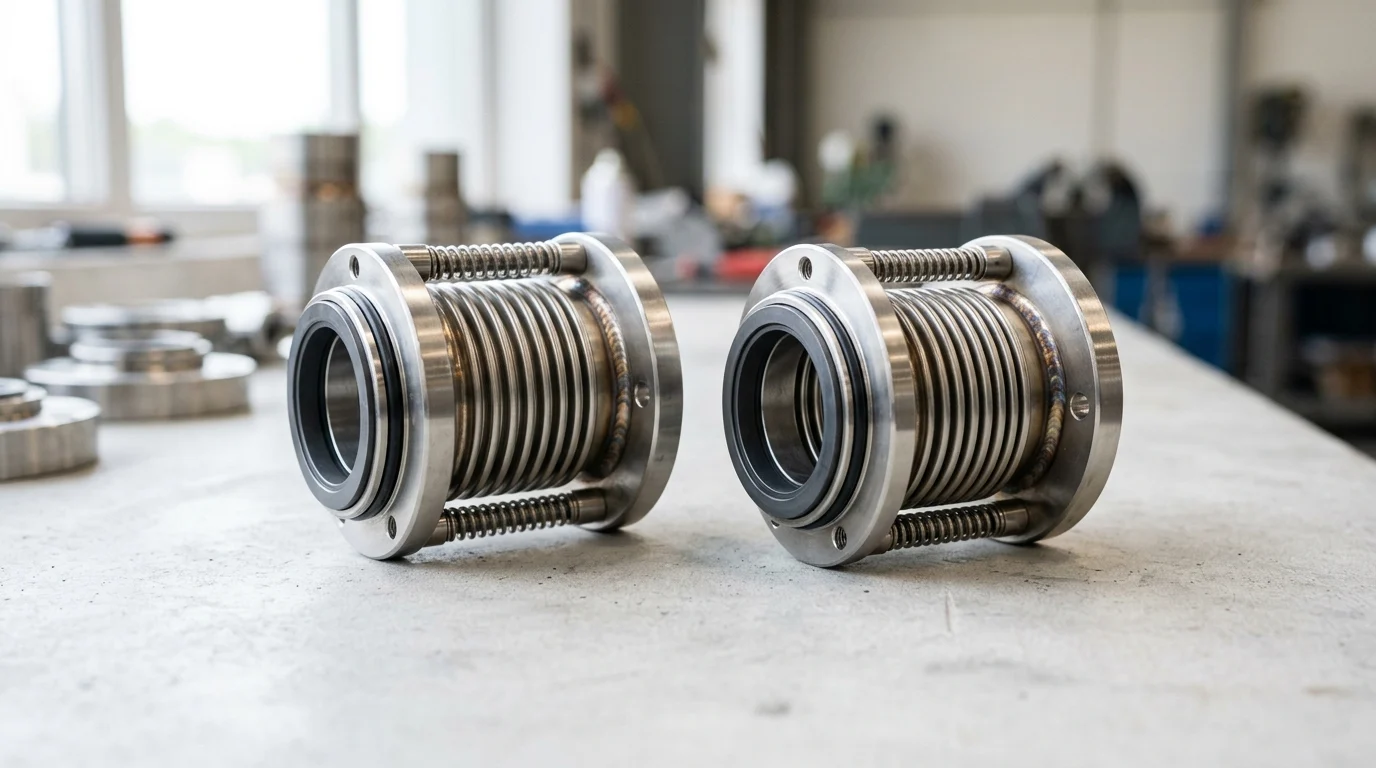
Why Metal Bellows Mechanical Seals Need a Material Strategy
Metal bellows mechanical seals are engineered to operate in some of the most demanding industrial environments, serving as a critical barrier where traditional pusher seals with dynamic elastomers would rapidly degrade. By replacing vulnerable O-rings and sliding components with an edge-welded or formed metal bellows, these seals inherently eliminate elastomeric hang-up and fretting. However, this design transfers the entire chemical and mechanical burden directly onto the metallurgy of the bellows core.
Because the individual convolutions of an edge-welded metal bellows are exceptionally thin—typically ranging from 0.10 mm to 0.15 mm in thickness—they present an highly vulnerable surface area to aggressive fluids. Even microscopic localized corrosion that would merely stain a thick pump casing can penetrate a bellows convolution, leading to catastrophic loss of spring tension and immediate fluid containment failure. Consequently, deploying a rigorous material selection strategy is not merely an optimization exercise; it is a fundamental requirement for plant safety and operational viability.
Impact on uptime and leakage control
The direct correlation between seal metallurgy and rotating equipment uptime cannot be overstated. In heavy chemical processing and hydrocarbon refining, the Mean Time Between Failures (MTBF) for a correctly specified metal bellows seal typically exceeds 36 to 48 months. Conversely, applying a standard austenitic stainless steel in an incompatible corrosive environment can reduce MTBF to less than 3 months.
Leakage control relies entirely on the structural integrity of the bellows to maintain a consistent closing force across the seal faces. If the material suffers from uniform corrosion rates exceeding 0.05 mm per year, the diminishing material thickness will alter the spring rate. This degradation reduces face closing pressure, allowing process fluid to breach the primary sealing gap long before a total mechanical fracture occurs.
Key seal components that require material review
While the bellows core is the most critical element, a comprehensive material review must encompass all wetted components of the mechanical seal cartridge. The end fittings, which connect the thin bellows leaflets to the primary ring and the seal sleeve, require compatible metallurgy to prevent galvanic corrosion at the weld joints.
Additionally, the adaptive hardware, including the gland plate, sleeve, and set screws, must be evaluated. Although these components feature significantly greater wall thicknesses than the bellows leaflets, they are subjected to the same corrosive media. Specifying a highly resistant nickel alloy for the bellows while utilizing standard 316L stainless steel for the gland plate introduces a severe galvanic couple that will accelerate anodic dissolution of the less noble material.
Common corrosion risks such as pitting and cracking
Corrosion in edge-welded metal bellows rarely manifests as uniform surface thinning; rather, it presents as localized attacks that rapidly penetrate the thin cross-sections. Pitting corrosion is the most prevalent threat in halogenated environments. The resistance to pitting is quantified by the Pitting Resistance Equivalent Number (PREN). A material with a PREN below 30 is generally unsuitable for continuous exposure to high-chloride aqueous streams.
Chloride Stress Corrosion Cracking (CSCC) is another primary failure mode, particularly for 300-series stainless steels operating above 60°C (140°F). The residual tensile stresses inherent in the micro-plasma welds of the bellows convolutions act as initiation sites for cracking. Intergranular corrosion can also occur if carbon precipitation takes place during the welding process, making the specification of low-carbon grades (such as 316L or 304L) or stabilized alloys an absolute necessity.
Converting Operating Conditions into Material Requirements
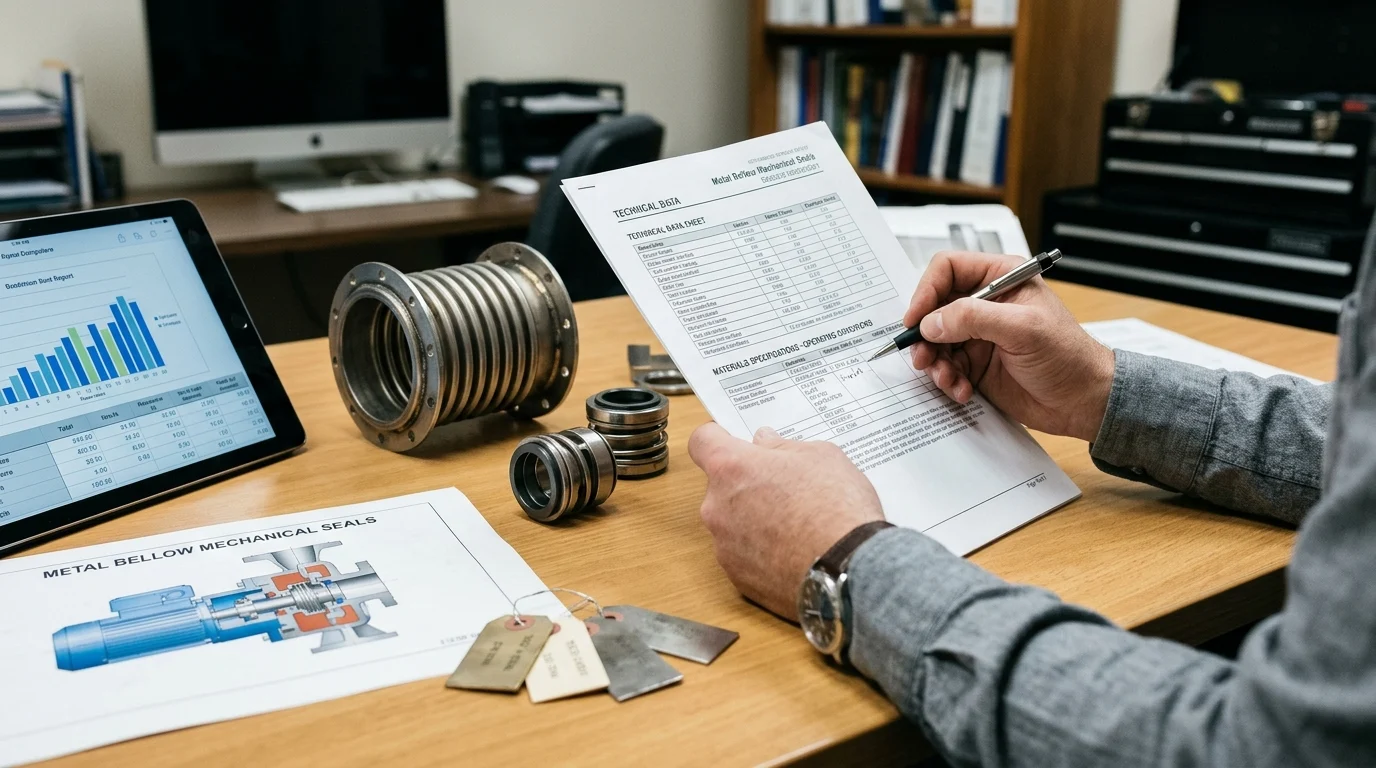
Transitioning from a general awareness of corrosion risks to actionable engineering specifications requires meticulous analysis of the operating conditions. Mechanical seal manufacturers cannot recommend an appropriate alloy without a comprehensive process profile. Relying solely on the nominal fluid name—such as “sour water” or “crude oil”—is insufficient, as trace contaminants frequently dictate the metallurgical requirements.
Engineers must capture both the steady-state operating parameters and the transient conditions experienced during startup, shutdown, and system upsets. The interplay between fluid chemistry, thermal dynamics, and mechanical pressure defines the fatigue life and chemical resistance required from the metal bellows.
Process data needed before material selection
Before evaluating alloys, reliability engineers must compile a detailed fluid datasheet. The absolute minimum data points include pH levels, specific gravity, viscosity, and the presence of dissolved gases. More importantly, the concentration of halogens—specifically chlorides, fluorides, and bromides—must be quantified in parts per million (ppm). A system with 50 ppm chlorides requires a vastly different material strategy than one with 5,000 ppm.
Beyond halogens, the presence of hydrogen sulfide (H2S), sulfuric acid (H2SO4), and sodium hydroxide (NaOH) dictates specific metallurgical paths. Furthermore, the vapor pressure margin must be calculated. If the fluid operates close to its boiling point, localized flashing at the seal faces can cause micro-pitting and cavitation, mechanically eroding the protective passive oxide layer of the metal bellows and accelerating chemical attack.
Effects of temperature cycling and pressure transients
Operating temperature heavily influences both corrosion rates and mechanical fatigue. A rule of thumb in chemical kinetics is that corrosion rates double for every 10°C increase in temperature. A bellows material that is perfectly passive at 40°C may suffer rapid pitting at 90°C. Temperature cycling also induces thermal expansion and contraction, imposing additional stress on the bellows welds.
Pressure transients are equally destructive. Metal bellows seals are typically rated for operational pressures up to 2.5 MPa (360 psi), depending on the convolution design. However, sudden pressure spikes or hydraulic shock (water hammer) can over-compress the bellows, pushing the metal past its yield strength. When a material is mechanically deformed, its localized susceptibility to stress corrosion cracking increases exponentially.
Relevant standards and plant specifications
Material selection must align with international standards and specific plant specifications. The American Petroleum Institute standard API 682 (4th Edition) is the definitive guideline for mechanical seals in the oil and gas sector. For Category 2 and Category 3 seals, API 682 mandates specific material configurations, frequently requiring Alloy C-276 for the bellows core as a default to ensure broad chemical compatibility.
In applications involving sour gas or high H2S concentrations, compliance with NACE MR0175 / ISO 15156 is mandatory. This standard restricts the maximum hardness of the alloys (typically requiring Rockwell C hardness below 22 for austenitic alloys) and limits the allowable cold-working processes to prevent sulfide stress cracking. Plant-specific piping classes often dictate the material of the seal gland to ensure it matches the metallurgical grade of the pump casing.
Comparing Corrosion-Resistant Material Options
With the operating conditions accurately mapped, the next phase is evaluating the available metallurgical options. The market offers a spectrum of alloys ranging from standard austenitic stainless steels to highly engineered superalloys. Selecting the optimal material requires balancing chemical resistance, mechanical spring properties, and weldability.
Because edge-welded bellows rely on the precise fusion of ultra-thin metal stampings, not all corrosion-resistant alloys can be successfully manufactured into a bellows core. The material must possess excellent ductility for the stamping process and exhibit flawless micro-plasma weldability without forming brittle intermetallic phases.
Stainless steels, duplex alloys, and nickel alloys
Austenitic stainless steels, primarily 316L and 316Ti, represent the baseline for metal bellows. They offer excellent weldability and adequate resistance for mildly corrosive fluids, but with a PREN of approximately 24, they are highly susceptible to pitting in chloride-rich environments above 50°C. Duplex stainless steels (such as Alloy 2205) provide higher strength and better chloride resistance, but their complex microstructure makes them difficult to weld into thin bellows convolutions.
For severe environments, high-nickel alloys are the industry standard. Alloy C-276 (Hastelloy) is widely utilized due to its exceptional resistance to localized corrosion, boasting a PREN of over 68. For high-temperature applications requiring superior mechanical fatigue strength, Alloy 718 (Inconel) is frequently specified, maintaining its spring rate and yield strength at temperatures approaching 400°C (750°F).
Seal face material combinations to evaluate
The metallurgy of the bellows must be evaluated in tandem with the tribological materials used for the seal faces. In corrosive environments, the primary ring (often shrink-fitted or brazed to the bellows) and the mating ring must withstand both chemical attack and mechanical wear. Carbon graphite is commonly used for its self-lubricating properties, but the resin or metal impregnation must be chemically compatible with the process fluid.
For highly abrasive and corrosive slurries, hard-on-hard face combinations are required. Sintered Silicon Carbide (SiC) is universally favored, offering extreme chemical inertness and a hardness of 2500 to 2800 HV. Tungsten Carbide (WC) is an alternative, but the binder material is critical; nickel-bound WC is preferred in corrosive applications, as cobalt-bound WC is highly susceptible to leaching in acidic and alkaline solutions.
Alloy performance comparison criteria
When comparing alloy performance, engineers must look beyond basic corrosion charts and evaluate the specific properties that dictate bellows longevity. Yield strength determines the material’s ability to maintain its spring rate, while the maximum operating temperature dictates its thermal limits.
| Material Grade | PREN (Approx.) | Yield Strength (MPa) | Max Operating Temp (°C) | Primary Strength |
|---|---|---|---|---|
| Alloy 316L | 24 | 170 | 200 | Cost-effective baseline |
| Alloy 20 (Carpenter 20) | 32 | 240 | 315 | Sulfuric acid resistance |
| Alloy C-276 (Hastelloy) | 68 | 355 | 400 | Extreme chloride/acid resistance |
| Alloy 718 (Inconel) | 40 | 1030 | 425 | High mechanical fatigue strength |
This comparative data highlights why Alloy C-276 is the default upgrade for chemical processing, whereas Alloy 718 is selected for high-pressure, high-temperature refinery applications where mechanical yield strength is just as critical as corrosion resistance.
Validating Suppliers, Quality, and Cost
Specifying the correct alloy is only half the battle; ensuring that the manufactured seal actually meets those specifications requires rigorous quality control and supplier validation. The supply chain for exotic alloys is complex, and the risk of counterfeit materials or substandard welding is a significant threat to plant reliability.
Purchasing departments often default to the lowest upfront cost, which can lead to disastrous outcomes in corrosive applications. Validating the supplier’s engineering capabilities, demanding verifiable documentation, and understanding the total lifecycle cost are essential steps in the procurement process.
Required supplier documentation for metal bellows seals
To guarantee material integrity, buyers must mandate strict documentation from the seal manufacturer. The baseline requirement is an EN 10204 Type 3.1 material certificate, which provides traceability of the alloy back to the original steel mill heat number. For critical or lethal service, a Type 3.2 certificate, validated by an independent third-party inspector, may be required.
Beyond raw material certs, Positive Material Identification (PMI) using X-ray fluorescence (XRF) should be performed on the finished seal components before shipment. Additionally, because the integrity of the bellows relies on thousands of micro-plasma welds, buyers should request weld penetration reports and leak testing certifications. A standard requirement is 100% helium mass spectrometry leak testing, confirming a leak rate of less than 1×10^-7 atm-cc/sec.
Balancing premium alloys against lifecycle cost
The initial purchase price of a metal bellows seal scales aggressively with the chosen metallurgy. If a standard 316L bellows seal is assigned a baseline cost multiplier of 1.0x, upgrading to Alloy 20 might increase the cost to 1.8x, while an Alloy C-276 or Alloy 718 seal can range from 3.5x to 5.0x. However, this capital expenditure must be contextualized against the lifecycle cost.
Consider a chemical pump processing hot chlorides where a 316L seal fails every 4 months, resulting in $15,000 of maintenance labor, lost production, and environmental cleanup per incident. Over a three-year period, the “cheap” seal costs the plant $135,000 in downtime. Investing $6,000 upfront for an Alloy C-276 seal that achieves a 36-month MTBF yields an overwhelming return on investment, rendering the initial premium mathematically negligible.
Logistics, sourcing, and lead-time considerations
Logistics and supply chain lead times must heavily influence material strategies, especially for critical spares. Standard 316L bellows seals are typically stocked or can be assembled within 2 to 4 weeks. In contrast, exotic alloys like Alloy C-276, Monel 400, or Titanium require specialized raw material sourcing and dedicated manufacturing runs.
Lead times for highly engineered exotic bellows can extend to 12 to 16 weeks, and manufacturers may impose Minimum Order Quantities (MOQs) for custom stamping dies. To mitigate this risk, plants must maintain an optimized inventory of exotic spare seals or establish blanket order agreements with suppliers to hold safety stock, ensuring that an unexpected pump failure does not result in a three-month production outage.
Decision Workflow for Selecting the Best Seal Material
To prevent material selection from becoming an ad-hoc, subjective process, engineering teams must implement a standardized decision workflow. This ensures that every mechanical seal specified for a corrosive environment undergoes the same rigorous analytical scrutiny, balancing technical requirements against commercial realities.
A structured workflow moves the team from the initial process data gathering phase through technical filtering, financial evaluation, and final specification. By utilizing quantifiable metrics and decision matrices, plants can document the rationale behind every material upgrade, providing a clear audit trail for future reliability reviews.
Moving from process review to material shortlist
The workflow begins by filtering the universe of available alloys through the hard constraints of the process fluid. Step one is cross-referencing the fluid’s chemical composition, pH, and maximum chloride concentration against published corrosion resistance tables (such as NACE guidelines or manufacturer compatibility charts). This immediately eliminates unsuitable materials, narrowing a list of 15+ alloys down to a shortlist of 3 or 4 candidates.
Step two applies mechanical and thermal constraints. If the fluid temperature exceeds 300°C, or if the pressure transients exceed 2.0 MPa, materials with lower yield strengths at elevated temperatures are discarded. This mechanical filtering ensures that the shortlisted alloys can not only survive the chemical environment but also maintain the dynamic spring force required to keep the seal faces closed over a 36-month lifecycle.
Using a decision matrix to rank seal options
With a shortlist of technically viable alloys, a weighted decision matrix is utilized to identify the optimal choice. This matrix assigns priority weights to various factors based on the specific criticality of the pump.
| Evaluation Criteria | Weight | Alloy 316L Score | Alloy 20 Score | Alloy C-276 Score |
|---|---|---|---|---|
| Chemical Resistance | 40% | 2 | 6 | 10 |
| Mechanical Fatigue Life | 20% | 4 | 6 | 8 |
| Initial Cost | 20% | 10 | 6 | 2 |
| Lead Time / Availability | 20% | 10 | 5 | 3 |
| Total Weighted Score | 100% | 5.6 | 5.8 | 6.6 |
In this aggressive chemical scenario, Alloy C-276 emerges as the logical choice despite its poor scores in cost and lead time, because the heavy 40% weighting on chemical resistance dominates the matrix. If the fluid were less corrosive, the matrix would naturally favor the more cost-effective and readily available 316L.
When to revalidate material selections
Material selection is not a static achievement; it requires periodic revalidation. Process conditions in chemical plants and refineries frequently drift over time due to changes in feedstock, production debottlenecking, or catalyst degradation. A material strategy that was optimal in 2020 may result in premature seal failures in 2025.
Plants must establish strict Management of Change (MOC) triggers. For instance, if the process operating temperature increases by more than 15°C, or if chloride concentrations jump by 500 ppm, the existing seal material specifications must be automatically flagged for engineering review. Continuous monitoring of MTBF data via the plant’s CMMS (Computerized Maintenance Management System) will provide the ultimate feedback loop, confirming whether the selected metal bellows materials are successfully surviving the corrosive realities of the process.
Key Takeaways
- Treat bellows metallurgy as a safety-critical decision because 0.10–0.15 mm convolutions can fail rapidly from localized corrosion.
- Review every wetted seal component, including end fittings, sleeves, gland plates, and set screws, to prevent galvanic corrosion between dissimilar metals.
- Avoid using standard austenitic stainless steel in incompatible corrosive media, as seal MTBF can drop from 36–48 months to less than 3 months.
- Use PREN as an initial screening tool for chloride service, and avoid materials below PREN 30 for continuous high-chloride aqueous exposure.
- Keep uniform corrosion rates below about 0.05 mm per year to preserve bellows spring rate and maintain stable face closing pressure.
Frequently Asked Questions
Why are metal bellows seals sensitive to material selection?
Metal bellows convolutions are very thin, often about 0.10–0.15 mm, so localized corrosion can quickly penetrate the bellows and cause loss of spring force, leakage, or seal failure.
What corrosion risks matter most in metal bellow mechanical seals?
Pitting, chloride stress corrosion cracking, crevice corrosion, and galvanic corrosion are key risks. They are especially dangerous because small defects can compromise thin bellows sections faster than thicker pump components.
Is 316L stainless steel suitable for all corrosive services?
No. 316L may work in mild conditions, but high-chloride, acidic, or high-temperature environments often require higher-alloy materials such as duplex stainless steel, Hastelloy, Inconel, or titanium, depending on the fluid chemistry.
What PREN value should be considered for chloride environments?
For continuous high-chloride aqueous service, materials with a PREN below 30 are generally risky. A higher PREN indicates better resistance to pitting, but final selection should also consider temperature, pH, oxidizers, and velocity.
Should only the bellows material be upgraded?
No. The bellows, end fittings, sleeve, gland plate, and set screws should be reviewed together. Mixing a noble bellows alloy with less resistant wetted hardware can create galvanic corrosion and shorten seal life.
Post time: Sep-15-2026