


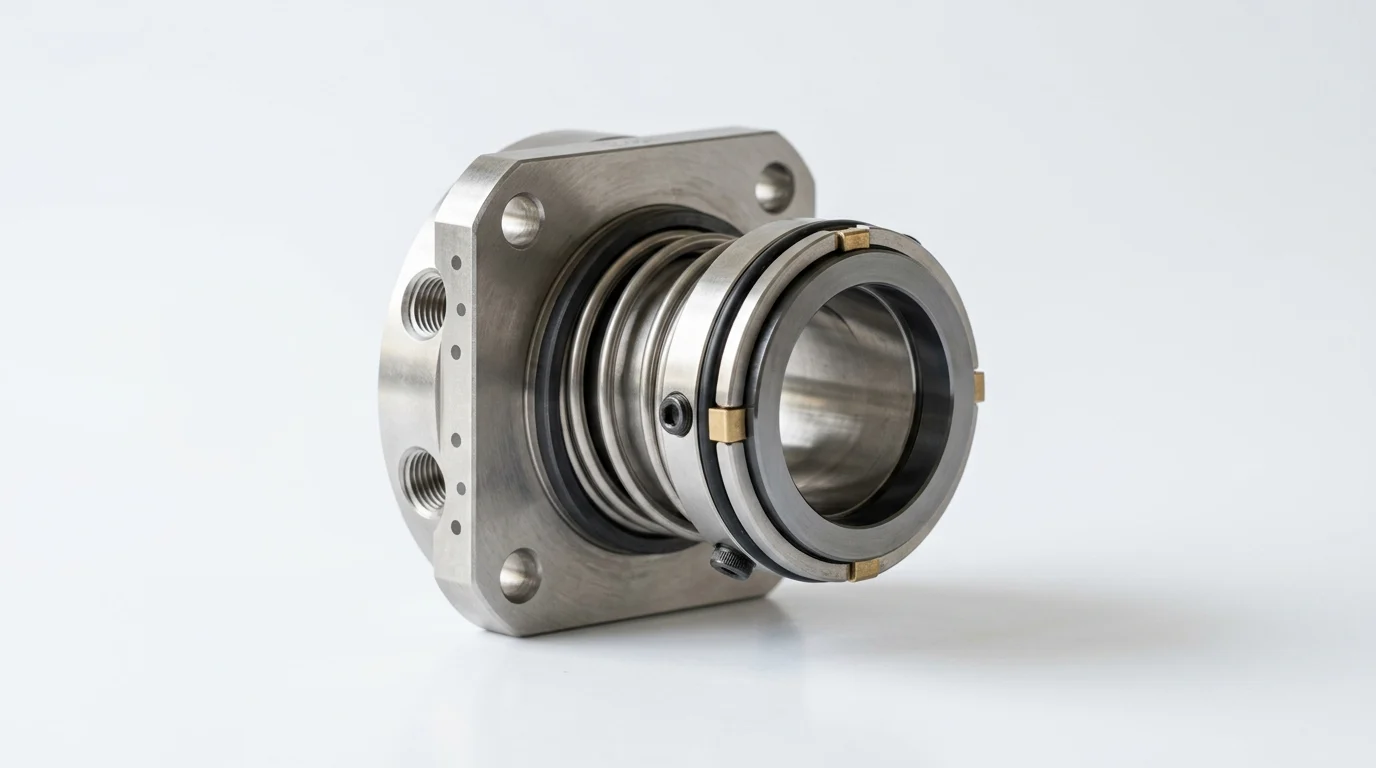
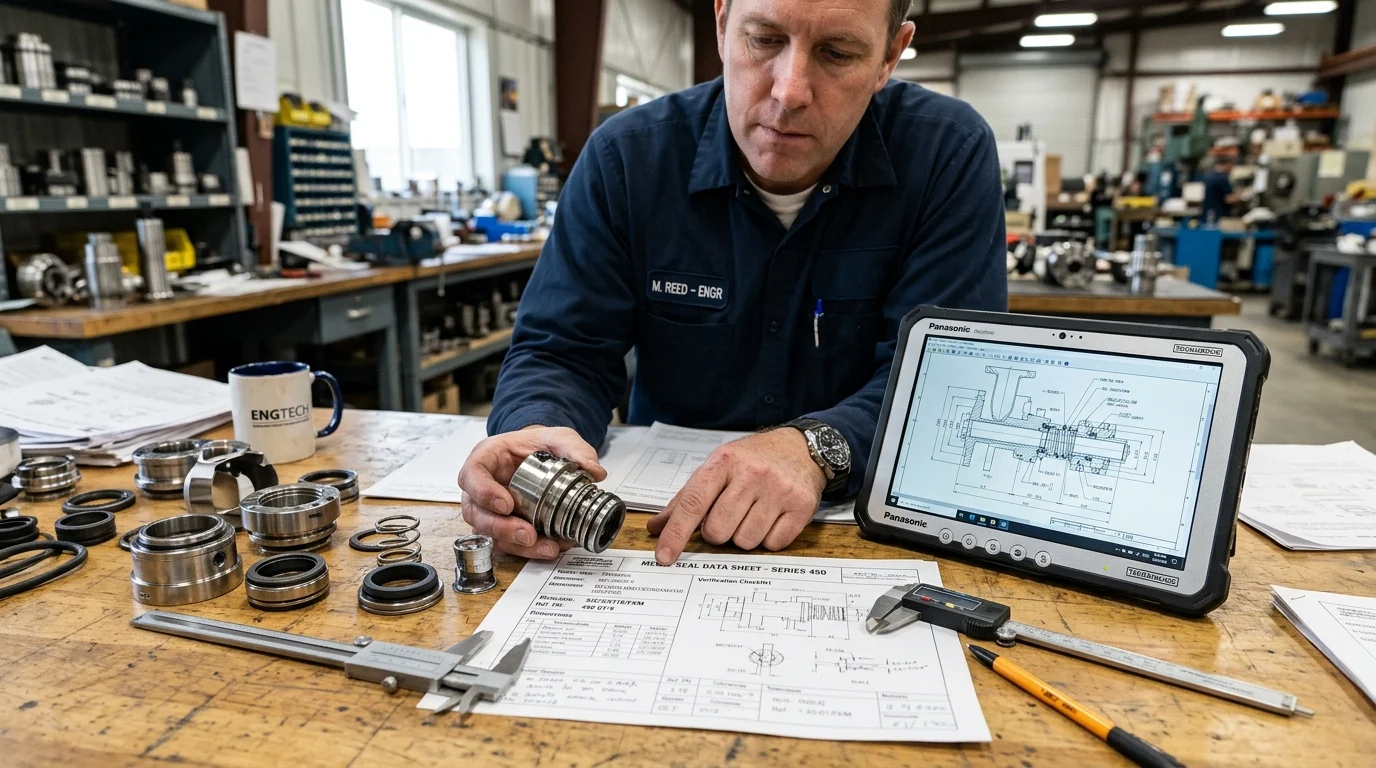
Modern mechanical seal manufacturers must utilize advanced predictive modeling tools, such as Finite Element Analysis (FEA) and Computational Fluid Dynamics (CFD), to simulate thermal distortion and fluid vaporization across seal faces before physical manufacturing begins. Suppliers lacking these predictive engineering capabilities rely on costly and time-consuming trial-and-error methodologies, which pose unacceptable risks for mission-critical applications.
Design range and material compatibility
The foundation of mechanical seal reliability lies in the optimal pairing of seal face materials and secondary elastomers. Evaluators must verify the supplier’s access to, and expertise in, premium-grade materials. This includes advanced elastomers like Perfluoroelastomers (FFKM) for aggressive chemical resistance, as well as highly engineered face materials such as reaction-bonded Silicon Carbide (SiC) and nickel-bound Tungsten Carbide (TC).
| Face Material Combination | Illustrative Friction Coefficient | Typical Max PV Limit (psi-ft/min) | Primary Application Strengths |
|---|---|---|---|
| Carbon vs. Silicon Carbide | 0.05 – 0.08 | 50,000 | Excellent dry-running tolerance, general water and chemical duty. |
| Silicon Carbide vs. Silicon Carbide | 0.08 – 0.12 | 100,000+ | High hardness, superior chemical resistance, abrasive slurries. |
| Tungsten Carbide vs. Tungsten Carbide | 0.10 – 0.15 | 80,000 | Extreme high pressure, heavy shock loads, high-torque environments. |
A technically proficient supplier will not offer a one-size-fits-all solution but will utilize empirical data, similar to the illustrative industry approximations in the table above, to specify the exact material pairing required to prevent premature wear and thermal cracking under the specific fluid’s lubricity and particulate load.
Testing and documentation standards
Robust testing protocols are non-negotiable when evaluating mechanical seal suppliers. A tier-one manufacturer will maintain an in-house dynamic testing laboratory capable of replicating the end-user’s exact pressure, temperature, and speed conditions. Evaluators should request documentation of standard static hydrostatic testing, which typically requires holding the seal at 1.5 times the Maximum Allowable Working Pressure (MAWP) for a minimum of 15 minutes to verify structural integrity and O-ring sealing.
Beyond static tests, the supplier’s documentation standards must be scrutinized. Comprehensive documentation packages should include detailed assembly drawings, installation manuals, bill of materials (BOM), and material test reports (MTRs). For critical applications, the ability to provide API 682 qualification test reports—proving the specific seal design has successfully completed rigorous cyclical testing over hundreds of hours—is a definitive indicator of engineering maturity. To verify these claims, evaluators should request the specific test protocols and, for highly critical applications, mandate third-party witness sign-offs during the testing phase.
Standard versus customized seal solutions
Facilities operate a mix of standard utility pumps and highly specialized process equipment. Therefore, suppliers must be evaluated on their dual capacity to deliver cost-effective standard seals and highly engineered custom solutions. Standard ANSI or DIN cartridge seals are typically catalog items expected to ship within 2 to 4 weeks, providing economical solutions for benign fluids like cooling water.
However, when a plant requires a custom-engineered dual pressurized seal for a multi-phase flow pump operating at 150 bar, the evaluation criteria shift. The supplier must demonstrate a proven track record of managing customized projects, which often entail 12 to 16-week lead times, iterative design reviews with plant engineers, and custom API Plan 53B or 54 support systems. A supplier’s inability to seamlessly transition between standard volume production and bespoke engineering is a major red flag for complex industrial sites.
Quality, Compliance, and Production Control
Translating a robust theoretical design into a reliable physical product demands exacting manufacturing standards. Mechanical seals are precision instruments; their efficacy relies on microscopic tolerances that must be maintained across hundreds or thousands of production units. When evaluating a supplier, procurement and quality assurance teams must look past the sales presentations and directly audit the factory floor.
The evaluation must focus on the manufacturer’s capital equipment, environmental controls, and the rigor of their quality management systems. A supplier may possess excellent engineering blueprints, but if their machining centers suffer from spindle runout or their lapping machines are poorly calibrated, the resulting mechanical seals will inherently fail to perform in the field.
Quality management and inspection processes
Quality control in mechanical seal manufacturing is most critically observed in the lapping and polishing of the seal faces. To maintain a stable fluid film and prevent leakage, seal faces must be lapped to a flatness of 2 to 3 helium light bands, which equates to approximately 0.6 to 0.9 microns. Evaluators must verify that the supplier utilizes monochromatic light sources and optical flats to measure these tolerances on every critical component, not just as a random batch sample.
Furthermore, surface finish (Ra) parameters must be strictly controlled. A baseline ISO 9001 certification is expected, but true quality management extends to statistical process control (SPC) on the CNC machining lines. Evaluators should check if the supplier holds general machining tolerances of ±0.01 mm for critical shaft sleeves and gland plates, ensuring that cartridge seals align perfectly upon installation without inducing localized stress or angular misalignment.
Industry standards and regulatory compliance
Compliance is not a generic checklist; it is highly specific to the end-user’s industry. For the oil, gas, and petrochemical sectors, the supplier must demonstrate absolute fluency in API 682 (currently in its 4th Edition). This standard dictates everything from seal flush plan configurations to specific bolt sizes and clearance dimensions. A supplier’s ability to consistently meet API 682 fugitive emission targets—often achieving less than 50 ppmv against a standard allowance of 1000 ppmv—is critical for environmental compliance.
Conversely, if evaluating a supplier for pharmaceutical or food and beverage applications, the regulatory focus shifts entirely. The supplier must provide FDA-compliant materials, USP Class VI certified elastomers, and designs that adhere to EHEDG or 3-A Sanitary Standards. These designs require specialized surface finishes (often electropolished to Ra <0.4 microns) and crevice-free geometries to allow for effective Clean-In-Place (CIP) and Steam-In-Place (SIP) operations without harboring bacterial growth.
Capacity, traceability, and process consistency
Scalability and consistency are vital for long-term supply agreements. Evaluators must assess the supplier’s production capacity to ensure they can handle sudden surges in demand, such as during a massive plant turnaround where hundreds of seals may be required simultaneously. This assessment includes reviewing their machine utilization rates and cross-training matrices for machine operators.
Traceability is equally paramount. In the event of a catastrophic failure, the plant must be able to trace the compromised seal back to its exact metallurgical origins. Suppliers must provide Material Test Reports (MTRs) according to EN 10204 3.1, documenting the chemical composition and mechanical properties of the raw bar stock. A stringent evaluation will confirm that the supplier’s ERP system links these heat numbers directly to the serialized finished seal, ensuring total process consistency and accountability.
Commercial, Logistics, and Service Factors
Even the most technically advanced mechanical seal becomes a liability if the supplier’s commercial structures and logistical networks cannot support the day-to-day realities of industrial plant operations. Supply chain resilience is a critical evaluation vector. The best engineered seal is effectively useless if it arrives three months late during a scheduled maintenance outage, forcing the plant to extend downtime or install substandard backup equipment.
Procurement professionals must evaluate suppliers on their ability to integrate into the facility’s broader supply chain strategy. This involves analyzing their inventory management capabilities, localized support footprint, and the commercial flexibility required to establish long-term, mutually beneficial agreements rather than transactional, single-purchase relationships.
Total cost of ownership
When structuring a long-term supplier agreement, the evaluation methodology must center on the Total Cost of Ownership (TCO). While the lifecycle cost section addresses the operational penalties of failure, evaluating a supplier’s TCO approach involves analyzing their proactive cost-reduction programs. For instance, the friction generated by a poorly optimized mechanical seal can consume an estimated $500 to $2,000 in additional electrical costs per pump annually.
Suppliers should be evaluated on their willingness to engage in these TCO reduction initiatives. Leading manufacturers will proactively audit a plant’s existing seal population and propose upgrades—such as transitioning from single seals to dual gas-lubricated seals—that eliminate liquid flush water usage and drastically reduce energy consumption. A supplier’s ability to provide documented ROI calculations for these upgrades is a strong indicator of their value as a long-term partner.
Lead times, inventory, and delivery reliability
Supply chain volatility necessitates a rigorous evaluation of a supplier’s lead times and delivery reliability. While custom-engineered seals may legitimately require 12 weeks of manufacturing time, standard cartridge seals and replacement parts should be available almost immediately. Evaluators must inquire about Minimum Order Quantities (MOQs); aggressive MOQs can force plants to hold unnecessary inventory, tying up working capital.
To mitigate lead time risks, top-tier suppliers offer localized inventory stocking programs or Vendor Managed Inventory (VMI) agreements. By establishing a consignment inventory at the plant site or a nearby regional distribution center, suppliers can effectively reduce lead times for critical spares from 12 weeks to less than 24 hours. The evaluation should heavily weight a supplier’s logistical footprint and their willingness to hold safety stock on behalf of the end-user.
Aftermarket support and repair capability
Mechanical seals are wear components; eventual overhaul is inevitable. Therefore, a supplier’s aftermarket support and repair capabilities are just as critical as their new-product manufacturing. Refurbishing a mechanical seal typically costs between 40 and 60 percent of the price of a new unit, provided the metal hardware remains intact. Evaluators must assess the proximity and capability of the supplier’s authorized repair centers.
An effective repair facility must be able to reverse-engineer failed seals, perform ultrasonic cleaning, re-lap faces to OEM specifications, and conduct static pressure tests before returning the unit. Turnaround time for standard repairs should reliably fall within a 1 to 3-week window. Furthermore, the supplier’s field service presence is crucial; having a certified technician available for on-site troubleshooting, laser alignment, and installation supervision directly correlates with improved long-term equipment reliability.
Decision Framework for Supplier Selection
Transitioning from a theoretical evaluation to actionable procurement requires a structured, data-driven decision framework. Relying on subjective impressions or historical inertia often leads to suboptimal supplier selection. To ensure long-term stability, cross-functional teams comprising maintenance, reliability engineering, and procurement must utilize standardized metrics to objectively compare potential mechanical seal partners.
The objective of this framework is to quantify risk and value. By systematically scoring suppliers, executing controlled pilot programs, and strategically deciding between sole-sourcing and dual-sourcing models, industrial facilities can build a resilient mechanical seal supply chain that drives continuous improvement in plant reliability.
Supplier scorecard criteria
A formalized supplier scorecard is the most effective tool for objective evaluation. This matrix assigns weighted values to the various technical, quality, and commercial factors discussed previously, ensuring that an exceptionally low price does not overshadow critical deficiencies in engineering or quality control. The weightings in the table below are illustrative and should be customized to reflect a specific facility’s operational priorities.
| Evaluation Category | Weighting | Key Performance Indicators (KPIs) to Measure |
|---|---|---|
| Technical Capability | 30% | Material selection expertise, FEA/CFD usage, API/ANSI design range. |
| Quality & Compliance | 25% | ISO 9001, API 682 compliance, face flatness (light bands), MTR traceability. |
| Commercial & TCO | 20% | Unit pricing, energy reduction initiatives, repair pricing structure. |
| Logistics & Delivery | 15% | On-time delivery rate (>95%), VMI capabilities, standard lead times. |
| Service & Support | 10% | Local engineering support, repair turnaround time, training programs. |
By utilizing a scorecard similar to the one above, the evaluation committee can generate a numeric score for each vendor. Suppliers failing to meet a minimum threshold (e.g., scoring below 75 out of 100) are automatically disqualified from long-term contract consideration, streamlining the final selection process.
Pilot orders, audits, and performance reviews
Before awarding a plant-wide contract, the highest-scoring suppliers must prove their capabilities in the real world. This phase involves executing process audits, such as the VDA 6.3 standard, to verify that the supplier’s documented quality systems match their actual shop-floor practices. Following a successful audit, the plant should initiate a pilot order.
Pilot programs typically target “bad actor” pumps—equipment with historically low MTBF due to chronic seal failures. The supplier is tasked with designing a solution and monitoring its performance over a defined period, usually 6 to 12 months. If the supplier’s seal successfully extends the MTBF from 6 months to 12 months without leakage or excessive wear, they provide empirical proof of their technical and manufacturing claims, justifying the broader contract award.
Consolidation, dual sourcing, or replacement decisions
The final strategic consideration in the decision framework is determining the sourcing model. Consolidating the entire plant’s mechanical seal spend with a single supplier (sole-sourcing) can yield significant commercial benefits, often unlocking volume discounts of 10 to 15 percent and simplifying inventory management. However, sole-sourcing introduces substantial risk if that supplier experiences a catastrophic facility fire, labor strike, or financial insolvency. To mitigate these risks, evaluators must assess a supplier’s business continuity planning, geographic diversification of their manufacturing footprint, and overall financial health metrics.
To balance commercial leverage with supply chain security, many large facilities employ a dual-sourcing strategy. This typically involves a 70/30 or 80/20 volume split. The primary supplier handles the bulk of standard applications and enjoys economies of scale, while a secondary, highly vetted supplier handles specialized applications and maintains enough active engagement to rapidly scale up production if the primary supplier falters. This balanced approach ensures competitive pricing while maintaining the long-term operational stability of the plant.
Key Takeaways
- Evaluate mechanical seal suppliers by lifecycle reliability, not unit price, because seals can drive 60 to 70 percent of pump maintenance costs over a 15-year equipment life.
- Use MTBF as a core supplier performance metric, with properly selected seals expected to reach about 36 to 60 months in suitable operating conditions.
- Confirm the supplier can support your operating envelope, including pressure-velocity limits, shaft speeds around 3,600 RPM or higher, and extreme temperature requirements.
- Check financial stability, inventory depth, and engineering staff continuity to reduce the risk of delayed support during outages or supply chain disruptions.
- Prioritize suppliers that provide application engineering, material selection guidance, and failure analysis rather than simply matching part numbers.
Frequently Asked Questions
Why is supplier stability important when buying mechanical seals?
Mechanical seals affect pump uptime, leakage control, and lifecycle cost. A stable supplier is more likely to maintain engineering support, material availability, quality consistency, and replacement continuity over years of operation.
What technical data should I provide before requesting a seal quote?
Share pump model, shaft size, speed, pressure, temperature, fluid properties, solids content, operating hours, and any failure history. This helps the supplier recommend the right seal design and materials.
How long should a properly selected mechanical seal last?
In suitable operating conditions, a well-designed mechanical seal can support an MTBF of about 36 to 60 months. Poor selection or low-quality manufacturing may reduce service life to under 12 months.
Should price be the main factor in choosing a mechanical seal supplier?
No. Unit price matters, but total cost includes downtime, labor, leakage risk, energy loss, spare parts, and emergency support. A lower-cost seal can become expensive if it fails prematurely.
What makes Victor Seals relevant for OEM and replacement seal sourcing?
Ningbo Victor Seals Co., Ltd., founded in 1998, manufactures standard and OEM mechanical seals, cartridge seals, double seals, pump shaft seals, and replacement parts for industrial pump applications.

Post time: Aug-15-2026