


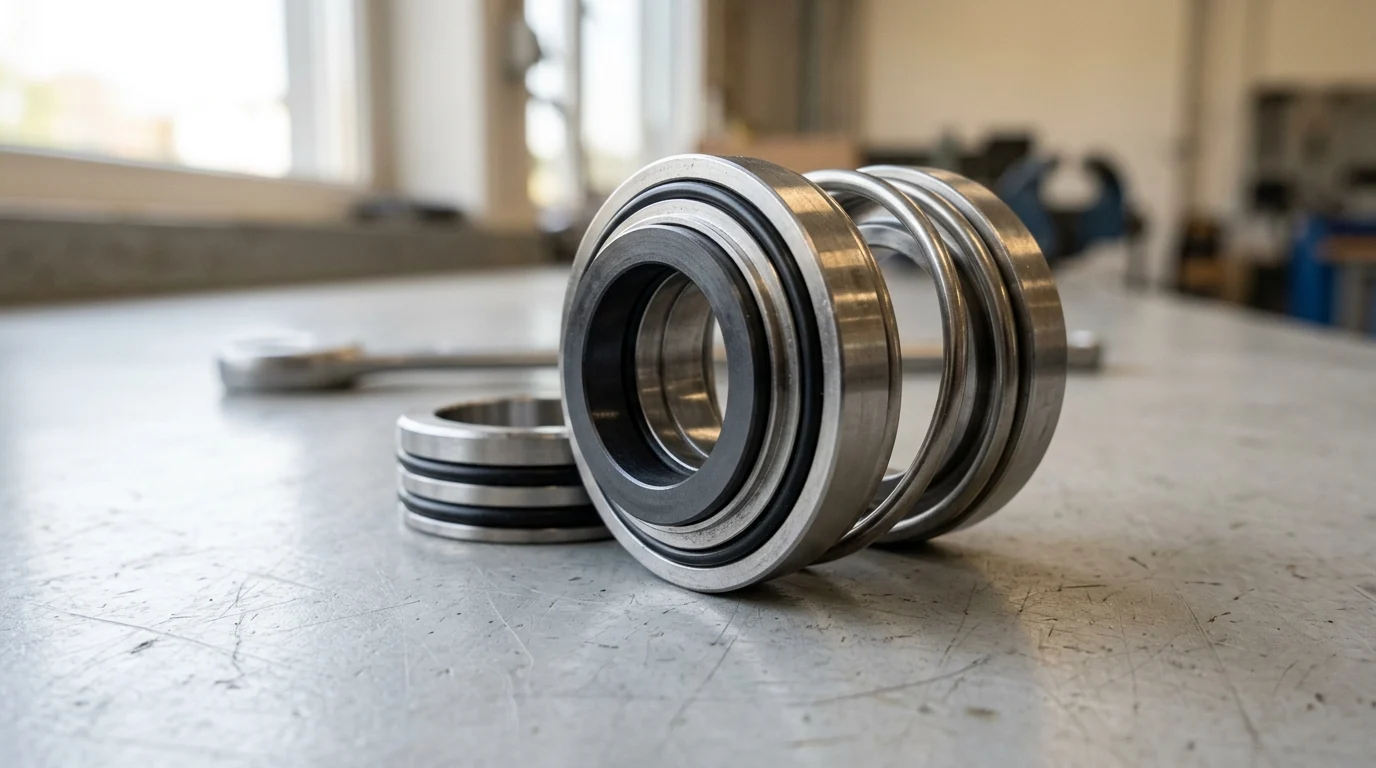
Planning a Grundfos Mechanical Seal Replacement
Executing a mechanical seal replacement on high-performance centrifugal pumps requires meticulous planning to minimize downtime and ensure long-term reliability. Grundfos pumps, particularly the widely used CR, CRN, and TP series, rely on highly engineered mechanical seals to maintain hydraulic efficiency and prevent fluid leaks. Maintenance teams must approach seal replacement not merely as a corrective task, but as an opportunity to evaluate system health.
Establishing a standardized replacement protocol improves the Mean Time Between Failures (MTBF) and reduces the total cost of ownership. By analyzing operational parameters before initiating repairs, maintenance teams can shift from reactive repairs to proactive equipment management.
When Replacement Is Justified
Differentiating between normal operational weepage and catastrophic seal failure is the first step in justifying a replacement intervention. During the initial break-in period, a new mechanical seal may exhibit minor weepage—typically 2 to 3 drops per minute—as the primary faces lap together to form a perfect hydrodynamic seal. However, sustained leakage exceeding this break-in rate, or failing to stop after the first 24 hours of operation, indicates a compromised seal face or a degraded secondary elastomer.
Maintenance engineers must also monitor vibration signatures as a primary diagnostic indicator. Sustained vibration exceeding ISO 10816-3 thresholds (typically greater than 4.5 mm/s RMS for rigid foundations) often precipitates mechanical seal failure. If vibration levels remain high, replacing the seal without addressing the underlying imbalance or misalignment will result in rapid, repeated failures, necessitating immediate root cause investigation before shaft damage occurs.
Key Operating Conditions to Review
Before initiating the physical replacement, a comprehensive review of the hydraulic and thermal operating conditions is mandatory. The dynamic conditions of the fluid system directly influence the mechanical seal’s longevity and material requirements. Key parameters include the maximum operating pressure, which can reach up to 25 bar (362 psi) in standard multistage CR pumps, and scale up to 50 bar in specialized high-pressure variants.
Thermal dynamics are equally critical. Fluid temperature variations dictate the thermal expansion of the pump shaft and seal components. A sudden temperature delta exceeding 60°C (140°F) can induce thermal shock, particularly in brittle face materials like ceramic or silicon carbide. Evaluating fluid viscosity and specific gravity ensures the selected replacement seal can maintain an adequate fluid film between the mating faces, preventing dry-run conditions.
Diagnosing Seal Failure and Confirming Specifications
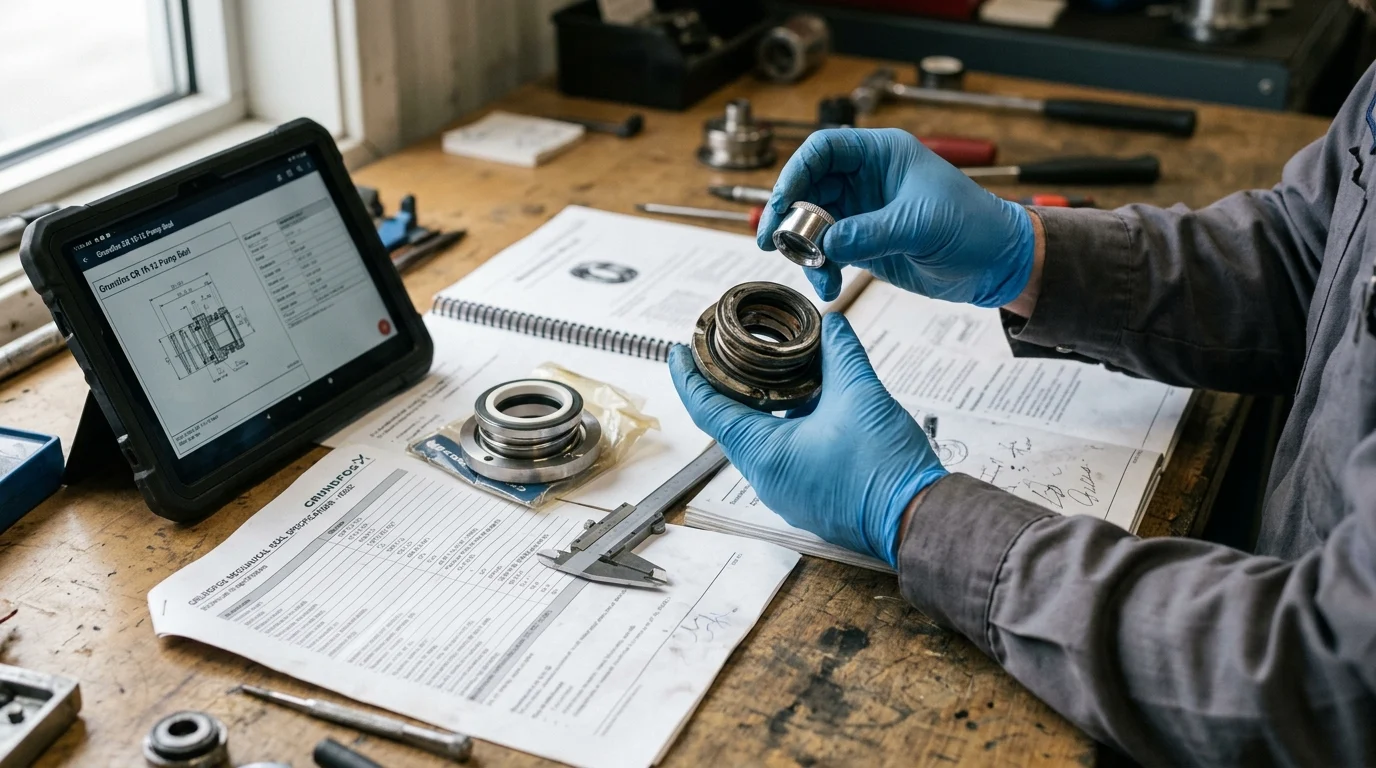
Proper diagnosis of a failed mechanical seal is critical; simply swapping a broken component without identifying the root cause guarantees a recurring failure. Maintenance professionals must conduct a thorough Root Cause Analysis (RCA) to understand whether the failure originated from systemic hydraulic issues, improper installation procedures, or chemical incompatibility.
How a Grundfos Mechanical Seal Works
Grundfos utilizes sophisticated cartridge and component seal designs to manage fluid containment under demanding industrial conditions. A mechanical seal functions by maintaining a microscopic fluid film—typically 1 to 3 microns thick—between a rotating face affixed to the shaft and a stationary face secured in the pump housing. This fluid film lubricates the faces while preventing bulk fluid leakage.
In Grundfos cartridge seals, the spring tension is pre-set at the factory to deliver an optimized face pressure of approximately 15 to 20 N/cm². This ensures the faces remain in contact regardless of hydraulic pressure fluctuations. The balanced seal design, commonly found in high-pressure Grundfos models, reduces the hydraulic closing forces acting on the seal faces, thereby lowering heat generation, reducing friction, and extending operational life.
Common Failure Modes
Mechanical seals fail through several distinct mechanisms, primarily driven by adverse system conditions rather than inherent manufacturing defects. Dry running is the most prevalent failure mode, occurring when the pump loses prime or air becomes trapped in the seal chamber. This leads to rapid frictional heating and thermal cracking of the seal faces within seconds. Chemical attack manifests as elastomer swelling or embrittlement, while abrasive wear is characterized by concentric grooving on the seal faces due to suspended solids.
| Failure Mode | Visual Symptom on Seal | Primary Root Cause |
|---|---|---|
| Thermal Shock (Dry Run) | Heat checking, radial cracks on ceramic/SiC faces | Loss of fluid film, inadequate venting |
| Chemical Attack | Swollen, sticky, or hardened O-rings | Incorrect elastomer for fluid pH/composition |
| Abrasive Wear | Deep concentric grooves on mating faces | Particulate matter > 50 ppm in pumped fluid |
| Mechanical Distortion | Uneven wear track on stationary face | Pipe strain, severe shaft misalignment |
Pump Model and Seal Code Verification
Accuracy in procurement relies entirely on deciphering the Grundfos nameplate and the specific seal type designation. The alphanumeric code stamped on the pump’s data plate (e.g., HQQE or HUUV) provides the exact specification of the factory-installed seal. Understanding this nomenclature is a mandatory skill for maintenance planners.
For example, in the specific seal configuration “HQQE”, the “H” indicates a balanced cartridge seal. The first “Q” denotes a Silicon Carbide (SiC) rotating face, the second “Q” denotes a Silicon Carbide stationary face, and “E” signifies EPDM elastomers. Misinterpreting this code can lead to catastrophic chemical incompatibility. Installing an EPDM seal in an application pumping mineral oils will cause the elastomers to swell aggressively, leading to complete seal failure shortly after startup.
Comparing Grundfos Mechanical Seal Options
Selecting the correct replacement mechanical seal requires balancing upfront procurement costs against long-term operational reliability. Maintenance teams must evaluate whether to utilize OEM components or compatible aftermarket alternatives, while closely scrutinizing the wear and friction characteristics of the seal face materials and the chemical resistance of the secondary elastomers.
OEM Kits vs Compatible Alternatives
The market offers both genuine Grundfos OEM seal kits and third-party compatible replacements. OEM kits offer guaranteed dimensional tolerances and ensure strict adherence to factory performance curves. These kits provide peace of mind for critical process applications.
Compatible aftermarket alternatives can reduce upfront procurement costs. However, facilities operating under strict regulatory frameworks (such as FDA food-grade or API standards) generally mandate OEM components to maintain compliance certificates and preserve the manufacturer’s warranty. For non-critical utility pumps, high-quality aftermarket seals from reputable manufacturers can provide acceptable reliability, provided dimensional accuracy is rigorously verified prior to installation.
Material Comparison: Carbon, Ceramic, and Silicon Carbide
The selection of face materials dictates the seal’s resistance to wear, heat, and chemical degradation. Carbon graphite provides excellent self-lubricating properties, making it forgiving during marginal lubrication events, but it is highly susceptible to abrasive wear. Aluminum oxide (Ceramic) is a cost-effective stationary face material suitable for clean water applications but is brittle and prone to thermal shock.
Silicon Carbide (SiC) is the industry standard for demanding applications, boasting a Vickers hardness of approximately 2500 HV, exceptional thermal conductivity, and broad chemical resistance. When pumping highly abrasive slurries, Tungsten Carbide is often paired with SiC to withstand extreme mechanical shear forces.
| Material Pair (Rot/Stat) | Max Temp (°C) | Hardness (Vickers) | Best Application Profile | Relative Cost Index |
|---|---|---|---|---|
| Carbon / Ceramic | 120°C | Carbon: ~100, Cer: ~1500 | Clean water, low pressure, light duty | 1.0x (Baseline) |
| Carbon / SiC | 120°C | Carbon: ~100, SiC: ~2500 | Boiler feed, low abrasive fluids | 1.5x |
| SiC / SiC (QQ) | 150°C+ | SiC: ~2500, SiC: ~2500 | High pressure, abrasive liquids | 2.5x |
| Tungsten Carbide / SiC | 150°C+ | TC: ~2200, SiC: ~2500 | Highly abrasive slurries, high torque | 3.5x |
Application-Specific Selection Factors
Beyond the primary faces, the secondary sealing elements (O-rings and bellows) must be perfectly matched to the application fluid. EPDM elastomers are optimal for hot water and low-pressure steam applications up to 120°C (standard) or 150°C (specialized), but they will degrade rapidly in the presence of hydrocarbons or mineral oils.
Conversely, FKM (Viton) is excellent for oils and solvents up to 90°C but suffers in hot water or steam environments. For aggressive chemical processing, FFKM (Kalrez) elastomers are required, despite pushing the seal kit cost up significantly. Maintenance engineers must also consider the Minimum Order Quantity (MOQ) and lead times for specialized elastomers, which can extend to several weeks compared to standard off-the-shelf EPDM variants.
Replacement Procedure and Commissioning Checks
The physical replacement of a mechanical seal demands strict adherence to precision maintenance protocols. Contamination, improper torque application, or failure to isolate the system correctly can instantly compromise the integrity of a newly installed seal, negating the investment in high-quality engineering materials.
Lockout, Isolation, and Preparation
Safety and system preparation are non-negotiable prerequisites. Maintenance personnel must execute strict Lockout/Tagout (LOTO) procedures on the pump motor and physically verify energy isolation before proceeding. Isolate the pump using suction and discharge valves. The volute must be completely drained and the system depressurized, with bleed valves opened to verify zero residual pressure.
Technicians must wear appropriate Personal Protective Equipment (PPE), including face shields and chemical-resistant or thermal gloves. In high-temperature applications, the casing must be allowed to cool below 40°C (104°F) to prevent thermal injury to personnel and avoid thermal shock to the new seal during installation. Proper disposal protocols for the drained fluid must be observed, particularly when handling hazardous chemicals or hydrocarbons with strict environmental compliance thresholds.
Disassembly and Seal Installation Workflow
Disassembly requires specialized tooling to prevent scoring the pump shaft or damaging the seal housing. Once the old seal is removed, the shaft must be meticulously cleaned and inspected for wear, fretting, or pitting. Shaft runout must be measured using a dial indicator; runout exceeding 0.05 mm (0.002 inches) will induce excessive radial movement, guaranteeing premature failure of the new seal.
When installing the replacement, O-rings must be lubricated with a chemically compatible medium—such as silicone grease or soapy water for EPDM—avoiding petroleum-based lubricants entirely. For Grundfos cartridge seals, the installation is streamlined, but the coupling screws must be tightened to the exact OEM torque specifications found in the specific pump’s service manual. This ensures symmetrical load distribution and prevents shaft distortion.
Leak Testing and Startup Verification
Post-installation, the system must undergo rigorous validation before returning to full operational service. The pump should be slowly flooded and vented to purge all trapped air from the seal chamber. Failing to vent the chamber properly is the leading cause of immediate dry-run conditions upon startup.
A static pressure test should be conducted by opening the suction valve and observing the seal gland for 15 minutes at standard static pressure. Upon motor engagement, maintenance teams must verify the correct direction of rotation and monitor the seal for initial break-in weepage. If leakage exceeds the acceptable break-in rate of 2 to 3 drops per minute or persists beyond 2 hours of continuous operation, the pump must be shut down immediately to investigate potential O-ring rolling or face contamination.
Final Selection and Maintenance Strategy
The conclusion of a seal replacement provides a critical juncture for maintenance teams to refine their asset management strategies. Rather than perpetually reacting to failures, organizations should leverage historical failure data to optimize seal selection, streamline inventory, and implement predictive maintenance practices that maximize equipment uptime.
Like-for-Like vs Upgraded Replacement
Automatically replacing a failed seal with a like-for-like component is often a missed opportunity for reliability engineering. If a standard HQQE (SiC/SiC/EPDM) seal consistently fails short of its expected operational life, an engineering upgrade is warranted. Upgrading to an HQQV (FKM elastomer) may resolve previously undiagnosed hydrocarbon contamination issues.
For fluids containing high concentrations of suspended solids (greater than 50 ppm), facilities should consider upgrading the pump configuration to accommodate an external flush plan, such as API Plan 11 or Plan 32. While upgrading materials or flush plans may increase the initial component cost, the resulting extension in reliability frequently justifies the investment.
Authorized Sourcing and Inventory Planning
Effective inventory planning mitigates the financial impact of unexpected seal failures. Partnering with authorized Grundfos distributors ensures access to genuine components and dedicated technical support, while significantly reducing the risk of counterfeit parts entering the supply chain.
Maintenance teams should utilize the Grundfos Product Center (GPC) to verify exact 96-series or 98-series part numbers based on the pump’s specific nameplate data, rather than relying on visual matching. For critical pumps, facilities should maintain dedicated, on-site spare seal kits to ensure zero supply chain latency during an emergency. For non-critical utility pumps, relying on local distributor inventory with standard lead times can reduce warehouse carrying costs.
Long-Term Reliability Practices
Sustaining mechanical seal reliability requires a shift toward proactive equipment monitoring. Implementing routine vibration analysis on bearing housings can detect the early stages of cavitation, bearing wear, or shaft misalignment before they translate into destructive forces at the mechanical seal faces.
Additionally, monitoring the temperature of the seal flush fluid provides real-time indicators of face friction and cooling efficiency. Systematically capturing and analyzing this performance data drives continuous improvement in the facility’s overall fluid handling infrastructure and extends the lifecycle of every installed pump.
Key Takeaways
- Confirm that leakage exceeds normal break-in weepage or continues beyond 24 hours before scheduling a Grundfos mechanical seal replacement.
- Check vibration levels before replacing the seal, because sustained vibration above ISO 10816-3 guidance can cause rapid repeat failures.
- Review pressure, temperature, fluid viscosity, and specific gravity to ensure the replacement seal can maintain a stable lubricating film.
- Investigate root causes such as misalignment, imbalance, cavitation, dry running, or chemical incompatibility before installing a new seal.
- Match seal face and elastomer materials to the actual operating conditions to reduce downtime and improve mean time between failures.
Frequently Asked Questions
How do I know a Grundfos mechanical seal needs replacement?
Replacement is justified when leakage exceeds normal break-in weepage, continues beyond 24 hours, or is accompanied by vibration, overheating, or visible seal face damage. Always confirm the root cause before installing a new seal.
Is minor leakage normal after installing a new mechanical seal?
Yes. A new seal may weep about 2 to 3 drops per minute during the initial break-in period as the faces lap together. Leakage that continues or increases after 24 hours should be investigated.
What operating data should maintenance teams check before replacement?
Review pump pressure, temperature, fluid viscosity, specific gravity, chemical compatibility, shaft condition, and vibration levels. These factors determine the correct seal material and help prevent repeat failures.
Why does vibration matter when replacing a Grundfos pump seal?
High vibration can damage seal faces, elastomers, and bearings. If vibration exceeds acceptable limits, replacing the seal alone may not solve the issue; alignment, imbalance, cavitation, or foundation problems should be corrected first.
Can Victor Seals supply replacement mechanical seals for industrial pumps?
Yes. Ningbo Victor Seals manufactures standard and OEM mechanical seals, pump shaft seals, cartridge seals, double seals, and replacement seal parts for many industrial pump applications.

Post time: Aug-24-2026