



Why Seal Selection Determines Pump Reliability
In industrial fluid handling, abrasive wastewater presents one of the most hostile environments for rotating equipment. The presence of suspended solids, corrosive chemicals, and fluctuating viscosities places immense mechanical stress on pump components. At the center of this vulnerability is the mechanical seal, a critical barrier that prevents hazardous or costly fluids from escaping the pump casing along the rotating shaft.
Selecting an appropriate seal is not merely a matter of preventing leaks; it is a primary determinant of overall pump reliability and operational uptime. In large-scale municipal or industrial wastewater treatment facilities, an unplanned pump failure due to seal degradation can incur downtime costs ranging from $5,000 to over $15,000 per hour. Consequently, seal selection serves as a strategic asset protection measure rather than a routine consumable purchase.
Define abrasive wastewater duty
Abrasive wastewater duty is characterized by fluid streams containing high concentrations of hard, suspended particulates that aggressively erode wetted pump components. Unlike clean water applications, abrasive wastewater often exhibits Total Suspended Solids (TSS) exceeding 500 mg/L, and in mining or heavy industrial effluents, this figure can surpass 50,000 mg/L (5% by weight).
The abrasiveness of the fluid is heavily influenced by the hardness of the entrained particles. For example, silica sand, a common contaminant in industrial wastewater, typically registers a 7 on the Mohs hardness scale. When these particles enter the microscopic gap between rotating and stationary seal faces, they act as a lapping compound. If the seal faces are manufactured from standard carbon or ceramic materials—which generally register between 2 and 5 on the Mohs scale—the silica will rapidly score and destroy the seal interface, leading to premature failure.
Identify risks of incorrect seal selection
Deploying an inadequate seal in abrasive environments triggers a cascading sequence of mechanical failures. The most immediate risk is rapid face wear, which compromises the fluid film essential for seal lubrication. Once the faces are scored, the seal will begin to leak, allowing corrosive wastewater to migrate along the pump shaft, potentially causing severe shaft fretting and bearing contamination.
From a quantitative perspective, incorrect selection can reduce the Mean Time Between Failures (MTBF) from a typical manufacturer target of 24 to 36 months down to less than 3 months, depending on the specific application and operating severity. Early warning indicators of impending failure include abnormal pump vibration, rising seal chamber temperatures, and unexplained drops in barrier fluid pressure. Monitoring these metrics helps operators validate their selection in service and catch degradation before catastrophic leaks occur. Beyond equipment damage, premature seal failure introduces severe regulatory risks, with unpermitted discharges of contaminated wastewater frequently triggering fines that exceed $25,000 per day.
Key Seal Designs to Compare
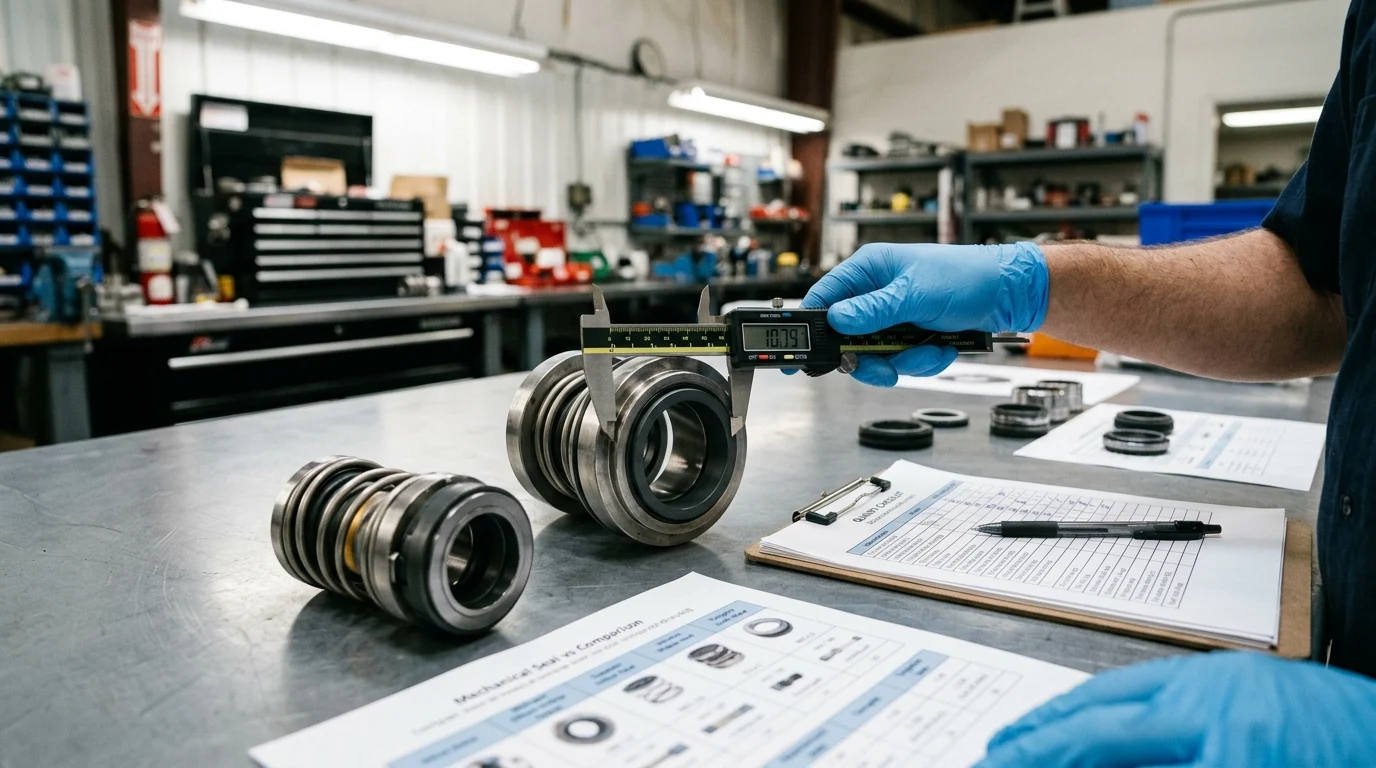
Navigating the complex landscape of mechanical seals requires a thorough understanding of available configurations and their respective tolerances for harsh environments. Manufacturers offer a spectrum of designs, ranging from basic component seals to highly engineered double cartridge systems, each tailored to specific operational thresholds.
Evaluating these designs requires looking at both mechanical architecture and material composition. The intersection of seal geometry and metallurgy ultimately dictates the component’s capacity to withstand the relentless abrasion inherent in wastewater processing.
Single, double, tandem, and cartridge seals
Single seals utilize one set of mating faces and rely on the pumped wastewater itself for lubrication. While economical, single seals are generally limited to applications where solids concentrations remain below 2% by weight, unless supported by an external clean water flush. If the fluid becomes too abrasive, the single face is left unprotected.
Double seals incorporate two sets of faces and utilize a clean barrier or buffer fluid between them. This design isolates the inner seal faces from the abrasive wastewater, extending operational life in environments with solids concentrations exceeding 5%. Tandem configurations arrange the seals in series to manage high pressures, while back-to-back configurations are highly effective for heavily contaminated slurries.
Cartridge seals represent a major advancement in installation reliability. Unlike component seals, which require precise manual measurement and setting of spring compression on the shaft, cartridge seals arrive pre-assembled and pre-set from the factory. Field studies suggest that utilizing cartridge seals reduces installation-related failures by up to 70%, as they eliminate the axial tolerance errors commonly introduced during field assembly.
Seal materials and face combinations
The selection of seal face materials is arguably the most critical variable when combating abrasion. Standard combinations like Carbon versus Ceramic are entirely unsuitable for abrasive wastewater. Instead, ultra-hard face combinations, predominantly Silicon Carbide (SiC) or Tungsten Carbide (TC), are standard requirements.
Silicon Carbide offers exceptional hardness, typically measuring around 2,800 on the Vickers hardness scale (HV), making it highly resistant to wear from abrasive particles. However, SiC is relatively brittle. In applications where the pump is subjected to heavy mechanical shock or vibration, Tungsten Carbide—which is slightly softer at approximately 1,500 HV but significantly tougher—may be the preferred choice for the stationary face.
Secondary sealing elements, such as O-rings and elastomers, must also match the chemical and thermal profile of the wastewater. Fluoroelastomers like FKM (Viton) are standard for general industrial wastewater up to 200°C, whereas perfluoroelastomers like FFKM (Kalrez) are necessary if the stream contains aggressive solvents or operates near 300°C.
Seal comparison criteria
Comparing configurations requires balancing initial capital expenditure against long-term operational resilience. The table below outlines the primary criteria used to benchmark different models for abrasive service.
| Seal Configuration | Max Solids Tolerance | Typical MTBF (Wastewater) | Relative Cost Multiplier | API Flush Plan Requirement |
|---|---|---|---|---|
| Single Component | < 2% | 6 – 12 Months | 1.0x | Plan 11 or 32 |
| Single Cartridge | Up to 5% | 12 – 24 Months | 1.8x | Plan 32 |
| Double Cartridge | > 5% (up to 40%) | 36+ Months | 3.5x | Plan 53A or 54 |
While a double cartridge seal requires a higher initial investment than a basic single component seal, its ability to tolerate extreme solids concentrations and extend MTBF makes it a highly reliable choice for severe abrasive applications.
Operating Conditions That Shape Seal Choice
A seal cannot be selected in a vacuum; it must be engineered to survive the exact hydraulic and thermodynamic conditions of the specific pumping application. The physical properties of the wastewater dictate the mechanical loads placed on the faces, springs, and elastomers.
A comprehensive audit of the operating environment is essential, mapping out variables such as particulate density, system pressure, thermal extremes, and the availability of external utilities. These parameters form the technical boundary conditions that shape the final specification.
Solids load, particle size, and slurry density
The density and size of the suspended particles directly impact the torque and wear rates experienced by the seal. Abrasive wastewater slurries frequently possess a Specific Gravity (SG) ranging from 1.1 to 1.4, which significantly increases the power required to rotate the shaft and generates higher friction at the seal faces.
Particle size distribution is equally critical. Fine silts measuring between 10 and 50 microns can easily penetrate the microscopic fluid film between seal faces (which is typically only 1 to 3 microns thick), causing severe three-body abrasion. Conversely, larger solids (exceeding 500 microns) pose a risk of clogging dynamic components. In high-solids applications, isolating the dynamic elements from the fluid is critical. This is typically achieved using either stationary coil springs (located outside the fluid path) or stationary metal bellows, both of which prevent particulate packing from restricting axial movement.
Pressure, temperature, and dry-run risk
Stuffing box pressure determines the closing forces applied to the seal faces. In multistage wastewater pumps or deep-well applications, stuffing box pressures can exceed 300 psi (20 bar). Unbalanced seals will generate excessive heat under these loads, causing the fluid film to vaporize. Therefore, hydraulically balanced seals—which reduce the face closing area to minimize heat generation—are required when pressures exceed 75 psi.
Temperature spikes and dry-run risks are the nemesis of mechanical seals. If a wastewater pump loses prime or experiences a suction blockage, the seal will run dry. Standard Silicon Carbide faces can catastrophically shatter from thermal shock in under 60 seconds of dry running. If dry-run conditions are a known risk, diamond-coated SiC faces are often specified, as they drastically reduce the coefficient of friction and can survive prolonged periods without fluid lubrication.
Flush plans, barrier fluids, and quench systems
To guarantee survival, the immediate environment within the stuffing box must be controlled via standardized piping plans, governed by API 682 standards. For single seals in abrasive service, an API Plan 32 is common, injecting a continuous stream of clean external water into the stuffing box at a pressure 15 to 30 psi higher than the pump pressure to keep abrasives away from the faces.
For double seals, barrier fluid systems such as API Plan 53A or Plan 54 are utilized. Plan 53A utilizes a pressurized reservoir to circulate a clean barrier fluid between the inner and outer seals. Maintained at roughly 10% higher pressure than the wastewater, the barrier fluid ensures that any leakage across the inner faces results in clean fluid flowing into the pump, rather than abrasive wastewater entering the seal cavity. Typical flow rates for these cooling and lubrication loops range from 1 to 2 GPM per inch of shaft diameter.
How Procurement Teams Verify the Right Seal
Once the technical parameters are defined, supply chain and procurement processes play a vital role in verifying that the sourced model aligns perfectly with both the physical pump architecture and broader corporate reliability goals. Bridging the gap between engineering specifications and execution requires rigorous documentation and vendor evaluation.
Evaluating seals based on compliance, dimensional accuracy, and the total cost of ownership is far more effective than looking solely at initial capital expenditure. Purchasing a non-compliant or dimensionally incorrect seal invariably leads to delayed installations and compromised plant safety.
Required pump and process data
Exact dimensional and operational data must be provided to the manufacturer. Critical pump data includes the shaft rotational speed (e.g., 1,750 RPM vs. 3,600 RPM), exact shaft diameter (which commonly ranges from 1.500 inches to over 4.000 inches in heavy wastewater pumps), and the dimensions of the stuffing box or seal chamber.
Furthermore, mechanical tolerances must be verified. The pump shaft must exhibit minimal deflection, with radial runout strictly kept below 0.002 inches (0.05 mm) and axial end play limited to similar margins. Providing this baseline data ensures the final cartridge is machined with the correct clearances to accommodate dynamic shaft movement without shattering brittle SiC faces.
Supplier drawings and standards compliance
High-quality procurement requires stringent verification of supplier documentation and manufacturing standards. Seals intended for heavy industrial wastewater should comply with ISO 21049 or API 682 (Category 1, 2, or 3, depending on severity). Material Test Reports (MTRs) verify the metallurgy of the seal glands and sleeves, ensuring components are genuinely cast or machined from 316 Stainless Steel, Duplex stainless, or Titanium.
Quality assurance documentation should also include surface flatness certifications. For optimal sealing, the lapped faces must be exceptionally flat, typically measured using optical flats and monochromatic helium light. Manufacturers generally guarantee face flatness to within 2 to 3 light bands (approximately 0.000023 to 0.000035 inches), ensuring a perfect mating surface prior to installation.
Lifecycle cost beyond purchase price
A critical function of the procurement process is shifting the purchasing paradigm from initial price to Lifecycle Cost (LCC). The upfront purchase price of a mechanical seal typically represents only 10% to 15% of its total cost over a five-year operational lifecycle. The hidden costs lie in installation labor, barrier fluid consumption, energy losses due to face friction, and unplanned downtime.
| Cost Category | Low-Cost Single Seal (5-Year) | Engineered Double Cartridge (5-Year) |
|---|---|---|
| Initial Procurement | $850 | $3,400 |
| Installation Labor | $1,500 (Requires 3 replacements) | $500 (Single installation) |
| Unplanned Downtime | $45,000 (Based on $15k/event) | $3,000 (Occasional maintenance) |
| Barrier Fluid/Flush Water | $8,500 (Continuous Plan 32 flush) | $1,400 (Closed loop Plan 53A) |
| Total Lifecycle Cost | $55,850 | $8,300 |
Note: These figures represent a generalized baseline. Real-world Total Cost of Ownership (TCO) analyses require sensitivity ranges to account for regional labor rates, varying fluid costs, and the reality that even premium seals occasionally experience wear-related failures.
As illustrated, a low-cost seal that requires continuous clean water flushing and suffers frequent failures will cost an operation significantly more over a five-year period than a properly specified, premium double cartridge seal.
Final Decision Framework for Engineers
Synthesizing hydraulic data, material science, and economic analysis culminates in the final decision framework. A methodical approach helps narrow down the myriad of available models to the single most effective solution for a specific abrasive wastewater application.
By following a structured selection process, reliability teams can confidently specify configurations that guarantee long-term operational security and maximize pump availability.
Step-by-step seal selection process
To streamline the decision, the final selection should follow a structured technical checklist:
- Characterize the fluid: Document the maximum TSS percentage, particle hardness, pH level, and specific gravity.
- Determine dynamic loads: Map the dynamic stuffing box pressure and maximum operating temperature to establish whether hydraulic balancing and specialized elastomers are required.
- Assess utility capabilities: Match the site’s water and cooling availability to the appropriate API environmental control plan. If abundant clean water is available, a Plan 32 flush with a single seal might be viable; if water conservation is a priority, a closed-loop Plan 53A with a double seal is generally required.
- Select metallurgy and geometry: Default to SiC/SiC faces with stationary springs or stationary metal bellows for abrasive services to prevent particulate clogging.
Warning signs of unsuitable low-cost seals
Identifying the warning signs of unsuitable, low-cost seals is crucial when evaluating aggressive cost-cutting proposals. A primary red flag is the use of stamped metal components rather than heavily machined 316SS or Duplex steel glands. Stamped components lack the rigidity required to maintain face alignment under high-pressure wastewater surges.
Another critical warning sign is the exposure of dynamic coil springs directly to the pumped fluid. In abrasive wastewater with solids exceeding 1%, exposed springs will quickly pack with sludge, restricting the seal face’s ability to track shaft movement, leading to immediate leakage. High-quality seals for this duty feature isolated springs or stationary bellows designs that keep the dynamic elements completely shielded from the abrasive slurry.
How to justify the final seal model
Justifying the selection to plant management requires translating technical specifications into clear economic Return on Investment (ROI). Presenting MTBF data demonstrates how extending seal life from 6 months to an expected 36 months eliminates multiple repair cycles, saving significantly in direct maintenance labor and replacement parts alone.
Furthermore, leveraging vendor guarantees helps solidify the justification. Reputable manufacturers confident in their engineered solutions often provide 12-month to 24-month operational warranties when their seals are paired with the correct API flush plans. By presenting a comprehensive business case that highlights guaranteed uptime, mitigated environmental risks, and drastically reduced lifecycle costs, teams can easily justify the procurement of an optimized sealing solution for any abrasive wastewater pump.
Key Takeaways
- Match the seal model to the wastewater’s suspended solids level, because abrasive duty can range from over 500 mg/L TSS to more than 50,000 mg/L in heavy industrial streams.
- Select seal face materials harder than the entrained particles, especially where silica sand with a Mohs hardness of about 7 is present.
- Use double or cartridge seal designs for highly abrasive, corrosive, toxic, or regulated wastewater applications where leakage carries high operational or compliance risk.
- Monitor vibration, seal chamber temperature, leakage, and barrier fluid pressure to identify seal degradation before it causes shaft damage or bearing contamination.
- Treat seal selection as a reliability decision, because improper selection can cut MTBF from 24–36 months to less than 3 months in severe service.
Frequently Asked Questions
Why does abrasive wastewater require a different seal model?
Abrasive wastewater contains suspended solids that can enter the seal interface and score the faces. Hard particles such as silica sand can quickly damage standard carbon or ceramic faces, causing leakage, heat buildup, and shortened pump life.
What seal face materials are best for abrasive wastewater pumps?
Hard face combinations such as silicon carbide versus silicon carbide are commonly preferred because they resist scoring from abrasive solids better than softer materials. The final choice should also consider corrosion, temperature, speed, and lubrication conditions.
When should a double mechanical seal be used?
A double mechanical seal is recommended when the fluid is highly abrasive, toxic, corrosive, or environmentally regulated. A barrier or buffer fluid helps isolate the seal faces from solids and can reduce the risk of leakage into the environment.
How can operators detect early seal failure?
Common warning signs include abnormal vibration, rising seal chamber temperature, visible leakage, reduced barrier fluid pressure, and frequent bearing contamination. Tracking these indicators helps confirm whether the selected seal model is performing correctly.
How much can incorrect seal selection affect pump reliability?
In severe abrasive service, the wrong seal can reduce mean time between failures from a typical 24–36 months to less than 3 months, increasing downtime, repair costs, and regulatory exposure.

Post time: Sep-04-2026