


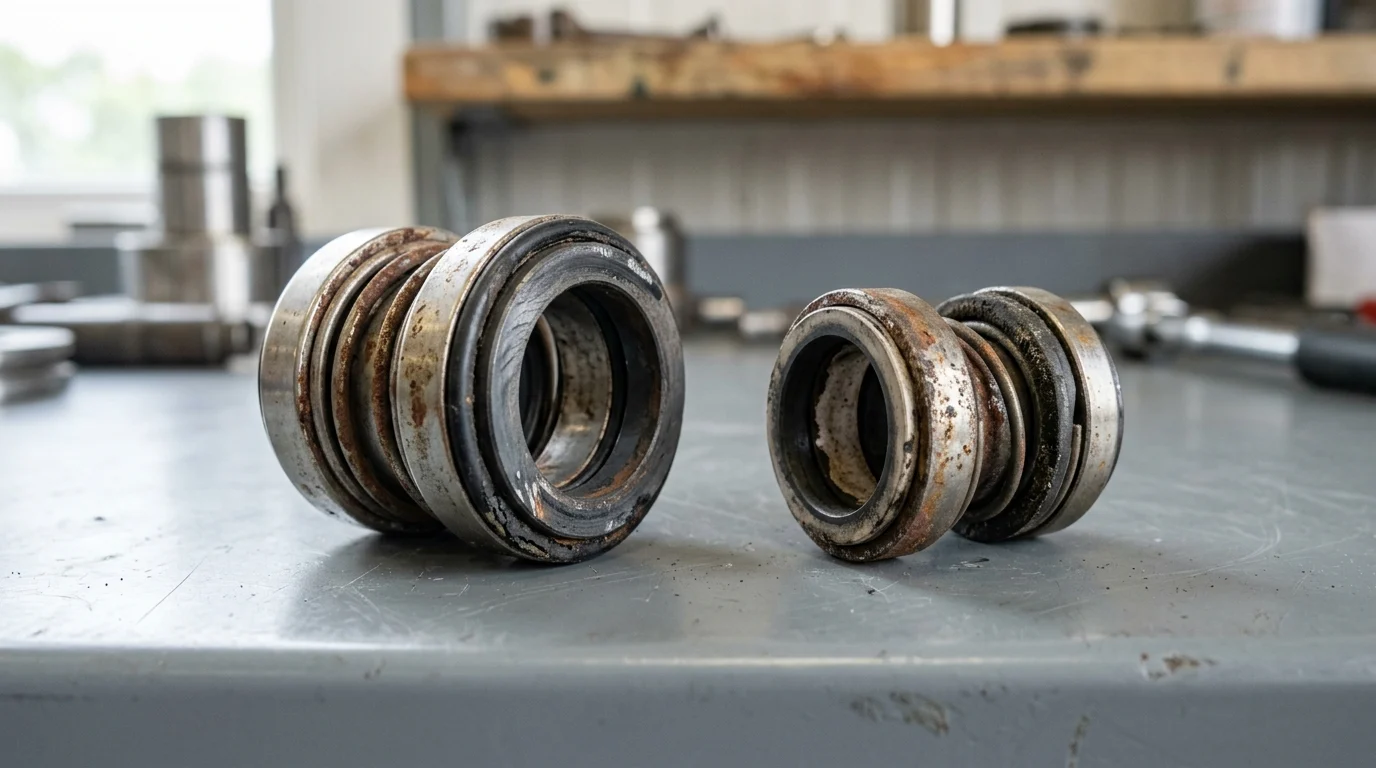
Why Low-Quality Mechanical Seals Create Procurement Risk
Mechanical seals serve as the primary containment barrier in rotating equipment, making their procurement a high-stakes endeavor. Although these components typically account for less than 2% of a pump system’s initial capital expenditure, their operational footprint is massive. Relying solely on the initial purchase price frequently introduces severe operational vulnerabilities.
Procurement professionals must recognize that low-quality seals directly compromise plant safety, environmental compliance, and continuous production. Understanding the exact mechanisms of these risks is the first step in building a resilient sourcing strategy.
How Procurement Teams Should Define Low Quality
Defining “low quality” requires moving beyond superficial visual inspections to focus on metallurgical and physical deviations. In a rigorous procurement framework, low quality is characterized by non-compliance with recognized industry standards such as API 682 or ISO 21049. It manifests as inconsistent grain structures in silicon carbide faces, inadequate curing of elastomeric O-rings, or reliance on substandard binder materials in tungsten carbide.
For instance, a high-quality seal face is engineered to maintain a fluid film of roughly 1 to 3 micrometers. Low-quality alternatives often lack the micro-topography necessary to sustain this film, leading to dry running and rapid degradation. Furthermore, low-quality seals frequently exhibit unacceptable static leakage rates, failing to meet the stringent threshold of less than 5.0 mL/hr during bench testing.
Which Failure Modes Increase Cost and Downtime
The financial impact of substandard seals is realized through catastrophic failure modes that abruptly halt production. Thermal cracking occurs when uneven face topography generates excessive frictional heat, causing localized expansion and immediate fracturing of the seal face. Blistering is another common failure mode in low-quality carbon-graphite faces, where trapped hydrocarbons expand under the surface and destroy the precision-lapped finish.
When these failure modes occur, the resulting downtime is highly expensive. In a continuous petrochemical refining process, a single unplanned pump outage triggered by a substandard $500 mechanical seal can easily result in $50,000 to $150,000 per day in lost production revenue. This figure does not even account for the premium labor costs associated with emergency maintenance or potential environmental fines for hazardous fluid leaks.
Technical Specifications That Help Buyers Identify Seal Quality
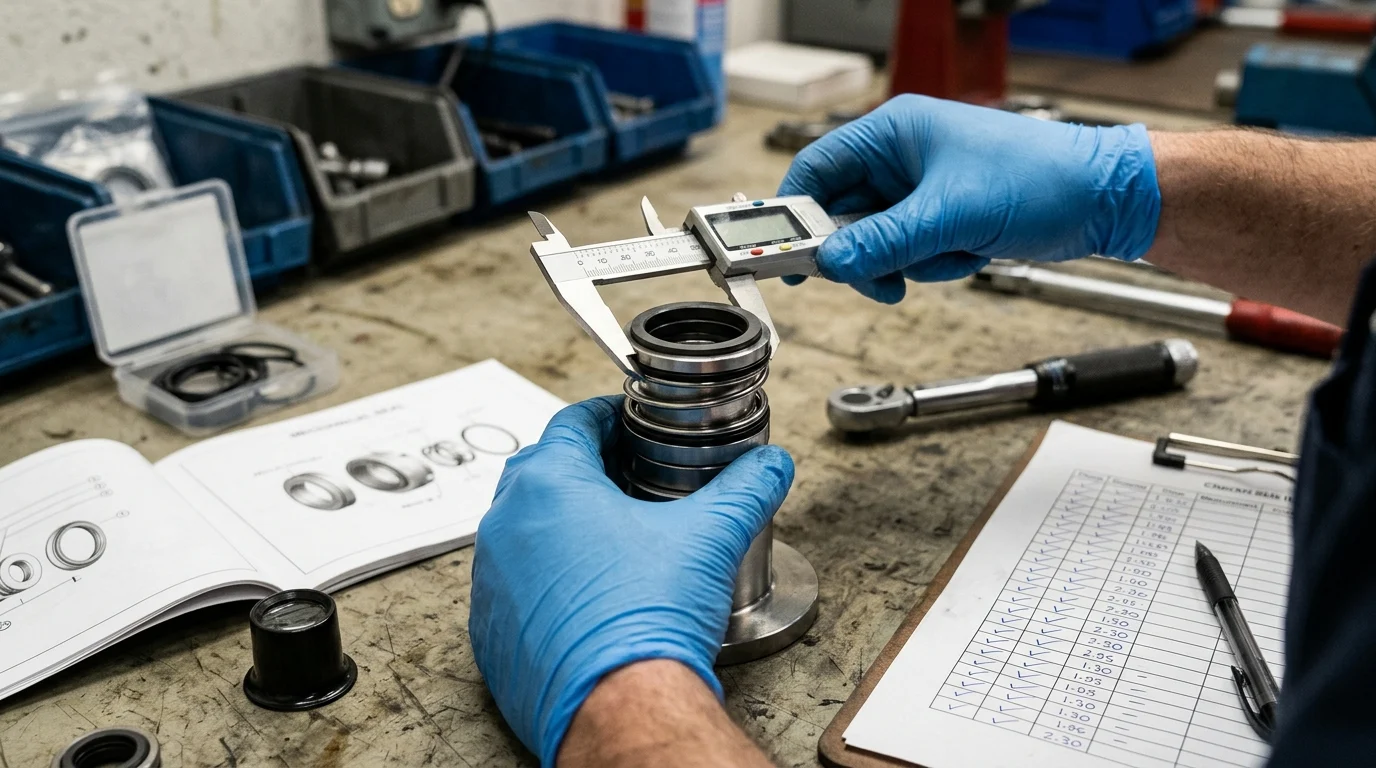
To effectively filter out inferior products, procurement teams must elevate their technical evaluation criteria. Purchasing mechanical seals strictly by generic part numbers or legacy catalog codes strips away the buyer’s ability to verify the underlying engineering.
Buyers must demand comprehensive technical datasheets that specify exact material grades, dimensional tolerances, and operational limits. These specifications form the contractual baseline for quality.
How to Review Materials, Face Combinations, and Elastomers
The core of any mechanical seal lies in its primary face materials and secondary sealing elastomers. Procurement must scrutinize the exact grade of silicon carbide (SiC) being offered. Reaction-bonded SiC contains free silicon, making it susceptible to chemical attack in caustic environments, whereas sintered alpha SiC provides superior chemical resistance. Similarly, tungsten carbide must be specified by its binder; nickel-bound tungsten carbide is required for corrosive applications, whereas cheaper cobalt-bound variants will rapidly leach and fail.
Elastomer selection is equally critical and highly temperature-dependent. Buyers must ensure that standard FKM (fluoroelastomer) is strictly limited to applications below 200°C, while demanding FFKM (perfluoroelastomer) for aggressive chemicals and temperatures up to 327°C. Substituting FFKM with lower-grade elastomers is a common cost-cutting tactic that leads to rapid O-ring embrittlement and extrusion.
Which Dimensional Tolerances and Surface Finishes Matter
Precision engineering separates premium seals from inadequate imitations. The flatness of the mating seal faces is the most critical dimensional metric. Procurement specifications should mandate that faces are lapped to a flatness of 1 to 2 helium light bands, which equates to an allowable deviation of just 0.3 to 0.6 micrometers. If a supplier cannot guarantee or measure this tolerance, their product will invariably leak.
Additionally, the surface finish (Ra) of the shaft or sleeve where the dynamic O-ring slides must be tightly controlled. An optimal Ra value of 0.2 to 0.4 µm ensures the elastomer can slide to compensate for face wear without being shredded by a rough surface or sticking to a surface that is too smooth. Dynamic runout tolerances must also be specified and strictly limited to less than 0.05 mm to prevent the seal from opening during high-speed rotation.
How to Compare Approved and Unapproved Seal Options
Comparing approved original equipment manufacturer (OEM) seals against unapproved or third-party alternatives requires a structured, data-driven approach. Buyers should utilize a standardized matrix to evaluate whether an unapproved option genuinely meets the technical baseline.
| Evaluation Criteria | Approved Premium Seal | Unapproved / Low-Quality Seal |
|---|---|---|
| Face Flatness | 1–2 Helium light bands (0.3–0.6 µm) | > 3 light bands (inconsistent film) |
| Material Traceability | EN 10204 Type 3.1 certification standard | Batch certificates only (no heat numbers) |
| Dynamic Runout Limit | < 0.05 mm | Often > 0.10 mm (causes vibration) |
| Elastomer Curing | Post-cured, vacuum processed | Standard mold cure (high compression set) |
This comparative framework allows procurement to objectively demonstrate to engineering stakeholders why an exceptionally low bid carries unacceptable technical risk.
Supplier Qualification and Documentation Controls
Technical specifications hold little value if the chosen supplier lacks the manufacturing infrastructure to execute them consistently. Relying on a vendor’s self-reported capabilities is a frequent point of failure in the sourcing lifecycle.
Robust supplier qualification protocols and stringent documentation requirements are the operational safeguards that prevent low-quality mechanical seals from entering the supply chain.
Which Supplier Audit Criteria Reveal Manufacturing Capability
A comprehensive supplier audit must evaluate specific manufacturing and metrology capabilities rather than simply verifying the existence of an ISO 9001 manual. Auditors should specifically look for climate-controlled lapping rooms, as temperature fluctuations during the lapping process can warp the seal faces.
The presence of monochromatic light sources and optical flats for measuring face flatness is non-negotiable. If a supplier relies solely on coordinate measuring machines (CMM) without optical metrology, they cannot verify seal face tolerances. Furthermore, CNC machining centers must demonstrate the capability to hold tolerances of ±0.005 mm on critical gland and sleeve dimensions. A high scrap rate or the absence of statistical process control (SPC) data on the shop floor are immediate red flags indicating unstable manufacturing processes.
What Certificates, Traceability Records, and Test Reports to Request
Traceability is the ultimate proof of quality in mechanical seal procurement. Buyers must mandate the submission of Material Test Reports (MTRs) according to EN 10204 Type 3.1, which provide the exact chemical composition and mechanical properties of the metals used in the seal cartridge.
For critical applications, procurement should also request hydrostatic pressure test reports. A standard quality control benchmark requires the assembled seal cartridge to be statically tested at 1.5 times its maximum allowable working pressure (MAWP) for a minimum of 15 minutes, with a strict requirement of zero pressure drop. Additionally, traceability records should link the batch number of the elastomers to their specific cure dates, ensuring no expired O-rings are built into the assembly.
How to Use Samples and First-Article Inspection
Before awarding a high-volume contract or transitioning to a new supplier, procurement must execute a First-Article Inspection (FAI) protocol. The FAI requires the supplier to produce a sample seal using the exact production methods and materials intended for the final order.
Buyers should subject this sample to independent metallurgical verification, such as positive material identification (PMI) via X-ray fluorescence, to confirm alloy grades. Dimensional checks should be performed against the approved drawings. For batch orders, establishing an Acceptable Quality Limit (AQL) is crucial; implementing an AQL of 0.65 for critical sealing dimensions ensures that the statistical probability of accepting defective components remains exceedingly low. Only after the FAI is fully approved should full-scale production be authorized.
Procurement Process Controls That Prevent Poor-Quality Purchases
The transactional phase of procurement is where tightly defined specifications often unravel due to administrative oversights or poor logistical handling.
Implementing rigid controls throughout the RFQ, ordering, and receiving phases is essential to maintain the integrity of the purchased mechanical seals and prevent unauthorized substitutions.
How to Align RFQs, Technical Datasheets, and Purchase Orders
The Request for Quotation (RFQ) must be engineered to leave no room for supplier assumptions. It must explicitly detail the operating environment, including fluid type, specific gravity, vapor pressure, operating temperature, and shaft speed. Providing incomplete data forces suppliers to guess, often resulting in the quotation of a standard, lower-tier seal that will fail in a volatile application.
When the Purchase Order (PO) is generated, it must hard-code the exact Bill of Materials (BOM) revision number, the approved general arrangement (GA) drawing, and the required test procedures. Furthermore, PO terms should explicitly prohibit any material substitution without prior written authorization from the buyer’s engineering department. This closes a common loophole used by lower-tier vendors to inject cheap materials post-award.
Which Incoming Inspection Steps Check Packaging and Marking
Mechanical seals are highly engineered, fragile components that require specialized incoming inspection protocols. Standard warehouse receiving checks are insufficient. Inspectors must first verify the integrity of the packaging; seals should arrive in vacuum-sealed, moisture-barrier bags suspended in custom-molded foam inserts.
A seal dropped from a height of merely 10 centimeters can sustain micro-fractures in its silicon carbide faces that are invisible to the naked eye but will cause catastrophic failure upon startup. Inspectors must also verify that all components, particularly the gland plate, feature permanent laser marking that includes the part number, BOM revision, and unique batch traceability code. Any shipment lacking these markings or showing signs of inadequate packaging should be immediately quarantined.
How to Control Logistics and Storage Conditions
The lifespan of a mechanical seal can be severely compromised before it is ever installed if logistics and storage conditions are not strictly controlled. Elastomers are highly susceptible to environmental degradation.
Procurement must enforce storage protocols aligned with ISO 2230 guidelines, which dictate the shelf life of elastomeric components. For example, nitrile (NBR) has a maximum shelf life of 5 years, while fluoroelastomers (FKM) can be stored for up to 10 years, provided conditions are optimal. Warehousing controls must mandate that seals are stored in a climate-controlled environment maintained below 25°C, strictly shielded from direct ultraviolet (UV) light, and kept isolated from ozone-generating equipment such as electric motors or high-voltage switchgear, which will rapidly degrade secondary seals.
How Buyers Should Make the Final Supplier Decision
The culmination of the procurement process is the final supplier award. Making this decision requires a sophisticated synthesis of technical compliance, commercial viability, and operational risk.
Buyers must resist the pressure to award contracts based solely on the lowest initial capital outlay, as this artificially inflates long-term operational costs.
Which Total Cost of Ownership Factors to Weigh
Total Cost of Ownership (TCO) is the only valid metric for evaluating mechanical seal investments. A comprehensive TCO model incorporates the initial purchase price, the cost of installation, inventory holding costs, and the statistical cost of failure over the equipment’s lifecycle.
| Cost Component | High-Quality Seal (Premium OEM) | Low-Quality Seal (Budget Tier) |
|---|---|---|
| Initial Purchase Price | $2,500 | $1,200 |
| Mean Time Between Failures (MTBF) | 48 Months | 14 Months |
| Maintenance Replacements (over 4 yrs) | $0 (No replacements needed) | $3,600 (3 replacements) |
| Estimated Downtime Cost (over 4 yrs) | $0 | $45,000 (3 unplanned outages) |
| Total 4-Year TCO | $2,500 | $49,800 |
By framing the decision through a lifecycle lens, procurement can easily justify a higher upfront investment, proving that low-quality seals are a massive financial liability disguised as a discount.
How to Balance Price, Lead Time, Quality, and Risk
Balancing competing procurement priorities requires establishing clear thresholds for acceptability. A 40% reduction in purchase price is mathematically invalidated if the Mean Time Between Failures (MTBF) drops from an acceptable 36 months to a disruptive 12 months.
Lead time is also a critical indicator of quality and capability. The industry standard lead time for engineered, API-compliant mechanical seals ranges from 8 to 12 weeks, allowing for proper machining, lapping, and hydrostatic testing. If a supplier quotes a highly complex, customized seal with a suspicious 2-week lead time, procurement should recognize this as a high-risk indicator that the supplier is likely mismatching off-the-shelf components rather than engineering a proper solution.
When Procurement Should Reject or Escalate a Supplier
Procurement teams must establish rigid escalation and rejection protocols to protect the supply chain. A supplier should face immediate commercial rejection if they refuse or fail to provide authentic EN 10204 Type 3.1 material certificates, as this indicates a fundamental lack of supply chain control.
Similarly, if historical data shows a supplier has engaged in unauthorized material substitution—such as swapping FFKM for standard FKM to improve their margin—they must be escalated for immediate removal from the approved vendor list (AVL). Furthermore, if incoming inspection or test bench data reveals a failure rate exceeding a strict threshold of 2%, procurement must halt all active orders and initiate a formal root cause analysis before any further commercial engagement is permitted.
Key Takeaways
- Define seal quality through measurable criteria such as API 682 or ISO 21049 compliance, material grades, tolerances, and leakage performance rather than visual inspection alone.
- Require suppliers to disclose exact face materials and elastomers, because reaction-bonded silicon carbide and sintered alpha silicon carbide behave differently in chemically aggressive services.
- Treat low-cost seals as a lifecycle risk, since a substandard $500 seal can contribute to daily production losses of $50,000 to $150,000 in continuous processing environments.
- Use technical datasheets, drawings, test reports, and material certificates as procurement gatekeeping documents before approving any mechanical seal supplier.
- Evaluate mechanical seals by application conditions, including pressure, temperature, fluid chemistry, shaft speed, and pump design, not merely by generic part number or catalog code.
Frequently Asked Questions
Why are low-quality mechanical seals a procurement risk?
They can cause leakage, premature pump failure, safety incidents, environmental non-compliance, and unplanned downtime. Even if a seal is a small part of pump cost, failure can create major production losses.
What standards should buyers reference when evaluating mechanical seals?
Procurement teams should reference recognized standards such as API 682 and ISO 21049 where applicable, along with project-specific requirements for materials, leakage limits, operating pressure, temperature, and shaft speed.
How can buyers identify poor seal face quality?
Look for missing material grades, vague face descriptions, weak lapping quality, inconsistent surface finish, and no bench-test evidence. Quality seal faces should support stable lubrication film and meet defined leakage limits.
Why should procurement avoid buying only by the lowest price?
The lowest unit price may hide inferior silicon carbide, elastomers, springs, or machining tolerances. A cheap seal can trigger pump shutdowns, emergency labor, replacement costs, and lost production far exceeding the purchase saving.
What documents should suppliers provide before approval?
Ask for technical datasheets, material specifications, dimensional drawings, operating limits, test reports, quality certificates, and compatibility information for the pumped fluid and equipment model.

Post time: Aug-28-2026