


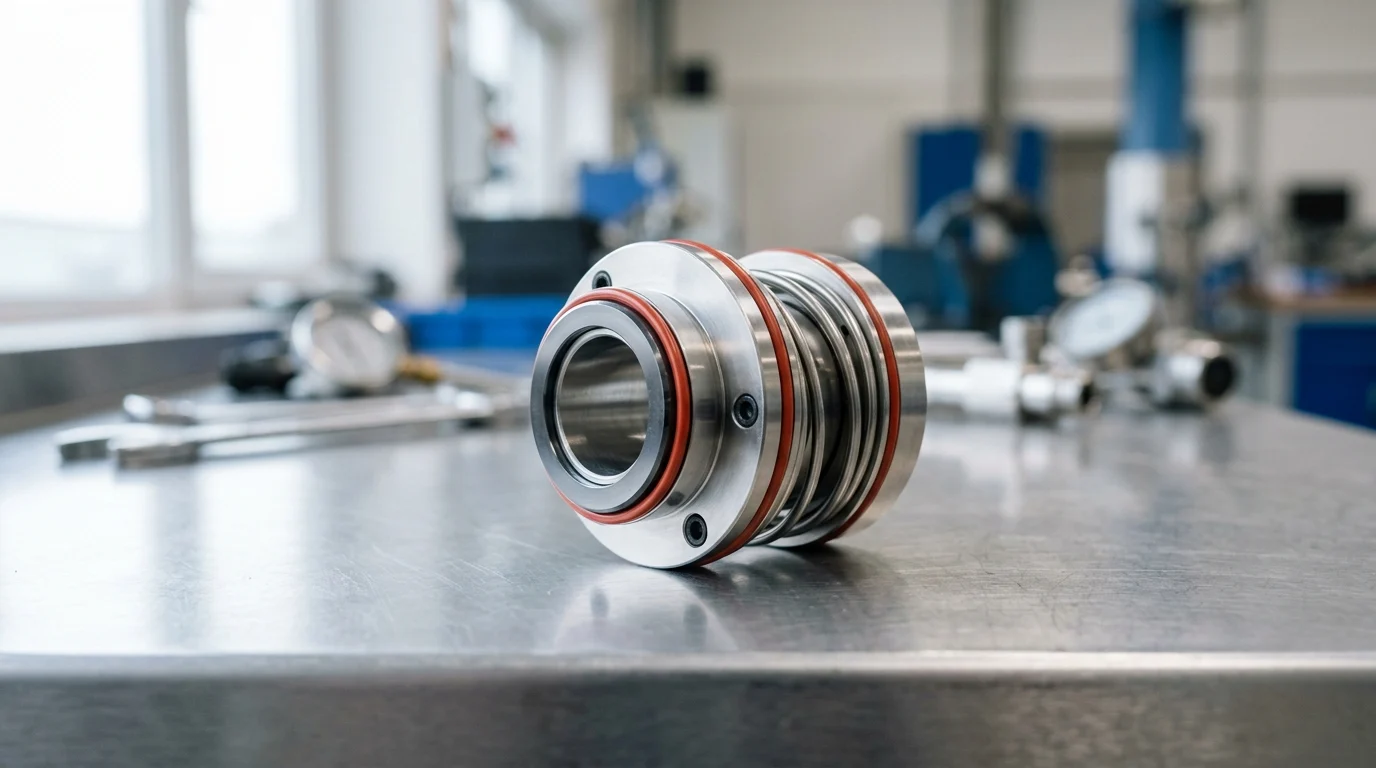
Why a Global Mechanical Seal Replacement Guide Matters
Mechanical seals represent a disproportionate share of rotating equipment maintenance budgets and operational liabilities across process industries. In sectors such as petrochemical refining, power generation, and pharmaceutical manufacturing, centrifugal pump failures account for approximately 70% of rotating equipment downtime, with mechanical seal failures driving up to 40% of those incidents. Procuring the correct replacement seal on a global scale is not merely a purchasing function; it is a critical engineering intervention that directly impacts plant availability and safety.
Establishing a rigorous global replacement strategy ensures that facilities transcend reactive maintenance. When engineers rely exclusively on localized, ad-hoc purchasing, they expose their operations to extreme variability in component quality, inconsistent mean time between failure (MTBF), and highly volatile lead times. A structured replacement framework harmonizes technical specifications with global supply chain realities, enabling multinational operations to standardize components, reduce spare parts inventory holding costs, and systematically engineer out chronic failure modes.
How to Define Replacement Requirements
Defining the requirements for a replacement mechanical seal begins with baselining the current operational envelope against the original equipment manufacturer (OEM) design specifications. Engineers must evaluate the fluid phase, specific gravity, viscosity, and vapor pressure margin at the seal face. Deviations from the original process conditions—such as a temperature increase of just 15°C or a 10% increase in suspended solids—can drastically alter the lubrication regime between the seal faces, transitioning the system from fluid film lubrication to boundary lubrication and accelerating wear.
Furthermore, establishing a target MTBF is essential. For API 682 standard applications in the oil and gas sector, a minimum continuous operating life of 25,000 hours (approximately 36 months) is the baseline expectation without requiring replacement. If the incumbent seal consistently fails before reaching this threshold, the replacement requirement must shift from a direct ‘like-for-like’ part swap to an engineered upgrade, potentially necessitating a change from a single to a dual seal configuration or the integration of an active seal support system (e.g., API Plan 53B or 54).
Key Commercial and Operational Risks
The procurement of replacement mechanical seals carries substantial commercial and operational risks, primarily centered around unplanned downtime. In high-output continuous process facilities, the cost of deferred production due to a critical pump failure can easily range from $10,000 to $50,000 per hour. Consequently, extending lead times for specialized replacement seals—which can stretch from 8 to 16 weeks for exotic metallurgy or custom cartridge designs—poses a severe operational threat if proper inventory buffers are not maintained.
Another critical risk in the global market is the proliferation of counterfeit or substandard aftermarket components. Seals manufactured with inferior elastomers or poorly lapped faces (exceeding the standard flatness tolerance of 2 to 3 helium light bands) will suffer premature leakage. Utilizing unqualified suppliers operating outside rigorous quality management systems introduces the risk of catastrophic loss of containment, which carries secondary liabilities including environmental fines, hazardous material exposure, and secondary equipment damage.
Mechanical Seal Specifications That Determine Fit and Reliability
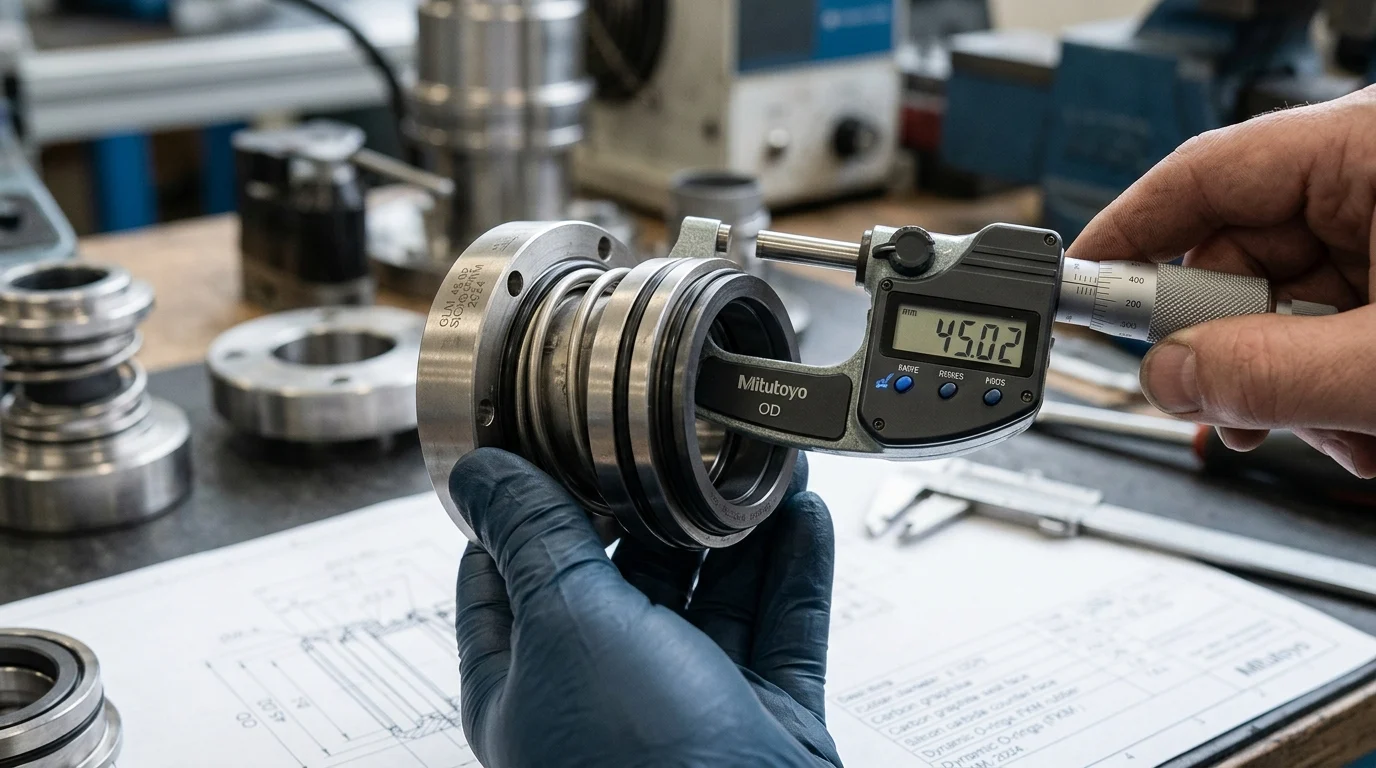
The fundamental reliability of a mechanical seal is dictated by strict adherence to dimensional tolerances and material compatibility. When sourcing replacements globally, engineers cannot assume that a part number cross-reference guarantees operational equivalence. A comprehensive technical evaluation must validate the physical envelope of the stuffing box, the dynamic properties of the rotating assembly, and the tribological characteristics of the wetted materials.
Global standards such as API 682 (ISO 21049) for the petroleum industry and DIN EN 12756 for general industrial applications provide standardized dimensional and material matrices. However, bespoke OEM pump designs often deviate from these standards, requiring precise reverse engineering or detailed technical data sheets to ensure a faultless retrofit.
Critical Dimensions and Equipment Data
The mechanical fit of a replacement seal is governed by the spatial constraints of the seal chamber and the dynamic condition of the pump shaft. Critical static dimensions include the shaft or sleeve outer diameter (typically ranging from 20mm to 150mm for standard process pumps), the stuffing box bore diameter, and the available axial length to the first obstruction. For cartridge seals, the bolt circle diameter and gland plate clearance are equally critical to avoid interference with the pump casing or bearing housing.
Dynamic equipment data is just as vital as static dimensions. A replacement seal will not achieve its design life if the host equipment exhibits excessive vibration or misalignment. Engineers must verify that shaft runout does not exceed 0.05mm (0.002 inches) Total Indicator Reading (TIR) at the seal face, and that axial end play is strictly limited to 0.12mm (0.005 inches). If the equipment falls outside these parameters, the replacement specification must either include a seal design with higher axial and radial tracking capabilities or mandate a pump overhaul prior to seal installation.
Seal Face, Elastomer, Metal, and Spring Materials
Material selection dictates the thermal, chemical, and abrasive limits of the seal. Primary seal faces require optimal tribological pairing. Reaction-bonded Silicon Carbide (SiC) paired against resin-impregnated Carbon Graphite is the industry standard for general chemical applications, offering excellent lubricity. For highly abrasive slurries, a hard-on-hard pairing such as Sintered SiC against Tungsten Carbide (WC) is required, despite the higher heat generation and friction coefficient.
Secondary sealing elements (O-rings and gaskets) are frequent points of failure if incorrectly specified. Standard Fluoroelastomers (FKM/Viton) are suitable for aqueous and mild chemical services up to 204°C. However, aggressive solvents, amines, or high-temperature steam applications necessitate Perfluoroelastomers (FFKM/Kalrez), which tolerate temperatures up to 327°C but carry a cost multiplier of 10x to 20x over FKM. Metal components, particularly springs and bellows, must resist stress corrosion cracking; while 316 Stainless Steel is standard, chlorides or sulfuric acid environments demand Alloy C-276 (Hastelloy) or Alloy 400 (Monel).
Specification Comparison Checklist
To systematically evaluate replacement options, engineering teams should utilize a specification comparison matrix. This prevents critical material or performance downgrades when transitioning from an OEM component to an aftermarket alternative.
| Material Category | Primary Material Option | Hardness (Knoop) | Max Temp Limit (°C) | Thermal Conductivity (W/m·K) | Primary Application Profile |
|---|---|---|---|---|---|
| Seal Face | Reaction Bonded SiC | 2500 | 1400 | 120 | General chemical, high abrasion tolerance |
| Seal Face | Tungsten Carbide (Ni bound) | 1500 | 400 | 80 | High torque, high mechanical impact |
| Seal Face | Carbon Graphite (Resin) | 100 | 260 | 15 | Non-abrasive, poor lubrication scenarios |
| Elastomer | FKM (Fluoroelastomer) | N/A | 204 | N/A | Standard water, oil, mild acids |
| Elastomer | FFKM (Perfluoroelastomer) | N/A | 327 | N/A | Aggressive solvents, extreme heat |
By auditing quotes against these precise parameters, procurement and reliability teams can filter out technically deficient bids and ensure the replacement seal matches or exceeds the legacy unit’s operational capabilities.
How to Compare Seal Designs and Suppliers
Once the physical and material specifications are locked, the evaluation shifts to mechanical design architecture and supplier capability. The global market offers a spectrum of seal configurations, ranging from basic component seals to highly engineered dual-cartridge assemblies. The selected design inherently dictates the complexity of the installation process, the vulnerability to human error during maintenance, and the overall lifecycle cost.
Equally important is the rigorous vetting of the supplier. A technically flawless design is useless if the manufacturer lacks the quality control infrastructure to produce it consistently or the global footprint to support it post-sale. Evaluating designs and suppliers requires a balance of mechanical engineering acumen and strategic supply chain auditing.
Component, Cartridge, and Split Seal Options
Component seals represent the traditional approach, consisting of separate rotating and stationary elements assembled directly on the pump shaft. While they offer the lowest initial purchase price, they require precise calculation of working length and delicate handling of seal faces during installation. Historical reliability data indicates that up to 30% of component seal failures are directly attributable to installation errors, such as incorrect spring compression or pinched O-rings.
Cartridge seals mitigate these risks by pre-assembling the faces, springs, and elastomers onto a shaft sleeve and within a gland plate. This self-contained unit slides over the shaft, requiring only the tightening of gland bolts and set screws before removing the setting clips. Although cartridge seals carry a 40% to 80% cost premium over component seals, they reduce installation time by up to 70% and virtually eliminate setting errors. For large-diameter equipment (shafts >100mm) or pumps where dismantling the casing is prohibitively time-consuming, split mechanical seals offer an alternative, allowing installation without removing the motor or coupling, albeit with lower pressure thresholds (typically limited to 15-20 bar).
Supplier Qualification Criteria
Qualifying a global supplier requires auditing their manufacturing tolerances, material traceability, and engineering support capabilities. A primary criterion is adherence to ISO 9001:2015 quality management systems, specifically focusing on their non-conformance and defect rates. Top-tier mechanical seal manufacturers consistently maintain defect rates below 0.5% (5,000 PPM).
Furthermore, global support infrastructure is critical for multinational operators. Suppliers must demonstrate the ability to provide localized application engineering, failure analysis, and rapid refurbishment facilities within the geographic region of the end-user. Relying on a supplier with a single manufacturing hub introduces unacceptable logistics risks during plant turnarounds or emergency outages. Engineers should also verify the supplier’s capability to provide 3D CAD models, finite element analysis (FEA) for thermal distortion, and computational fluid dynamics (CFD) for complex seal flush plans.
Test Reports, Certifications, and Standards
Certifications and test reports form the objective proof of a seal’s capability. For critical petrochemical applications, suppliers must provide documentation proving compliance with API 682 4th Edition testing protocols. This includes dynamic qualification testing where the seal must run for a minimum of 100 hours, encompassing steady-state operation, pressure fluctuations, and temperature cycling, while maintaining leakage rates strictly below 5.6 grams per hour for volatile organic compounds (VOCs).
In the pharmaceutical and food and beverage sectors, material certifications are paramount. Suppliers must furnish FDA compliance certificates for all wetted elastomers and carbon faces, alongside USP Class VI certifications demonstrating biocompatibility. Additionally, European installations will mandate ATEX (Atmosphères Explosibles) certification for seals operating in hazardous zones, ensuring the seal design limits surface temperatures and prevents spark generation under dry-running conditions. Requesting and archiving these material test reports (MTRs) and hydrostatic test certificates (typically tested at 1.5x the maximum design pressure) is a mandatory step in the procurement process.
Global Sourcing, Logistics, and Inventory Planning
Procuring a mechanical seal is only half the challenge; executing a resilient global supply chain strategy ensures the component is available exactly when the asset requires it. The logistics of mechanical seals are complicated by their precision nature, susceptibility to transit damage, and the vast array of permutations required to cover a complete plant equipment list.
A robust inventory and logistics plan requires engineers and procurement teams to navigate the trilemma of cost, availability, and capital lock-up. By strategically leveraging different tiers of the supply chain—from direct OEM relationships to localized distribution networks—facilities can optimize their spare parts management and drastically reduce mean time to repair (MTTR).
OEM, Aftermarket, and Distributor Options
End-users typically face three sourcing avenues: the Pump OEM, the Seal OEM, and third-party Aftermarket manufacturers. Sourcing directly from the Pump OEM guarantees absolute compliance with the original pump build but often incurs the highest commercial markup, sometimes adding 30% to 50% to the base cost of the seal. This route is generally reserved for pumps still under active warranty or highly specialized, non-standard equipment.
Sourcing from the Seal OEM (the actual manufacturer of the seal installed by the pump builder) offers a balance of guaranteed design fidelity and slightly reduced costs. However, the most significant cost savings and lead-time reductions often come from engineered aftermarket suppliers. High-tier aftermarket manufacturers specialize in reverse-engineering legacy seals, often upgrading the metallurgy or face designs to current standards. While this approach can reduce unit costs by up to 40%, it requires the end-user to strictly enforce the supplier qualification criteria and material verification processes outlined previously.
Regional Availability and Import Requirements
Global logistics introduce variables of customs clearance, tariffs, and regional stock availability. Mechanical seals are generally classified under Harmonized System (HS) Code 8484.20.00, but variations in material composition (such as high-nickel alloys or specialized ceramics) can trigger dual-use export restrictions under international arms control agreements, potentially extending lead times by weeks as export licenses are secured.
Regional availability heavily influences sourcing decisions. A seal manufactured in the United States may require 3 to 5 days of transit to a facility in Southeast Asia, but customs clearance can add an unpredictable 2 to 14 days. Consequently, multinational corporations often mandate that their primary seal suppliers maintain localized ‘bonded’ inventory or authorized repair centers within a 24-hour freight radius of critical production assets. This regionalization mitigates the impact of global freight disruptions and provides a safety net for rapid response during catastrophic equipment failures.
Spare Inventory and Emergency Order Planning
Inventory planning for mechanical seals must balance the high cost of holding precision spares against the catastrophic cost of downtime. Carrying costs for industrial inventory typically range from 15% to 25% of the component’s value annually. To optimize this, reliability engineers use criticality matrixes to dictate stocking levels. ‘Class A’ critical pumps—those without installed operational spares and whose failure halts production—require a complete replacement cartridge seal held in on-site inventory, representing a 100% stock coverage strategy.
For ‘Class B’ and ‘Class C’ equipment, facilities increasingly rely on vendor-managed inventory (VMI) or consignment stock models. In these arrangements, the supplier owns the inventory housed at the end-user’s site, and the facility is only invoiced upon consumption. Emergency order planning must also be codified in the service level agreement (SLA) with the supplier, stipulating guaranteed response times (e.g., 24-hour turnaround for standard cartridge refurbishment) and defining the premium freight channels to be utilized when a stockout occurs.
Practical Replacement Decision Process
The culmination of specification analysis, supplier evaluation, and logistics planning is the practical decision-making process utilized when a seal fails. Replacing a mechanical seal should never be a blind administrative transaction; it is a critical opportunity to perform root cause analysis (RCA) and implement corrective engineering.
A structured decision matrix prevents facilities from falling into the ‘replace-in-kind’ trap, where chronic failure loops are perpetuated because it is administratively easier to order the exact same part number. By integrating failure data with total cost of ownership (TCO) models, engineers can make defensible, data-driven procurement choices that permanently elevate equipment reliability.
Step-by-Step Failure Review and Selection Process
The selection process must begin with a physical inspection of the failed seal. Wear patterns on the silicon carbide or carbon faces provide diagnostic evidence of the failure mode. For example, deep concentric grooving indicates abrasive particulate ingress, suggesting the need for harder face materials (SiC/SiC) or the implementation of an API Plan 31 cyclone separator. Conversely, heat checking (radial micro-cracks on the hard face) points to fluid vaporization and dry running, necessitating a review of the vapor pressure margin and potentially upgrading to a dual-pressurized seal with a barrier fluid.
Once the root cause is identified, the engineer updates the operational parameters and compares the required performance against the incumbent seal’s design limits. If the incumbent design is deemed inadequate, the procurement workflow diverges from a standard reorder to an engineered upgrade. The engineer must then draft a revised technical specification, solicit bids from pre-qualified global suppliers, and evaluate the proposals against the dimensional and material matrices established in the facility’s engineering standards.
Total Cost of Ownership and Downtime Risk
The initial purchase price of a mechanical seal typically represents only 10% to 15% of its Total Cost of Ownership (TCO) over a 5-year lifecycle. The true cost encompasses installation labor, the cost of barrier fluids or flush water, the energy consumed by seal friction, and most significantly, the annualized risk of downtime.
TCO modeling requires quantifying these variables. For instance, a basic component seal might cost $800, while an engineered cartridge seal costs $2,500. However, if the component seal requires 4 hours of maintenance labor to install (at $100/hour) and historically fails every 14 months due to setting errors, while the cartridge seal installs in 1 hour and boasts a 36-month MTBF, the TCO heavily favors the cartridge seal. When the downtime risk—calculated as the probability of failure multiplied by the hourly cost of lost production—is factored into the equation, the justification for premium, highly reliable sealing solutions becomes financially irrefutable.
Final Decision Criteria
The final replacement decision rests on a weighted evaluation of technical viability, commercial impact, and supply chain security. To standardize this process across global operations, procurement and engineering teams should utilize a formalized decision matrix.
| Sourcing Strategy | Initial Capital Cost | Typical Lead Time | Technical Risk Profile | Best Application Scenario |
|---|---|---|---|---|
| Direct OEM Replacement | High (Baseline) | 4 to 12 weeks | Low | API critical pumps, active warranty period |
| Engineered Aftermarket | Low to Medium (-30%) | 1 to 4 weeks | Low to Medium | Mature assets, upgrading obsolete OEM parts |
| Distributor Stock (Standard) | Medium | 1 to 3 days | Low | Standard ANSI/DIN water pumps, utilities |
| Custom Engineered Solution | Very High (+50%) | 10 to 16+ weeks | Medium | Chronic bad actors, extreme temperature/pressure |
By applying this framework, facilities ensure that standard utility pumps are serviced rapidly and cost-effectively through local distribution, while critical process assets receive the rigorous engineering and OEM-level support required to protect the plant’s operational integrity. This balanced, analytical approach transforms mechanical seal replacement from a reactive maintenance burden into a proactive reliability strategy.
Key Takeaways
- Treat seal replacement as an engineering decision because centrifugal pump failures can account for about 70% of rotating equipment downtime, with seal failures driving up to 40% of those incidents.
- Verify process conditions before ordering, since a 15°C temperature increase or a 10% rise in suspended solids can change the lubrication regime and accelerate face wear.
- Use 25,000 hours, or about 36 months, as a benchmark for API 682 applications; repeated early failures should trigger an engineered redesign rather than a simple part swap.
- Plan inventory around supply risk because specialized seals using exotic metallurgy or custom cartridge designs may require 8 to 16 weeks of lead time.
- Qualify global suppliers carefully by checking materials, elastomers, face flatness, and quality controls to reduce the risk of leakage, counterfeit parts, and loss of containment.
Frequently Asked Questions
When should a replacement mechanical seal be upgraded instead of matched like-for-like?
Upgrade when the existing seal fails before the target MTBF, process conditions have changed, or leakage risk is unacceptable. Higher temperature, more solids, or poor lubrication may justify a dual seal, cartridge design, or support system.
What information is needed before buying a mechanical seal globally?
Confirm shaft size, seal chamber dimensions, rotation, pressure, temperature, fluid properties, solids content, elastomers, face materials, metallurgy, and applicable standards. Photos or drawings of the existing seal also help reduce selection errors.
Why is supplier qualification important for replacement mechanical seals?
Unqualified suppliers may use inferior elastomers, poor face lapping, or inconsistent materials, increasing leakage and failure risk. Engineers should verify manufacturing capability, quality controls, references, and compatibility with OEM or standard seal designs.
How long should a mechanical seal last in demanding process applications?
For API 682 oil and gas applications, a common expectation is at least 25,000 hours, or about 36 months, of continuous operation. Shorter life usually signals a selection, installation, process, or support-system issue.
What lead time risks affect global mechanical seal procurement?
Standard seals may be available quickly, but custom cartridge seals, exotic alloys, or specialized designs can take 8 to 16 weeks. Critical pumps should have planned spares to avoid costly downtime.

Post time: Sep-02-2026