


Why Cartridge Mechanical Seals Are a Strategic Choice
In the demanding environment of wastewater treatment, rotating equipment faces some of the most punishing conditions in the industrial sector. Centrifugal, progressive cavity, and rotary lobe pumps must continuously handle fluids laden with abrasive grit, fibrous solids, and corrosive chemicals. Historically, mechanical packing and traditional component mechanical seals were the standard solutions for shaft sealing. However, the paradigm has shifted significantly toward cartridge mechanical seals, which offer pre-assembled, factory-calibrated precision.
The need to optimize mean time between failures (MTBF) and reduce reliance on highly specialized maintenance labor drives this strategic transition. Increasing MTBF from 12 months to 36–48 months significantly cuts maintenance costs. By consolidating the seal faces, springs, O-rings, and gland plate into a single self-contained unit, cartridge seals fundamentally alter the risk profile and lifecycle economics of fluid handling in both municipal networks with consistent influent and industrial plants managing batch chemical processes.
Reducing installation risk
The most critical vulnerability of any mechanical seal lies in its installation phase. Component seals require technicians to manually measure and set the working length on the pump shaft to ensure correct spring compression. Industry experience suggests a miscalculation of even 0.015 inches can lead to excessive face pressure, causing rapid overheating and premature failure, or insufficient pressure, resulting in immediate leakage.
Cartridge mechanical seals eliminate this variable entirely. Manufacturers engineer them with removable setting clips that hold the seal faces exactly at the required tension. The technician simply slides the cartridge onto the shaft, bolts the gland to the stuffing box, tightens the set screws, and removes the clips. While this design substantially reduces the risk of incorrect spring compression, technicians must still avoid gland plate distortion from over-torquing bolts, improper clip removal, and sleeve contamination, which remain common failure modes.
Improving seal reliability
Reliability in wastewater processing hinges on maintaining perfectly mated seal faces under fluctuating hydraulic loads. Manufacturers assemble and hydrostatically test cartridge seals in cleanroom-like environments, often to pressures exceeding 150 psi, before they ever reach the plant floor. This controlled assembly ensures that delicate lapped faces avoid exposure to ambient dust, grease, or impact damage during the installation process.
Furthermore, the integrated design of a cartridge seal protects the pump shaft or sleeve from fretting wear. In many component seal designs, dynamic O-rings move axially along the shaft as the seal faces wear, gradually carving grooves into the metal. Cartridge seals typically house the dynamic elastomer within the internal sleeve of the cartridge itself, preserving the expensive pump shaft. To maintain this reliability, operators must actively monitor for sleeve corrosion in anaerobic environments and promptly diagnose barrier fluid contamination to prevent premature face degradation.
Supporting wastewater plant uptime
Wastewater treatment is a continuous process where downtime carries severe financial and environmental penalties. In critical lift stations or primary sludge transfer applications, an unexpected pump failure can trigger sanitary sewer overflows, leading to regulatory fines and environmental remediation costs that can easily exceed $10,000 per incident.
Cartridge mechanical seals support maximum uptime by drastically reducing repair times. When a seal eventually reaches the end of its lifecycle, replacing a modular cartridge unit takes a fraction of the time required to rebuild a component seal. Maintenance teams can return a critical asset to service swiftly, minimizing bypass pumping requirements and keeping the facility’s processing capacity fully optimized.
What Defines Cartridge Mechanical Seals in Wastewater Pumps
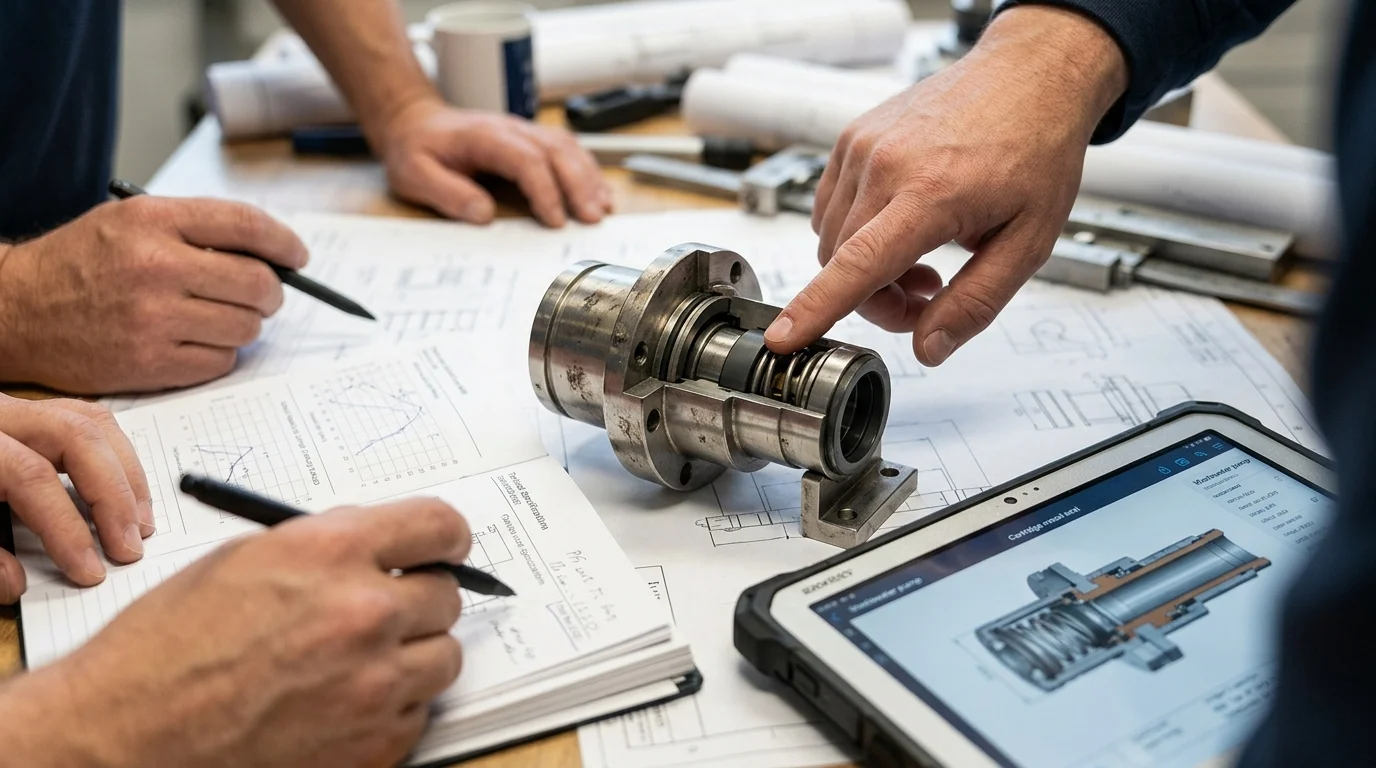
Understanding why cartridge seals outperform traditional sealing methods requires a detailed look at their anatomy and engineering principles. A mechanical seal’s primary function is to contain fluid within a pump casing where the rotating shaft passes through the stationary housing. While the fundamental physics of sealing—utilizing two highly polished faces pressed together by mechanical force and hydraulic pressure—remain the same across designs, the packaging and material science determine how effectively the seal performs in harsh wastewater applications.
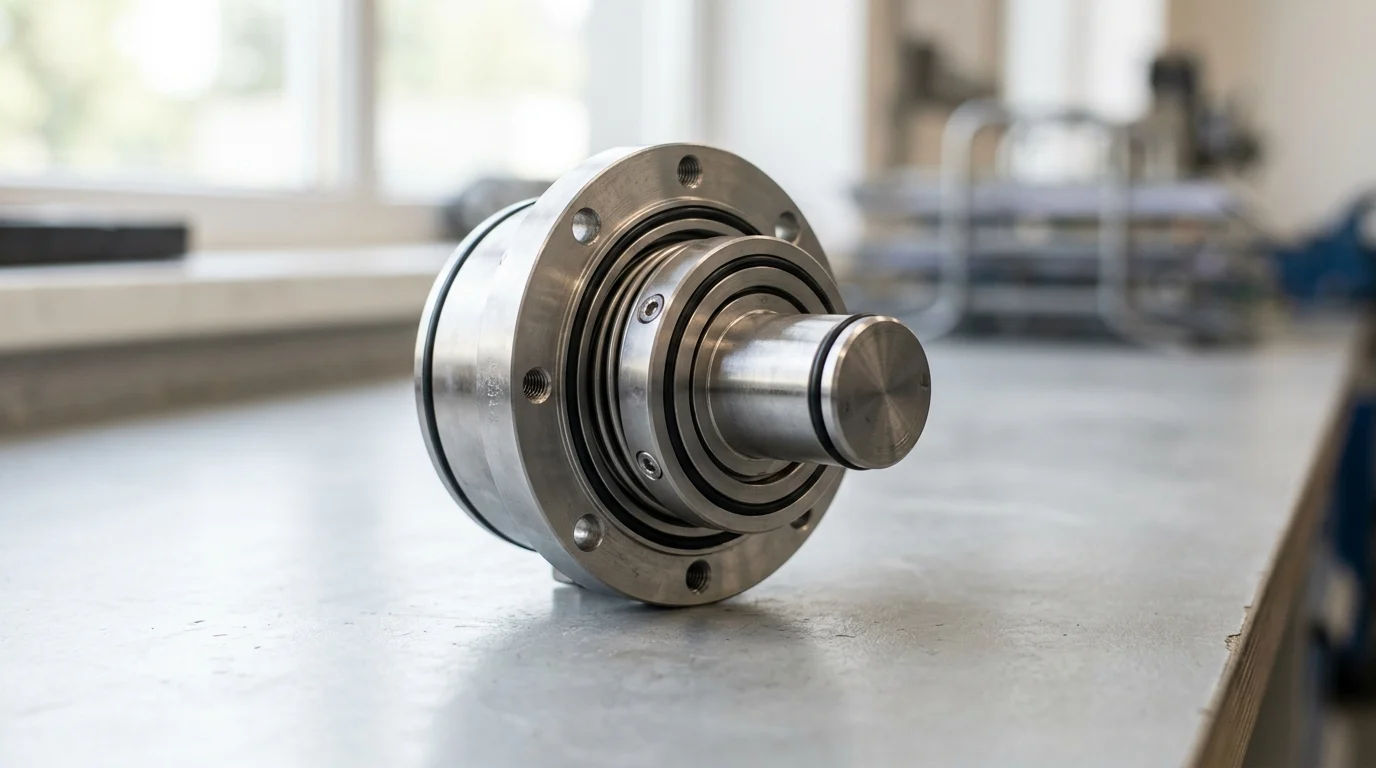
A cartridge mechanical seal features a modular, all-in-one construction. It encompasses the rotating seal face, the stationary seal face, the tensioning mechanisms (springs or metal bellows), secondary sealing elastomers (O-rings or gaskets), the shaft sleeve, and the outer gland plate. This comprehensive integration means the pump’s stuffing box acts merely as a receptacle, while the cartridge itself controls the sealing environment.
Cartridge seals vs component seals
The distinction between cartridge and component seals is best understood through their handling and operational tolerances. Component seals are essentially kits of loose parts. They require a pristine environment for assembly, precise shaft scribing, and careful handling to avoid chipping the brittle seal faces. Cartridge seals, conversely, are plug-and-play units designed for rapid deployment in less-than-ideal field conditions. While modern advanced packing systems—such as braided carbon with flush collars—offer incremental improvements over traditional packing, they still require regular adjustment and maintenance.
| Feature | Component Mechanical Seal | Cartridge Mechanical Seal |
|---|---|---|
| Assembly State | Loose, individual parts | Fully factory-assembled |
| Installation Time | 3 to 5 hours | 1 to 2 hours |
| Setting Method | Manual measurement and scribing | Pre-set with removable centering clips |
| Shaft Fretting Risk | High (dynamic O-ring on shaft) | Zero (dynamic O-ring on internal sleeve) |
| Skill Requirement | High/Specialized | Moderate/General Maintenance |
This fundamental difference in architecture means that cartridge seals inherently absorb minor misalignments and shaft deflections better than component seals. Because the entire assembly moves in unison, the cartridge’s engineered clearances internally manage the strict perpendicularity required between the shaft and the stuffing box face.
Key seal elements and materials
The materials utilized in a cartridge seal determine its resistance to the abrasive and chemically aggressive nature of wastewater. For the primary seal faces, standard carbon-graphite is often insufficient due to the presence of sand, grit, and calcified solids. Instead, wastewater applications heavily rely on silicon carbide and tungsten carbide. Silicon carbide offers a Vickers hardness of approximately 2500 HV, making it highly resistant to abrasive wear, whereas standard carbon faces measure only around 200 HV.
For secondary sealing, elastomer selection is equally critical and depends heavily on the facility type. Municipal plants with consistent influent frequently specify ethylene propylene diene monomer (EPDM) for general wastewater and sludge due to its excellent resistance to water and mild alkalis. However, industrial plants with batch chemical processes—or municipal systems dosing sodium hypochlorite for disinfection or ferric chloride for coagulation—require fluoroelastomers or perfluoroelastomers to prevent the O-rings from swelling, hardening, and ultimately failing under chemical attack.
Single, double, and split cartridge seal options
Cartridge seals are available in various configurations to match the severity of the application. Single cartridge seals feature one set of sealing faces and are the standard choice for secondary effluent, gray water, and applications where the pumped fluid provides adequate lubrication without excessive abrasive content.
Double (or dual) cartridge seals contain two sets of sealing faces and utilize a barrier or buffer fluid system (such as API Plan 53A or 54). Facilities mandate these for primary sludge, digested sludge, or fluids with a consistency exceeding 4% to 5% solids. The barrier fluid is pressurized slightly higher than the pump’s stuffing box (typically by 15 to 30 psig), ensuring that if any fluid migrates across the seal faces, clean barrier fluid moves into the process rather than abrasive sludge entering the seal gap.
Split cartridge seals represent a specialized subset designed for massive rotating equipment common in wastewater, such as main influent vertical turbine pumps or large horizontally split casing pumps with shaft diameters exceeding 4 inches. In these scenarios, dismantling the motor and coupling to slide a standard seal off the shaft can take 24 to 48 hours. Split seals are manufactured in two halves that bolt together around the shaft, allowing for complete seal replacement in mere hours without decoupling the equipment. They are highly cost-justified when the labor and downtime required to dismantle the equipment far exceed the premium price of the split seal itself.
How Cartridge Mechanical Seals Compare in Performance
Evaluating the performance of cartridge mechanical seals requires looking beyond the initial purchase price and analyzing the total lifecycle metrics. In municipal wastewater districts and heavy industrial effluent plants, total cost of ownership models increasingly drive procurement decisions. While the upfront capital expenditure for a cartridge seal is undeniably higher than that of a component seal or mechanical packing, the operational expenditure dynamics heavily favor the cartridge design.
Performance in these environments is quantified by reliability under duress, the labor burden of maintenance interventions, and the collateral preservation of the rotating equipment itself. When mapped over a standard 10-year pump lifecycle, the performance advantages of cartridge seals become quantifiable economic benefits.
Reliability and maintenance factors
Reliability in mechanical sealing relies on maintaining a stable fluid film between the seal faces, typically measuring between 0.5 and 1.5 microns in thickness. Component seals are highly sensitive to radial runout and shaft deflection; a tolerance deviation as small as 0.002 inches can disrupt this fluid film, allowing abrasive particles to penetrate and destroy the faces. Cartridge seals, with their heavy-duty gland plates and integrated bearings or bushings in certain dual designs, provide superior stabilization.
Maintenance factors also heavily favor cartridge designs. Because the springs are located within the stationary portion of the cartridge (often out of the process fluid), they resist clogging. In rotating spring component designs, fibrous materials like hair, flushable wipes, and rags common in municipal wastewater can wrap around the springs, solidifying them and preventing the seal faces from tracking properly as they wear.
Installation time and lifecycle cost
The installation time differential is a primary driver of lifecycle cost reductions. Replacing a component seal requires stripping the pump, cleaning the shaft, meticulously measuring the installation dimension, and carefully pressing the stationary seat into the housing. A cartridge seal replacement condenses this mechanical work significantly.
| Cost Variable (Over 10 Years) | Component Seal Approach | Cartridge Seal Approach |
|---|---|---|
| Initial Purchase Price | Base Cost (1x) | Premium (2x to 3x Base Cost) |
| Expected MTBF | 1.5 Years | 3.5 Years |
| Replacements Required | ~6 | ~2 |
| Labor Burden per Replacement | High (4 to 6 hours) | Low (1 to 2 hours) |
| Total 10-Year Estimated Cost | ~100% (Baseline) | ~60% of Baseline Cost |
| Note: These figures are illustrative estimates. Actual costs vary enormously by seal size, region, supplier, and specific downtime penalties. This model assumes stable process conditions. |
As demonstrated, despite a purchase price premium that can range from 30% to over 100% depending on materials, the cartridge seal pays for itself rapidly. The reduction in frequency of interventions, combined with the lower labor hours per intervention, results in a significantly lower lifecycle cost.
Trade-offs before standardization
Despite their overwhelming advantages, standardizing on cartridge mechanical seals requires acknowledging and managing specific trade-offs. The most prominent constraint is physical space. Because a cartridge seal must house the sleeve, gland, and spring mechanisms within a single modular unit, the radial and axial footprint is bulkier than a component seal. On older standard pumps, or pumps originally designed exclusively for packing, the stuffing box may require machining or enlargement to accommodate the cartridge gland. In extremely tight spaces where cartridge bulk is prohibitive, component seals or packing remain necessary.
Additionally, the initial shift to standardization demands an upfront investment in inventory. While a plant might previously stock generic O-rings, carbon faces, and springs to rebuild various component seals, transitioning to cartridges requires stocking the complete assemblies. However, modern seal manufacturers mitigate this by offering modular cartridge platforms where a single cartridge design can fit multiple pump sizes by simply swapping the internal sleeve and gland plate, thereby optimizing the spare parts inventory over time.
How to Select and Specify Cartridge Mechanical Seals
Specifying the correct cartridge mechanical seal is a rigorous engineering exercise. A seal that performs flawlessly in secondary clarifier effluent will fail catastrophically if applied to raw sewage or thickened sludge without the correct modifications. The selection process demands a precise mapping of the mechanical seal’s capabilities to the hydraulic, rheological, and chemical realities of the specific wastewater process.
Engineers and reliability managers must navigate a matrix of variables, collaborating closely with seal manufacturers to ensure the specified cartridge can withstand the specific operational envelope. This involves analyzing suspended solids, chemical concentrations, thermal loads, and pressure dynamics.
Matching seals to sludge and wastewater conditions
The concentration of suspended solids is the primary governing factor in seal selection. For relatively clean water applications, such as final effluent where solids are below 100 mg/L, a single cartridge seal with hard-on-hard faces is typically sufficient. The fluid itself provides adequate lubrication for the seal faces without introducing excessive abrasive wear.
However, when pumping primary sludge, thickened waste activated sludge, or raw influent where solids routinely exceed 2000 mg/L and can peak much higher, single seals become a liability. In these environments, dual pressurized cartridge seals are mandatory. The barrier fluid system ensures that the microscopic gap between the seal faces is lubricated by clean fluid, physically blocking the migration of jagged grit and fibrous material that would otherwise cause rapid catastrophic failure.
Specification details to confirm with suppliers
When generating specifications for procurement, engineers must confirm several critical dimensional and operational details. The physical envelope is paramount: the exact shaft outer diameter, the stuffing box bore inner diameter, the available stuffing box depth, and the bolt circle diameter must be measured down to the thousandth of an inch. Relying solely on pump model numbers can be dangerous, as shafts are frequently turned down or sleeved during previous rebuilds.
Operationally, the seal must be rated for the pump’s maximum discharge pressure and temperature. While wastewater temperatures rarely exceed 160°F (71°C), pressures in multi-stage or high-head lift applications can exceed 300 psig. Furthermore, the specification must detail the required environmental controls, often utilizing API 682 piping plans. For example, specifying an API Plan 11 (recirculation from pump discharge) or an API Plan 32 (injection of clean external flush water) dictates the porting requirements machined directly into the cartridge seal gland.
Installation and commissioning best practices
Even the most robustly specified cartridge seal relies on strict adherence to installation best practices. Prior to sliding the cartridge onto the shaft, technicians must dial-indicate the equipment to verify runout and end-play. Radial shaft runout should not exceed 0.002 inches, and axial end-play must be kept below 0.005 inches. Exceeding these mechanical tolerances will overwork the seal’s internal springs and elastomers, drastically reducing its operational lifespan.
Commissioning protocols are equally vital. A frequent cause of immediate seal failure is dry running during the initial bump-test of the motor. If the seal utilizes an external flush or a barrier fluid system, operators must fully purge these lines of air and pressurize them prior to equipment rotation. During operation, technicians should routinely check for barrier fluid contamination, which indicates inner seal face wear. Finally, a critical step that is surprisingly often overlooked is the removal of the setting clips. The clips must only be disengaged after the gland bolts are torqued to the housing and the set screws are locked into the shaft; removing them prematurely nullifies the factory-calibrated spring tension.
When Wastewater Plants Should Prefer Cartridge Mechanical Seals
While mechanical packing and component seals still hold positions in specific applications, the overarching trajectory of the wastewater industry points toward broad adoption of cartridge mechanical seals. Plant managers must evaluate their operational pain points to determine when an upgrade is justified. Rather than viewing cartridge seals as a universal solution, facilities should apply a concise decision framework. Component seals or packing remain appropriate for non-critical standby pumps, extremely tight spaces, or plants with extensive in-house seal rebuilding expertise. By understanding the specific environmental triggers that cause traditional seals to fail, facilities can strategically deploy cartridge seals where they deliver the highest return on investment.
Operating conditions that favor cartridge seals
Certain operational conditions strongly indicate that a cartridge seal upgrade is required. High-vibration environments, often exacerbated by the use of variable frequency drives that cause pumps to operate away from their ideal efficiency points, are particularly destructive to component seals. The robust, unified mass of a cartridge seal gland dampens harmonic shifts and maintains face alignment much more effectively under these fluctuating loads.
Remote or inaccessible lift stations also heavily favor cartridge seals. In municipal networks spanning hundreds of square miles, dispatching a specialized crew to rebuild a component seal in a confined space is logistically complex and dangerous. Cartridge seals allow for rapid, localized replacement by general technicians. Furthermore, any application pumping abrasive grit where the historical MTBF has fallen below 18 months is a prime candidate; the integration of hard faces and clean-flush porting in a cartridge design is the most reliable method to extend equipment lifespan.
Balancing purchase price and long-term value
The final justification for prioritizing cartridge mechanical seals lies in balancing the initial purchase price against long-term value creation, particularly regarding staffing constraints. For large wastewater treatment plants processing millions of gallons per day, the sheer volume of rotating equipment means that maintenance labor is a finite and highly constrained resource. Spending a premium on a cartridge seal rather than a component seal is not merely an equipment purchase; it is an investment in labor reallocation.
The break-even point for a cartridge seal is typically achieved after the very first avoided failure. When factoring in the cost of replacement parts, the hourly burden rate of maintenance technicians, the potential requirement for vacuum trucks or bypass pumps during the outage, and the administrative cost of emergency work orders, a single pump failure easily costs a facility several thousand dollars.
Key Takeaways
- Choose cartridge mechanical seals when installation consistency is critical, because factory-set clips remove the need for technicians to manually set spring compression on the pump shaft.
- Use cartridge seals to help target MTBF improvements from roughly 12 months to 36–48 months, provided the seal is matched correctly to the wastewater duty and maintained properly.
- Prevent premature leakage by avoiding gland plate distortion, over-torqued bolts, contaminated sleeves, and incorrect setting clip removal during installation.
- Specify cartridge designs that protect the pump shaft or sleeve from fretting wear, especially in abrasive wastewater service with grit, fibers, and solids.
- Monitor barrier fluid quality, sleeve corrosion, and signs of dry running to keep cartridge mechanical seals reliable after installation.
Frequently Asked Questions
What makes a cartridge mechanical seal different from a component seal?
A cartridge mechanical seal is pre-assembled with seal faces, springs, O-rings, sleeve, and gland in one unit. This removes much of the manual measuring and spring-setting required with component seals, reducing installation error in wastewater pump maintenance.
Why do wastewater plants prefer cartridge seals for installation?
They use factory-set clips to hold the correct working length and face compression. Technicians can slide the unit onto the shaft, bolt the gland, tighten set screws, and remove the clips, avoiding errors as small as 0.015 inches that can cause leakage or overheating.
How much can cartridge seals improve pump reliability?
Results depend on the application, fluid, and maintenance practices, but wastewater plants often target MTBF gains from about 12 months to 36–48 months by reducing installation errors, protecting seal faces, and limiting shaft wear.
Are cartridge mechanical seals better than packing in wastewater service?
In many wastewater pumps, yes. Cartridge seals typically reduce leakage, protect shafts better, and require less adjustment than packing. Packing may still be used in some low-cost or noncritical applications, but cartridge seals are preferred where uptime, cleanliness, and lifecycle cost matter.
What failure risks remain with cartridge mechanical seals?
Cartridge seals reduce installation risk but do not eliminate all failures. Common issues include over-torqued gland bolts, removing setting clips at the wrong time, sleeve contamination, corrosion in anaerobic environments, dry running, and contaminated barrier fluid in double seal systems.

Post time: Oct-29-2026