


Why Mechanical Seal Material Selection Matters
In modern fluid handling systems, selecting the right mechanical seal material is a foundational engineering decision that directly determines rotating equipment reliability. Pumps, agitators, and compressors rely on these precision-engineered interfaces to contain process fluids under extreme dynamic conditions. A poor material choice can cause sudden seal failure, which may result in hazardous environmental releases, compromised product purity, and severe mechanical damage to surrounding infrastructure.
Understanding how sealing materials interact chemically and mechanically is essential. A modern mechanical seal is a highly engineered system that must withstand specific local environments, ensuring the assembly reduces friction while reliably containing the fluid.
How Mechanical Seal Materials Are Defined
A mechanical seal assembly is fundamentally defined by three distinct material categories: primary seal faces, secondary sealing elements, and structural hardware. The primary seal faces consist of a rotating ring and a stationary ring pressed together by mechanical spring force and hydraulic pressure. These faces maintain a microscopic fluid film—often in the range of 0.5 to 5 micrometers depending on face geometry and fluid viscosity—which provides necessary lubrication while preventing bulk fluid leakage.
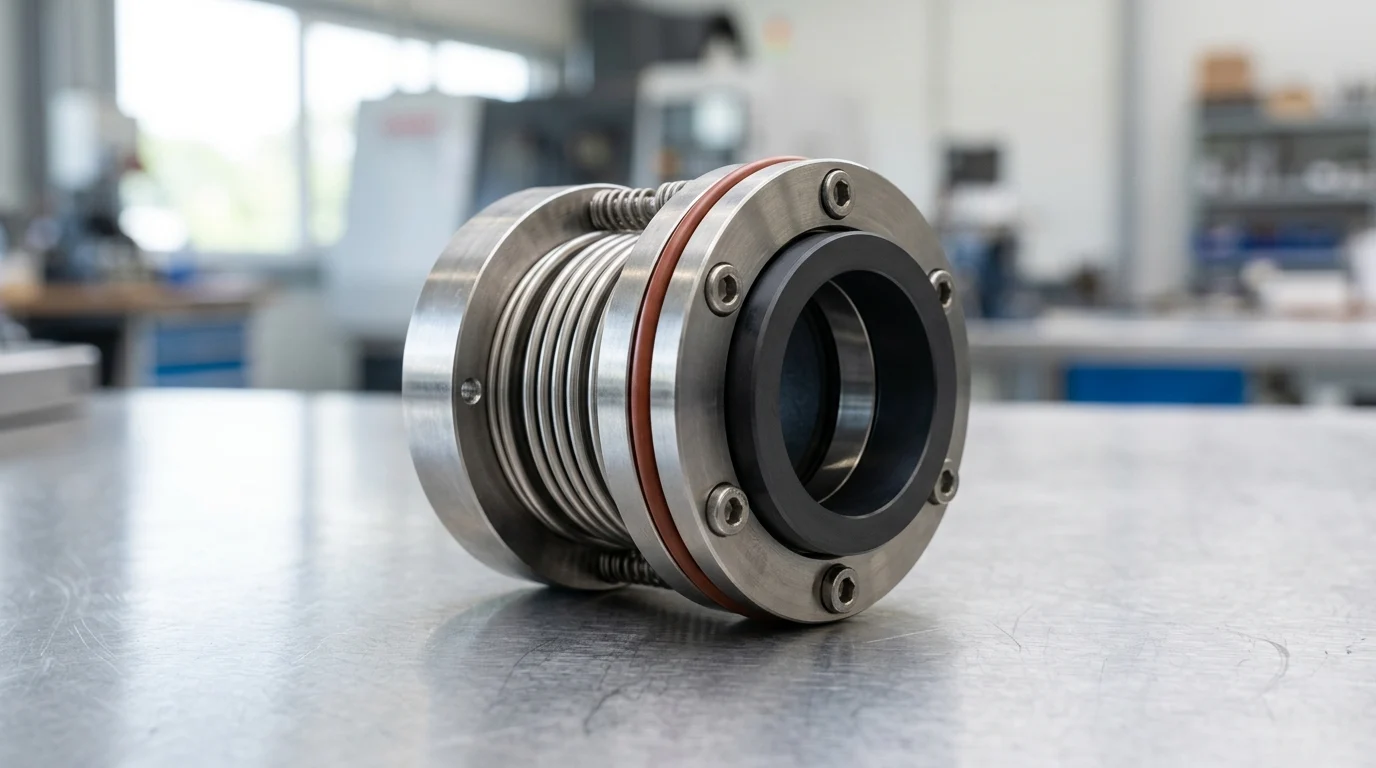
Secondary sealing elements, typically O-rings, V-rings, or elastomeric bellows, provide static sealing between the seal faces and the equipment casing or shaft. Finally, the structural hardware—including springs, drive pins, glands, and sleeves—must provide robust mechanical support and maintain precise dimensional tolerances under varying loads. The metallurgical specification of this hardware dictates the seal’s resistance to structural fatigue and bulk corrosion.
How Material Choice Affects Reliability and MTBF
The direct correlation between material selection and Mean Time Between Failures (MTBF) is commonly cited in industrial reliability engineering. Industry standards, such as API 682 for the oil and gas sector, mandate material configurations designed to target a minimum continuous operating life of 25,000 hours (approximately three years). However, it is critical to note that this benchmark is a design target under specified conditions, not a guaranteed field outcome. Many installations fail to achieve this lifespan due to installation errors, operational excursions, or maintenance factors that fall outside the scope of material selection.
Selecting incompatible face materials can reduce MTBF from years to mere weeks. For example, utilizing a soft carbon face in an abrasive slurry application will result in rapid wear, while pairing two extremely hard faces without adequate boundary lubrication can induce micro-welding and brittle fracture. By matching the material’s wear coefficient to the fluid’s lubricity and particulate load, engineers can predictably extend the operational lifespan of the equipment.
How Material Selection Impacts Cost
While premium materials cost more upfront, they significantly improve the total cost of ownership (TCO) profile of rotating equipment. Industry estimates suggest initial purchase costs typically represent only 15% to 20% of a seal’s lifecycle expense. The remaining 80% is dominated by maintenance labor, replacement parts, and lost production revenue.
Unplanned downtime in high-volume continuous processing environments—such as petrochemical refining or pharmaceutical manufacturing—can incur illustrative costs ranging from $10,000 to over $50,000 per hour, depending heavily on facility scale and regional market conditions. Specifying advanced materials like reaction-bonded silicon carbide or perfluoroelastomers (FFKM) may increase the initial seal cost by as much as 300%. However, this premium is often quickly justified if it prevents even a single premature failure event. Consequently, material selection must be evaluated as a long-term capital protection strategy rather than a short-term procurement expense.
Key Properties for Mechanical Seal Materials

Specifying the correct mechanical seal material requires a rigorous analysis of the thermo-mechanical dynamics occurring at the seal interface. The environment between the rotating and stationary faces is vastly different from the bulk fluid conditions in the pump casing. Frictional heat generation, localized pressure gradients, and varying fluid film states demand materials with specific physical and chemical properties.
Engineers must evaluate these properties not in isolation, but as a synergistic system. The primary goal is to maintain a stable, non-flashing fluid film while resisting the degradative forces of the process medium. This requires careful alignment of process conditions with the inherent performance limits of the chosen materials.
Process Conditions That Drive Material Compatibility
Process conditions dictate the baseline compatibility requirements for all seal components. The primary drivers are bulk fluid temperature, stuffing box pressure, and the chemical aggressiveness of the medium. For instance, standard elastomeric materials may degrade rapidly when exposed to aggressive solvents or amines, requiring a shift to highly fluorinated compounds.
Temperature gradients are particularly critical. Process temperatures can range from cryogenic levels (-320°F / -196°C for liquid nitrogen) to extreme heat (+750°F / +400°C for heavy hydrocarbon bottoms). High temperatures accelerate chemical attack and can cause elastomers to harden and lose their compression set. Pressure fluctuations also drive material choice; high-pressure applications exceeding 1,200 psig (82 bar) require face materials with a high modulus of elasticity to prevent pressure-induced mechanical distortion that would otherwise destroy the microscopic fluid film.
Critical Properties: Hardness, Wear, and Corrosion Resistance
Hardness, wear resistance, and corrosion resistance form the triad of critical mechanical properties. Hardness is typically measured on the Vickers scale (HV), with advanced face materials like Silicon Carbide (SiC) registering between 2,500 and 3,000 HV, compared to Tungsten Carbide at approximately 1,500 HV. This extreme hardness provides exceptional resistance to abrasive particles suspended in the process fluid.
Wear resistance is often quantified by the material’s Pressure-Velocity (PV) limit, which defines the maximum load and speed a material pair can endure before the lubricating film collapses and dry friction ensues. A premium SiC vs. SiC face combination can comfortably handle PV values exceeding 500,000 psi-ft/min in well-lubricated conditions.
Furthermore, corrosion resistance must account for integrated system risks, such as material interactions between primary faces, secondary seals, and hardware. Galvanic corrosion occurs when dissimilar metals contact within an electrolyte; mitigating this requires selecting hardware and face materials with similar anodic potentials. Chemical incompatibility is rarely limited to one component. For example, aggressive fluids might cause elastomer swell that exerts undue mechanical stress on primary faces, or penetrate face material porosity, leading to systemic failure. A common engineering oversight is neglecting the thermal expansion mismatch between dissimilar face materials and hardware, which can cause binding or loss of face flatness during temperature excursions. Cobalt-bound Tungsten Carbide is also highly susceptible to leaching in mildly acidic environments, necessitating the use of nickel-bound variants.
Application Data Needed Before Selection
Before initiating the material selection workflow, engineers must compile a comprehensive application data sheet. This prerequisite data feeds directly into the first step of the selection process. It requires exact figures for fluid specific gravity, dynamic viscosity at operating temperature, and vapor pressure margins relative to the seal chamber pressure (NPSHa margin). Pumping a fluid too close to its vapor pressure will cause the fluid film to flash into a gas across the seal faces, requiring materials with superior dry-running capabilities, such as specialized graphite-impregnated silicon carbides.
Engineers must also account for edge cases that frequently override standard material selection logic:
- Polymerization or crystallization: Fluids with these tendencies require hard faces that can shear through buildup without sustaining damage.
- Explosive decompression: In hydrocarbon services, elastomers must be formulated to resist rapid gas expansion that can otherwise rupture the O-ring from within.
- Shaft speed and runout: A standard centrifugal pump operating at 3,600 RPM generates significantly more frictional heat at the seal interface than a low-speed mixer operating at 60 RPM.
- Suspended solids: The presence, size, and concentration of particulates will immediately dictate whether a hard-vs-hard face combination is required to prevent abrasive scoring.
Common Mechanical Seal Material Options
The industrial market relies on several established material families to construct mechanical seals. Over decades of empirical testing and field application, specific combinations of carbon-graphites, technical ceramics, and advanced elastomers have emerged as the standard for high-performance sealing.
Selecting from these common options requires understanding the specific compromises each material offers regarding thermal conductivity, chemical inertness, and structural toughness.
Carbon, Silicon Carbide, and Tungsten Carbide
Carbon-graphite is the most common primary seal face material, prized for its excellent self-lubricating properties and low coefficient of friction. Typically impregnated with resins or metals (like antimony) to reduce porosity and increase strength, carbon is highly forgiving during transient dry-running conditions. However, its relatively low hardness makes it unsuitable for highly abrasive slurries.
Silicon Carbide (SiC) and Tungsten Carbide (WC) are the primary hard face materials. Reaction-bonded SiC offers exceptional hardness and high thermal conductivity, efficiently dissipating frictional heat away from the seal interface. Tungsten Carbide, while slightly less hard than SiC, offers superior fracture toughness, making it the preferred choice for high-torque applications or environments subjected to severe mechanical shock.
A frequent misconception in seal specification is assuming that harder materials are universally better. While hard-vs-hard combinations are necessary to prevent abrasive embedment, they are highly susceptible to thermal shock cracking if the fluid film is lost. For dry-running or non-contacting gas seal applications—which are increasingly common in critical compressor services—materials like SiC are often engineered with shallow hydrodynamic lift grooves to generate a stiff gas film, preventing face contact entirely.
Elastomer and Secondary Seal Materials
Secondary sealing elements are predominantly manufactured from elastomeric compounds. Fluoroelastomers (FKM), commonly known by the trade name Viton, are the industry standard for general water, oil, and mild chemical services, offering reliable performance up to 400°F (204°C). For extreme chemical resistance or higher temperatures, Perfluoroelastomers (FFKM), such as Kalrez, are specified; these can withstand aggressive solvents and temperatures up to 620°F (327°C) but come at a significant cost premium.
Ethylene Propylene Diene Monomer (EPDM) is strictly reserved for hot water, steam, and mild caustic applications, generally rated up to 300°F (150°C). Crucially, EPDM will swell and fail rapidly if exposed to petroleum-based hydrocarbons. In cryogenic or ultra-high-temperature services where elastomers fail entirely, flexible graphite or PTFE wedges are utilized as secondary seals, providing a purely mechanical static seal without elastomeric recovery.
Material Comparison Tables for Selection
To facilitate accurate engineering specification, the following tables compare the typical properties of common primary face materials and secondary elastomers.
Note: The temperature ranges, hardness values, and thermal limits cited below are single-point estimates. Actual specifications vary significantly by manufacturer, specific grade, and impregnant type. Always consult manufacturer datasheets for definitive limits.
| Material Type | Typical Hardness (HV) | Max Temp (°F / °C) | Thermal Conductivity (W/m·K) | Primary Advantage |
|---|---|---|---|---|
| Carbon-Graphite (Resin Impregnated) | 70 – 100 | 500 / 260 | 10 – 15 | Self-lubricating, excellent dry-run capability |
| Silicon Carbide (Reaction Bonded) | 2500 – 3000 | 750 / 400 | 120 – 200 | Extreme hardness, high thermal transfer |
| Tungsten Carbide (Nickel Bound) | 1500 | 750 / 400 | 80 – 100 | High fracture toughness, durable |
| Alumina Ceramic (99.5%) | 1200 – 1500 | 392 / 200 | 30 – 35 | Cost-effective chemical resistance |
| Elastomer Type | Temp Range (°F / °C) | Best Suited For | Not Recommended For |
|---|---|---|---|
| Nitrile (NBR) | -40 to 248 / -40 to 120 | General water, aliphatic hydrocarbons | Ozone, strong acids, ketones |
| Fluoroelastomer (FKM) | -4 to 400 / -20 to 204 | Oils, fuels, moderate chemicals | Steam, hot water, low molecular weight esters |
| Ethylene Propylene (EPDM) | -58 to 300 / -50 to 150 | Hot water, steam, dilute acids | Petroleum oils, mineral oils |
| Perfluoroelastomer (FFKM) | -4 to 620 / -20 to 327 | Extreme chemicals, high heat | Liquid alkali metals, fluorine gas |
Validation, Compliance, and Supplier Quality
Specifying the correct material on paper is only the first phase of the engineering process. Ensuring that the delivered mechanical seal meets the operational criteria requires rigorous validation, adherence to global compliance standards, and stringent supplier quality oversight.
In mission-critical industries, the traceability of seal materials is as important as the material selection itself. A microscopic flaw in a ceramic face or an undocumented substitution in an elastomer compound can compromise design safety margins, leading to premature and costly system failure.
Relevant Standards and Industry Requirements
Industry standards dictate baseline material configurations to ensure safety and interchangeability. The American Petroleum Institute’s API 682 (4th Edition) is a widely adopted standard for the oil, gas, and petrochemical sectors. It explicitly mandates default materials, such as specifying premium blister-resistant carbon grades and requiring reaction-bonded silicon carbide for standard refinery applications.
In the pharmaceutical and food processing sectors, material compliance shifts toward biological and toxicological safety. Elastomers and carbon faces must comply with FDA 21 CFR 177.2600 and USP Class VI standards. These regulations ensure that the materials will not leach toxic compounds into the process stream. To meet these stringent requirements, reputable manufacturers often report targeting internal defect rates below 0.1% and provide extensive documentation proving non-toxicity and cleanability.
Supplier Quality, Traceability, and Lead Time
Supplier quality management directly impacts the reliability of the mechanical seal. Engineers must demand material test reports (MTRs) and certifications, such as the EN 10204 3.1 certificate, which provides traceable chemical and physical analysis of the metallic hardware and primary faces. Without this traceability, operators risk installing counterfeit or substandard materials that may succumb to unforeseen corrosion or mechanical stress.
Beyond documentation, rigorous material qualification and acceptance testing protocols are essential. This includes non-destructive examination (NDE) for ceramic faces to detect micro-fractures, and batch testing for elastomer compounds to verify compression set and chemical resistance. These protocols close the loop between procurement and operational validation.
Lead time is another critical logistical factor influenced by material choice. Standard materials like 316 Stainless Steel hardware, carbon, and SiC faces are generally available with illustrative lead times of 1 to 3 weeks. However, specifying exotic metallurgies—such as Hastelloy C-276, Titanium, or Alloy 20 for highly corrosive environments—can extend procurement lead times to an estimated 10 to 14 weeks. These ranges are highly subject to regional availability and global supply chain variability. Engineers must balance the technical requirement for exotic materials against the facility’s inventory carrying costs and downtime risks.
Using Failure Analysis and Field Data
When a mechanical seal fails, the materials hold the forensic evidence required to prevent a recurrence. Root Cause Analysis (RCA) relies heavily on examining the wear patterns and material degradation of the seal faces and elastomers. For instance, ‘heat checking’—a pattern of fine radial cracks on a hard face like Tungsten Carbide—indicates that the fluid film vaporized, causing extreme thermal shock. This data directs engineers to select a material with higher thermal conductivity or to implement external flush plans.
Similarly, the presence of blister formation on carbon-graphite faces strongly suggests that process fluids have penetrated the material’s pores and rapidly expanded due to frictional heat. This field data serves as a critical feedback loop, systematically updating the material decision matrix over time. It validates the need to upgrade to a less porous carbon grade or transition to a solid SiC face, ensuring continuous refinement of site-wide material specifications.
Mechanical Seal Material Selection Workflow
To prevent ad-hoc decision-making, industrial facilities must implement a systemic mechanical seal material selection workflow. This structured approach ensures that all process variables, safety regulations, and lifecycle costs are evaluated consistently across different pumping applications.
By moving through a logical sequence of elimination and optimization, engineers can confidently specify a seal assembly that maximizes MTBF while remaining economically viable.
Step-by-Step Selection Process
The selection process follows a defined, four-step methodology. Step one is Environmental Mapping: utilizing the application data sheet compiled earlier to accurately define the fluid state, temperature, pressure, and chemical composition. Step two is Face Pair Selection: matching the primary ring materials to the fluid’s lubricity and particulate load. A clean, lubricating fluid generally receives a Carbon vs. SiC pairing, while an abrasive slurry requires SiC vs. SiC.
Step three involves Secondary Seal Matching: selecting an elastomer that can survive the chemical environment and temperature extremes established in step one. Finally, step four is Hardware Specification: choosing the metallurgy for the springs, glands, and sleeves. While 316 Stainless Steel is the default, the presence of chlorides or highly acidic compounds will necessitate an upgrade to duplex stainless steels or nickel-based superalloys.
Using a Material Decision Matrix
When multiple material combinations appear viable, engineers utilize a Material Decision Matrix to quantify the optimal choice. This matrix assigns weighting factors to different performance criteria based on the specific criticality of the application. A standard weighting model might allocate 40% to Chemical Compatibility, 30% to Thermal Limits, 15% to Initial Cost, and 15% to Supply Chain Availability.
For example, consider evaluating elastomers for a “moderate” application—defined as having temperatures well below 300°F (150°C) and lacking highly aggressive solvents—using a 1-to-10 scoring system. An engineer compares FKM and FFKM. FFKM might score a perfect 10 on Chemical Compatibility (weighted: 10 × 0.40 = 4.0) and 10 on Thermal Limits (10 × 0.30 = 3.0), but only a 2 on Initial Cost (2 × 0.15 = 0.3) and a 5 on Availability (5 × 0.15 = 0.75), yielding a total score of 8.05. Conversely, FKM might score an 8 on Chemical Compatibility (8 × 0.40 = 3.2), an 8 on Thermal Limits (8 × 0.30 = 2.4), a 9 on Initial Cost (9 × 0.15 = 1.35), and a 10 on Availability (10 × 0.15 = 1.5), resulting in a higher total score of 8.45.
While this example provides a baseline calculation, a robust decision matrix should incorporate sensitivity analysis or uncertainty ranges rather than relying solely on deterministic numbers. Real-world engineering judgment must factor in realistic complications such as uncertain future process changes, batch variability in process fluids, or supply chain disruptions that might make a theoretically optimal material practically unavailable. By providing a structured framework, the matrix objectively guides the engineer toward the more economical FKM when the application’s parameters fall safely within its operating limits.
When to Escalate to a Seal Specialist
While standard workflows cover the majority of industrial applications, certain operational thresholds require
Key Takeaways
- Evaluate mechanical seal materials as a complete system, including seal faces, elastomers, and metal hardware, rather than choosing each component in isolation.
- Match face material hardness and wear resistance to the fluid’s lubricity and solids content to avoid rapid wear, micro-welding, or brittle fracture.
- Use chemical compatibility, temperature limits, pressure, and shaft speed to screen elastomers such as O-rings, V-rings, and rubber bellows before final selection.
- Treat API 682’s 25,000-hour operating life as a design target under defined conditions, not as a guaranteed service interval.
- Compare seal options by total cost of ownership because the initial seal price may account for only 15% to 20% of lifecycle cost.
Frequently Asked Questions
What are the main material groups in a mechanical seal?
A mechanical seal is typically defined by primary seal faces, secondary sealing elements, and structural hardware. Faces control friction and leakage, elastomers or bellows provide static sealing, and metal parts such as springs, glands, and sleeves provide strength and corrosion resistance.
Which seal face materials are best for abrasive fluids?
Hard face materials such as silicon carbide or tungsten carbide are usually preferred for abrasive fluids because they resist wear better than softer carbon faces. The final choice should consider fluid lubricity, solids content, temperature, pressure, and shaft speed.
Why does elastomer selection matter in mechanical seals?
Elastomers such as O-rings, V-rings, and rubber bellows must resist chemical attack, swelling, hardening, and thermal degradation. An incompatible elastomer can fail even when the seal faces are correctly specified.
How does material selection affect mechanical seal MTBF?
Correct material selection can help extend Mean Time Between Failures by reducing wear, corrosion, thermal cracking, and face damage. Standards such as API 682 use 25,000 hours as a design target under specified conditions, but actual field life depends on installation and operation.
Are premium mechanical seal materials worth the higher cost?
Often, yes. Seal purchase price may represent only 15% to 20% of lifecycle cost, while maintenance, replacement, and downtime dominate total expense. Higher-grade materials can reduce failures and improve total cost of ownership in critical services.

Post time: Oct-21-2026