


Why Rubber Bellows Seals Matter in Chemical Processing
In chemical processing environments, the reliability of centrifugal pumps is intrinsically linked to the integrity of their mechanical seals. Industry data consistently indicates that mechanical seal failures account for 60% to 70% of all unplanned pump outages in fluid handling facilities. When processing hazardous, corrosive, or high-value chemicals, a compromised seal does not merely result in a minor leak; it triggers costly downtime, environmental compliance violations, and severe safety hazards.
Engineers and maintenance teams must navigate a complex landscape of sealing technologies to mitigate these risks. While traditional pusher-style seals have long been an industry staple, non-pusher designs have demonstrated superior reliability under specific operational stresses. Understanding the fundamental mechanics and strategic advantages of these specialized elastomeric structures is the first step toward optimizing pump lifecycle performance and driving down total maintenance expenditures.
What Rubber Bellows Seals Are
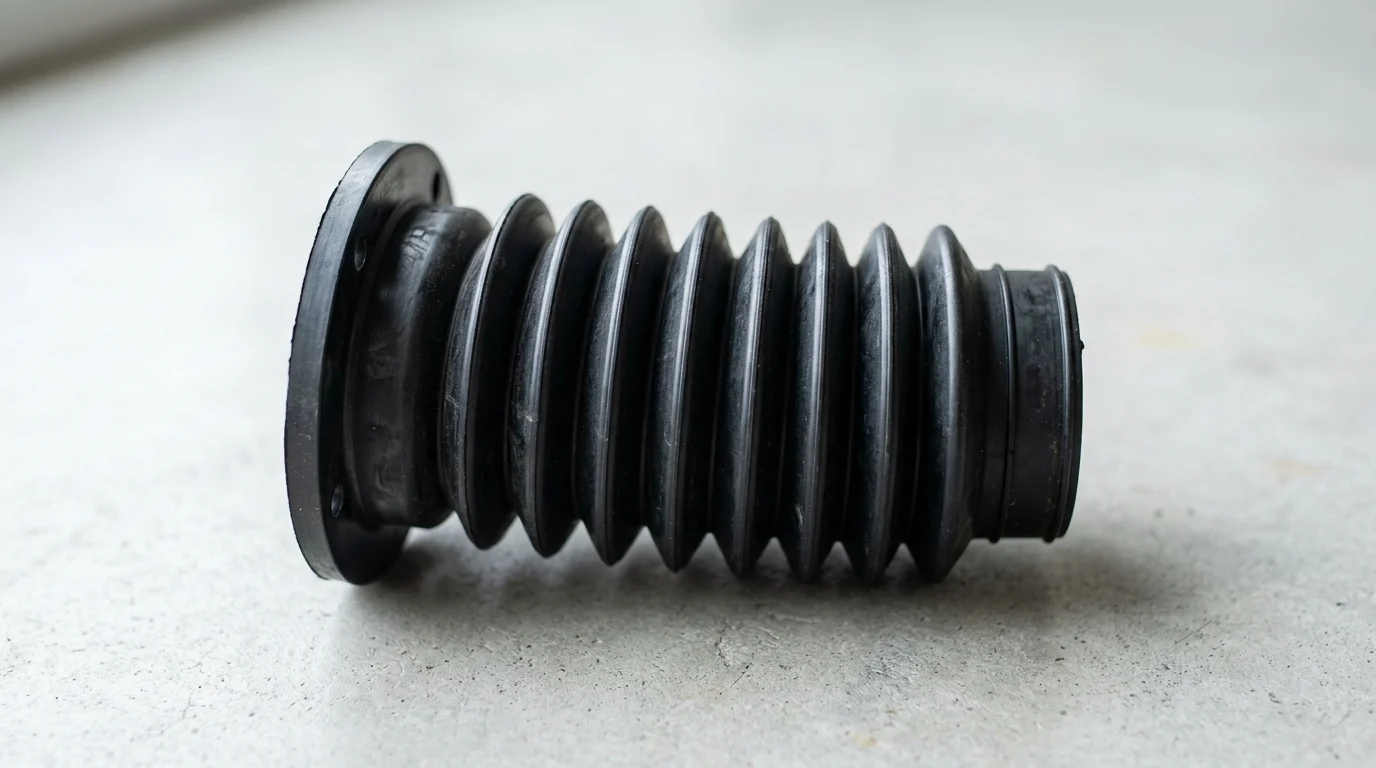
At their core, these non-pusher mechanical seals utilize a convoluted elastomeric tube that serves multiple operational functions simultaneously. Unlike traditional designs that rely on a separate dynamic secondary seal and a metallic spring mechanism to maintain face contact, the convoluted elastomer acts as both the secondary sealing element against the pump shaft and the primary mechanism for transmitting torque. A single, large-coil spring is typically wrapped around the exterior of the elastomer to provide the necessary axial closing force.
This integrated design eliminates the need for sliding components along the shaft. Available in standard shaft sizes ranging from 10mm up to 100mm, these seals are engineered to accommodate the dimensional standards of most ISO and DIN chemical pumps. The geometric profile of the convolution is precisely molded to distribute mechanical stress evenly, ensuring that the elastomer maintains its structural integrity even under continuous rotational torque and thermal expansion.
Why Seal Failures Impact Safety and Uptime
The operational consequences of a seal failure in a chemical plant extend far beyond the immediate cost of the replacement component. The Mean Time Between Failures (MTBF) for a standard chemical pump can plummet from an optimal 24 to 36 months down to less than 6 months if the mechanical seal is improperly specified for the process fluid. Every failure event requires isolating the pump, decontaminating the volute, and executing a precision maintenance procedure.
Downtime in continuous chemical processing operations carries a severe financial penalty, often quantified between $10,000 and $50,000 per hour depending on the production volume and the specific chemical commodity. Furthermore, fugitive emissions of volatile organic compounds (VOCs) or aggressive acids pose immediate risks to plant personnel. Maintaining a hermetic boundary is therefore a critical regulatory requirement, often governed by stringent local environmental mandates that enforce zero-tolerance policies for hazardous fluid leaks.
When Bellows Designs Offer Strategic Value
The strategic value of a non-pusher elastomeric design becomes most apparent in applications characterized by mechanical instability. Centrifugal pumps frequently experience shaft deflection, vibration, and thermal growth during transient operating conditions such as startup or sudden changes in system pressure. The inherent flexibility of a convoluted elastomer allows it to absorb significant axial play—often up to 0.5mm—without compromising the contact pressure between the primary sealing faces.
This dynamic adaptability is particularly valuable in older facilities where legacy pumping equipment may suffer from increased bearing wear and greater shaft runout. By decoupling the secondary seal from the rigid constraints of the shaft surface, the convoluted design compensates for mechanical imperfections that would otherwise cause a rigid sliding seal to hang up, leak, or fail prematurely. Consequently, plants adopting this technology often observe an immediate stabilization in pump reliability metrics across their aging infrastructure.
How Rubber Bellows Seals Compare With O-Ring Seals
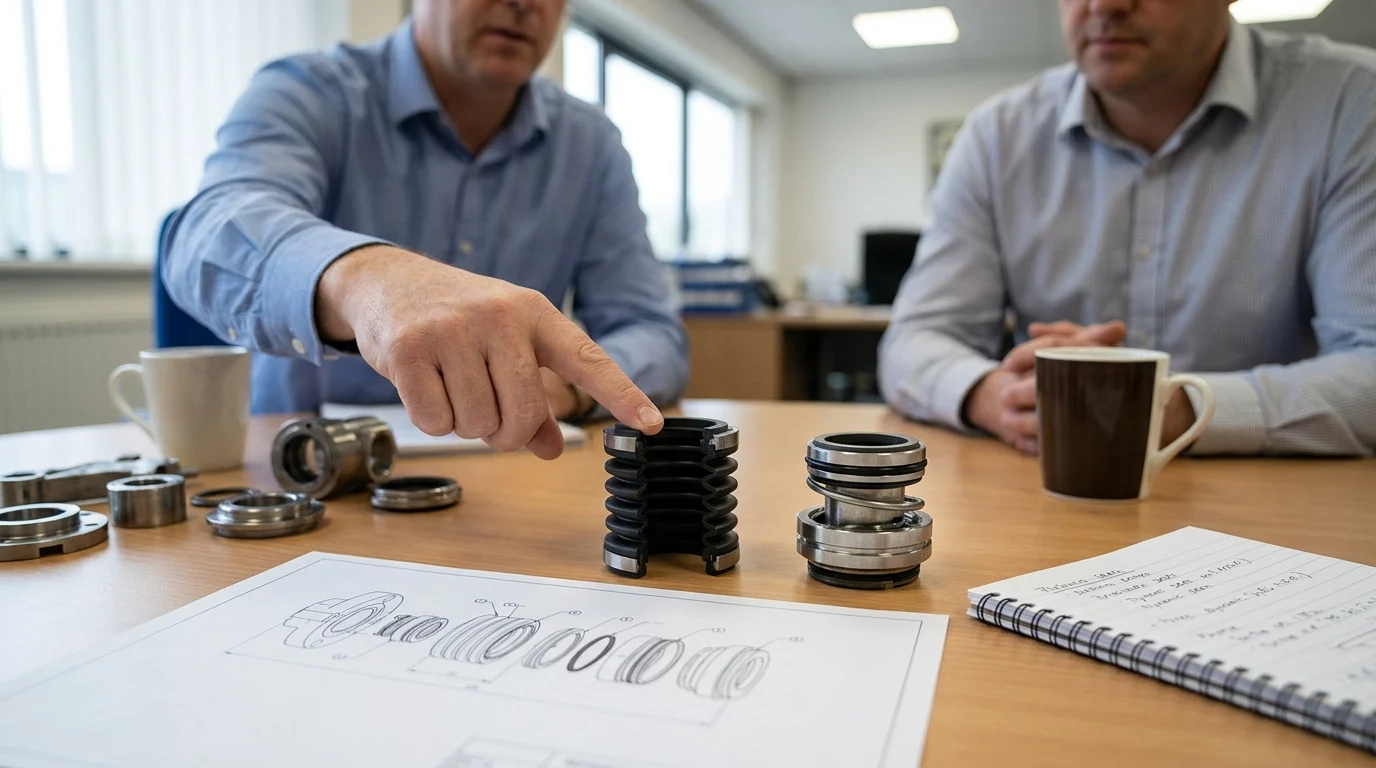
Evaluating mechanical seal options requires a rigorous comparative analysis of how different architectures respond to the physical demands of fluid transport. The primary technical divergence between an elastomeric non-pusher seal and a traditional pusher seal lies in the behavior of the secondary sealing element. This singular design variation profoundly influences wear patterns, tolerance for particulate matter, and overall lifecycle costs.
Key Design and Performance Differences
The distinction between these two technologies is rooted in how they accommodate the inevitable wear of the primary sealing faces. A traditional pusher seal utilizes a dynamic O-ring that must physically slide forward along the pump shaft or sleeve to keep the seal faces closed as they slowly wear down over thousands of hours of operation. Conversely, a non-pusher elastomeric seal remains entirely static relative to the shaft, expanding its convolutions to maintain face pressure.
| Feature / Metric | Non-Pusher (Convoluted Elastomer) | Pusher (Dynamic O-Ring) |
|---|---|---|
| Secondary Seal Movement | Static on the shaft | Dynamic (slides on shaft) |
| Shaft Wear (Fretting) | Eliminated | High risk in abrasive fluids |
| Solids Tolerance | High (handles up to 10% solids) | Low (prone to hanging up) |
| Spring Design | Single large non-clogging coil | Often multiple small springs |
| Axial Flexibility | High (absorbs >0.5mm runout) | Moderate to Low |
This fundamental architectural difference dictates how each seal interacts with process contaminants. Small springs and sliding O-rings are highly susceptible to fouling, whereas a large continuous elastomer coupled with a robust single spring provides a self-cleaning geometry that resists the accumulation of process debris.
Benefits of a Non-Sliding Secondary Seal
The most financially impactful benefit of a static secondary seal is the complete elimination of shaft fretting. In a pusher design, the microscopic back-and-forth movement of the O-ring—driven by shaft vibration and face runout—continuously strips away the protective oxide layer on the metallic shaft or sleeve. Over a 12-to-18-month operational cycle, this micro-abrasion grooves the metal, eventually providing a leak path beneath the O-ring.
Repairing fretting damage requires replacing the shaft sleeve, an operation that adds $300 to $1,000 in direct material costs per pump rebuild, alongside the labor required for complete disassembly. Because a non-pusher elastomer grips the shaft tightly and rotates with it, relative motion is localized entirely to the primary carbon or silicon carbide seal faces. Consequently, the underlying hardware remains pristine, drastically reducing the scope and cost of subsequent maintenance overhauls.
Where O-Ring Seals Still Make Sense
Despite the clear advantages of non-pusher designs, dynamic O-ring seals remain indispensable in specific extreme-duty applications. The primary limitation of convoluted elastomers is their susceptibility to pressure deformation. When stuffing box pressures exceed 12 to 16 bar (174 to 230 psi), the elastomeric bellows can distort or extrude, leading to catastrophic failure. High-pressure boiler feed pumps and multi-stage injection pumps therefore mandate pusher seals or heavily reinforced metal bellows.
Additionally, process temperatures exceeding 200°C (392°F) degrade most standard elastomers, including premium fluoroelastomers. In these extreme thermal environments, engineers must specify pusher seals equipped with specialized perfluoroelastomer (FFKM) O-rings, which can withstand temperatures approaching 320°C (608°F). Understanding these strict physical boundaries ensures that non-pusher seals are deployed exclusively within their optimal operating envelope.
Selecting Materials and Operating Limits
The ultimate success of any sealing system in the chemical industry depends on rigorous material selection and adherence to strict operating parameters. Because the convoluted elastomer serves as both the sealing barrier and the torque-transmission element, the chemical and thermal stability of the chosen rubber compound is paramount. A mismatch between the elastomer and the process fluid can result in swelling, embrittlement, or complete dissolution of the seal within hours of commissioning.
Matching Elastomers to Chemical Compatibility
Engineers typically select from three primary elastomeric families, each offering distinct chemical resistances and thermal profiles. Nitrile Rubber (NBR) is the standard choice for general-purpose water, mild oils, and non-aggressive fluids, offering a highly cost-effective solution for utilities and cooling loops. However, NBR is wholly inadequate for aggressive solvents and is strictly limited to a maximum continuous operating temperature of 100°C (212°F).
For more demanding chemical duties, Ethylene Propylene Diene Monomer (EPDM) and Fluoroelastomers (FKM) are specified. EPDM exhibits exceptional resistance to hot water, steam, alkalis, and polar solvents like ketones, operating reliably up to 140°C (284°F). Conversely, FKM is the industry standard for aggressive acids, aliphatic hydrocarbons, and petroleum-based fluids, maintaining integrity up to 200°C (392°F). Selecting the correct compound requires cross-referencing the exact chemical concentration and operating temperature against established compatibility matrices.
Handling Crystallizing, Corrosive, or Dirty Fluids
Chemical processing frequently involves fluids that precipitate solids, crystallize upon cooling, or carry high concentrations of abrasive particulates. Slurries and dirty fluids are notoriously hostile to mechanical seals. In pusher designs, particulates readily migrate beneath the dynamic O-ring or pack into the crevices of multi-spring mechanisms, causing the seal faces to hang open and leak.
Non-pusher elastomeric designs excel in these environments. The single, thick-wire coil spring is highly resistant to clogging, while the smooth, continuous surface of the elastomer provides no dead zones for solids to accumulate. When paired with hard-on-hard primary seal faces—such as Silicon Carbide against Silicon Carbide—these seals can reliably process fluids containing up to 10% solids by weight. This makes them highly effective in wastewater treatment, paper pulp processing, and the transport of crystallizing salts.
Pressure, Speed, and Temperature Limits
To guarantee safe operation, maintenance engineers must strictly enforce the mechanical and thermal limits of elastomeric non-pusher seals. Exceeding these specifications accelerates wear and invites sudden, hazardous containment breaches. The table below outlines the standard operational thresholds for typical industrial applications.
| Operating Parameter | Standard Limit | High-Performance Limit (Specialized Materials) |
|---|---|---|
| Maximum Pressure | 10 bar (145 psi) | 16 bar (230 psi) |
| Maximum Shaft Speed | 10 m/s (1,968 ft/min) | 15 m/s (2,952 ft/min) |
| Temperature Range (NBR) | -20°C to +100°C | N/A |
| Temperature Range (EPDM) | -30°C to +140°C | -40°C to +150°C (Peroxide Cured) |
| Temperature Range (FKM) | -15°C to +200°C | -20°C to +220°C |
Shaft speed is a critical, yet often overlooked, variable. At peripheral velocities exceeding 15 m/s, the centrifugal forces acting on the elastomer can cause it to balloon outward, disrupting the closing force on the seal faces. Therefore, high-speed centrifugal pumps operating at 3,600 RPM on shafts larger than 80mm generally require alternative sealing architectures.
Specifying, Sourcing, and Installing Rubber Bellows Seals
Transitioning from theoretical selection to practical application involves strict procurement controls and meticulous installation procedures. The most perfectly specified elastomer will fail if it is manufactured with substandard tolerances or installed incorrectly. Establishing a robust specification and sourcing protocol ensures that the mechanical seals delivered to the plant floor meet the exact engineering requirements of the chemical process.
Pump and Seal Specification Checklist
When specifying a replacement seal, engineers must verify that the dimensional envelope complies with the relevant pump standard. While API 682 governs heavy-duty petrochemical pumps, the majority of standard chemical pumps adhere to DIN 24960 or EN 12756. The specification checklist must include the exact shaft diameter, the L1k installation length, and the housing bore dimensions to ensure proper compression of the elastomer.
Furthermore, the specification must detail the required face material pairings. For highly corrosive but clean fluids, Carbon graphite against Silicon Carbide provides excellent dry-running survivability and low friction. For abrasive slurries, Silicon Carbide against Silicon Carbide is mandatory to resist scoring. The checklist serves as a binding technical document between the plant’s reliability engineering team and the procurement department.
Supplier Quality and Traceability Criteria
The chemical industry demands high traceability to mitigate the risks associated with counterfeit or off-spec industrial components. Suppliers must provide documentation confirming ISO 9001 manufacturing standards. For facilities producing pharmaceuticals, food-grade chemicals, or potable water derivatives, the elastomers must also carry FDA or WRAS compliance certifications, proving they are free from leachable toxins.
Quality control metrics at the manufacturing level should demonstrate a defect rate of less than 0.1%. Procurement teams should mandate batch traceability for the elastomer compounds, ensuring that if a premature failure occurs, the root cause can be isolated to a specific production run. High-tier suppliers will routinely provide material test reports (MTRs) and shore hardness certifications alongside the physical product.
Installation and Commissioning Best Practices
Installation errors account for a significant percentage of early-life seal failures. Because elastomeric non-pusher seals rely on an interference fit with the shaft to transmit torque, proper lubrication during assembly is critical. However, using the wrong lubricant is disastrous; applying petroleum-based grease to an EPDM elastomer will cause the rubber to swell by up to 40% of its original volume, completely destroying the seal before the pump is even energized.
Technicians must use approved, chemically compatible lubricants—typically a mild soap solution or a specialized silicone grease. During installation, the shaft must be inspected to ensure runout tolerances remain below 0.05mm Total Indicator Reading (TIR). Once installed, the seal must be compressed to its exact working length to ensure the spring applies the correct specific face pressure. Over-compression causes rapid face vaporization and thermal cracking, while under-compression leads to immediate weeping upon pressurization.
Decision Framework for Choosing Bellows or O-Ring Seals
Selecting the optimal sealing technology is a calculated exercise in risk management and lifecycle economics. Reliability engineers must weigh the initial capital outlay against the projected operational lifespan and the hidden costs of maintenance. By utilizing a structured decision framework, chemical plants can standardize their procurement strategies, reducing inventory complexity while maximizing equipment uptime.
Selection Matrix by Duty and Risk
A robust selection matrix categorizes pump duties by fluid characteristics and operational risk. For clean, non-hazardous fluids operating below 12 bar and 150°C, both pusher and non-pusher designs are technically viable; the choice often defaults to the non-pusher design due to its superior fretting resistance. When the fluid contains suspended solids up to 10%, or when the pump exhibits high vibration, the non-pusher elastomeric design becomes the mandatory choice to prevent dynamic hang-up.
Conversely, if the risk profile involves extreme pressures exceeding 16 bar, highly volatile hydrocarbons requiring dual-containment API 682 compliance, or temperatures soaring above 200°C, the matrix dictates a shift away from standard elastomeric bellows. In these high-risk, high-energy applications, engineered pusher seals utilizing perfluoroelastomers or edge-welded metal bellows are required to guarantee safe containment.
Lifecycle Cost Versus Purchase Price
Procurement decisions driven solely by the initial purchase price frequently result in inflated long-term costs. A standard O-ring pusher seal may present an initial acquisition cost that is 10% to 15% lower than a high-quality elastomeric non-pusher seal. However, this marginal upfront saving is rapidly eclipsed by the Total Cost of Ownership (TCO).
Lifecycle cost analyses reveal that standardizing on non-pusher designs in appropriate applications yields a 30% to 40% reduction in mechanical seal maintenance costs over a 5-year period. This reduction is primarily driven by the elimination of shaft sleeve replacements and the extension of the MTBF. When factoring in the reduced labor hours for pump rebuilds and the mitigation of unplanned downtime, the return on investment for specifying the optimal elastomer design is typically realized within the first 12 months of operation.
Final Recommendation for Chemical Plants
For the majority of low-to-medium pressure chemical processing applications, the elastomeric non-pusher seal represents the most technically sound and economically advantageous choice. Its ability to absorb mechanical runout, tolerate moderate particulate contamination, and completely eliminate shaft fretting addresses the most common root causes of premature pump failure.
Chemical plants are advised to audit their existing centrifugal pump population and identify chronic bad actors suffering from sliding-seal hang-ups or fretting damage. By systematically upgrading these specific assets to appropriately specified non-pusher designs—while strictly adhering to chemical compatibility and pressure limits—facilities can achieve a step-change improvement in baseline reliability, operational safety, and maintenance profitability.
Key Takeaways
- Choose rubber bellows seals for chemical pumps where shaft movement, vibration, or thermal growth can cause O-ring hang-up and premature leakage.
- Mechanical seal selection directly affects uptime because seal failures account for an estimated 60% to 70% of unplanned pump outages in fluid handling facilities.
- Use a non-pusher bellows design when corrosive, crystallizing, or dirty fluids could damage a sliding O-ring or cause it to stick on the shaft.
- Specify elastomer and face materials according to the process chemical, temperature, pressure, and shaft size to prevent rapid compatibility-related failures.
- Consider lifecycle cost rather than component price because downtime in continuous chemical processing can cost $10,000 to $50,000 per hour.
Frequently Asked Questions
Why do rubber bellows seals often outperform O-ring seals in chemical pumps?
Rubber bellows seals use a non-pusher design that avoids dynamic O-ring movement on the shaft. This reduces hang-up, fretting, and leakage risk in pumps exposed to corrosion, crystallizing fluids, vibration, or shaft movement.
What pump problems can rubber bellows seals help reduce?
They can help reduce leakage, shaft wear, seal hang-up, vibration-related face instability, and premature failure. This is especially valuable because mechanical seal failures can account for 60% to 70% of unplanned pump outages.
Are rubber bellows seals suitable for corrosive chemicals?
Yes, when the elastomer and seal face materials are correctly selected for the chemical. The bellows provides both secondary sealing and flexibility, making it useful in many corrosive or aggressive fluid applications.
How do rubber bellows seals affect pump maintenance costs?
By reducing dynamic shaft sealing problems and improving tolerance to vibration and misalignment, rubber bellows seals can extend service intervals and lower downtime costs, which may reach $10,000 to $50,000 per hour in continuous processing.
What shaft sizes are commonly available for rubber bellows seals?
Many standard rubber bellows mechanical seals are available for shaft sizes from about 10 mm to 100 mm, covering common ISO and DIN pump configurations used in chemical and industrial service.

Post time: Oct-18-2026