


Why Metal Bellows Seals Are a Strategic Reliability Choice
In the demanding landscape of high-pressure chemical processing, fluid containment dictates overall plant reliability. Rotating equipment engineers continuously evaluate mechanical seal architectures to mitigate fugitive emissions, protect personnel, and prevent catastrophic pump failures. As process conditions become more aggressive, traditional sealing methods often fall short, prompting a widespread transition to advanced engineered solutions.
Metal bellows seals have emerged as a strategic reliability choice, fundamentally altering the mean time between failures (MTBF) in severe applications. Plant operators replacing traditional pusher seals with metal bellows configurations frequently observe MTBF extensions from a baseline of 12 to 18 months to well over 48 months. This significant extension in equipment lifecycles drastically reduces maintenance expenditures and minimizes costly unplanned process interruptions.
Key Pump Failure Modes They Address
Mechanical seals in chemical pumps typically succumb to a predictable set of failure modes, with shaft fretting and secondary seal hang-up being the most prevalent. Fretting occurs when dynamic elastomers micro-oscillate against the pump shaft or sleeve, physically eroding the metal and compromising the sealing boundary. In abrasive or crystallizing fluid applications, shaft fretting can account for up to 35% of premature pusher seal failures.
Metal bellows seals eliminate the dynamic secondary elastomer entirely, relying instead on a static seal (typically a flexible graphite packing or static O-ring) combined with the flexing motion of the metallic core. By rendering the secondary seal static, the risk of shaft wear is neutralized. Furthermore, they address thermal distortion by providing uniform 360-degree face loading, mitigating the localized thermal warping often induced by the isolated coil springs of conventional seals.
Reliability Benefits in Chemical Processing
The chemical processing industry requires sealing solutions capable of withstanding volatile organic compounds (VOCs), highly corrosive acids, and crystallizing salts. By utilizing hermetically welded bellows, these seals remove the vulnerable dynamic O-ring from the primary chemical attack vector. This architectural shift prevents the common failure mode where elastomers swell, harden, or chemically degrade, causing the seal faces to separate and leak.
In high-temperature chemical processes, such as hot oil or heavy hydrocarbon transfer, metal bellows seals offer unparalleled thermal resilience. Depending on the metallurgy, they can consistently operate at temperatures up to 400°C (750°F) without the need for complex external cooling systems. This high-temperature capability ensures continuous processing, simplifies auxiliary piping requirements, and maintains strict compliance with environmental emission mandates.
How Metal Bellows Seals Work
Understanding the operational superiority of metal bellows seals requires an examination of their internal kinematics and metallurgical construction. Unlike multi-spring pusher seals that rely on sliding components to accommodate wear and shaft movement, metal bellows seals function through the controlled elastic deformation of a welded metal core.
Core Design and Operating Principles
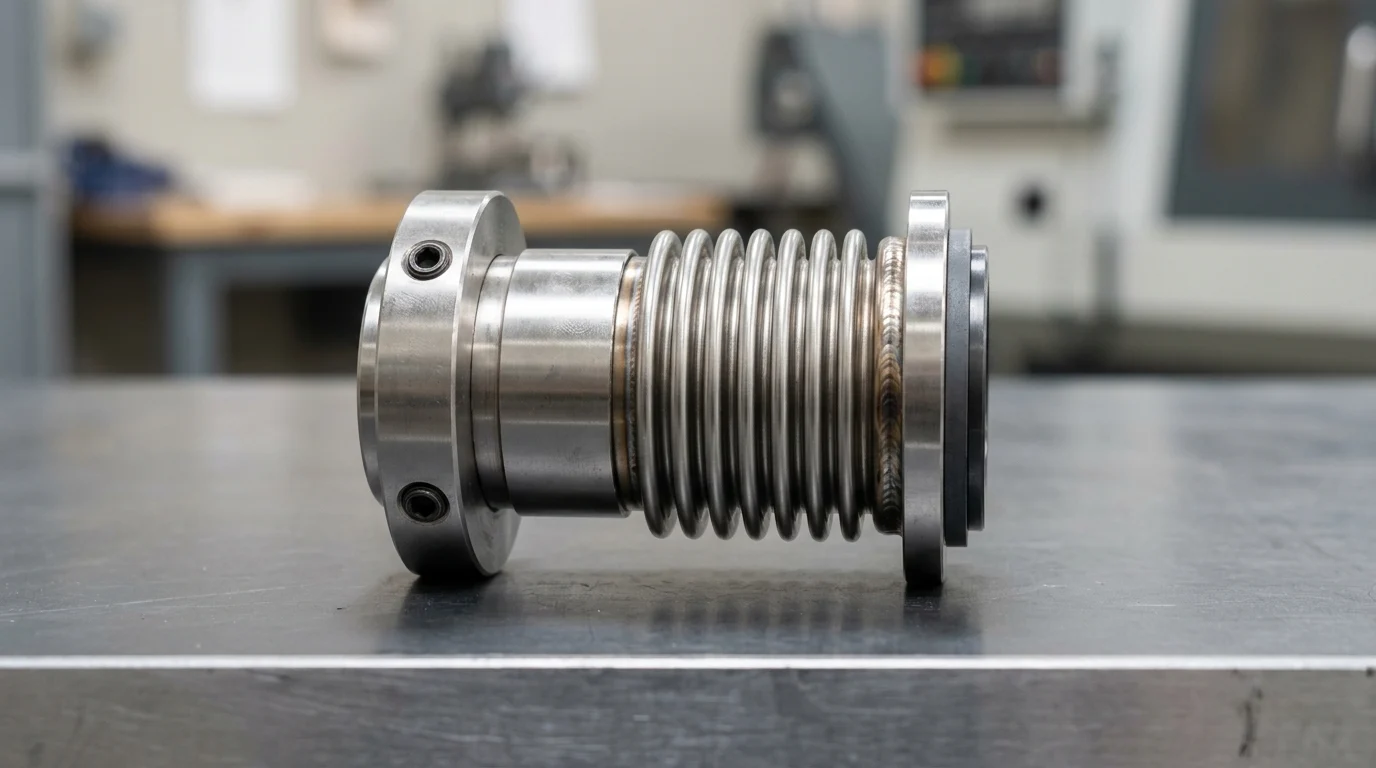
The bellows core is constructed by welding a series of precision-stamped metal leaflets at their inner and outer diameters, creating an accordion-like cylindrical structure. This assembly serves a dual purpose: it acts as the spring mechanism providing the necessary axial closing force for the primary seal faces, and it functions as the secondary sealing element, preventing fluid bypass along the shaft.
The thickness of individual bellows leaflets is meticulously engineered, typically ranging from 0.10 mm to 0.25 mm (0.004 to 0.010 inches), to provide specific spring rates and pressure deflection characteristics. As the pump shaft rotates and experiences minor axial play, thermal growth, or runout, the bellows compress and expand elastically. This continuous flexing maintains optimal face contact without the friction associated with sliding elastomers.
How Eliminating Dynamic Elastomer Movement Reduces Hang-Up
“Hang-up” is a critical failure mechanism in conventional seals where the dynamic O-ring becomes stuck on the shaft due to particulate accumulation, chemical crystallization, or elastomer degradation. When hang-up occurs, the seal faces cannot track each other properly, leading to instant and often severe leakage.
Because metal bellows seals utilize a static secondary seal—meaning the sealing element does not move axially along the shaft—the risk of hang-up is fundamentally eliminated. The absence of sliding friction also removes hysteresis, ensuring that the closing force applied to the seal faces remains perfectly consistent regardless of fluid crystallization, solid contaminants, or minor shaft deviations during operation.
Key Materials and Construction Variables
Metallurgical selection is paramount in metal bellows seal design, as the thin leaflets must withstand high fatigue cycles, aggressive corrosion, and elevated temperatures without suffering from stress corrosion cracking or fatigue failure. Standard construction often utilizes AM350 stainless steel for general duties, while highly corrosive or high-temperature environments demand superior nickel-based alloys.
| Bellows Material | Maximum Continuous Temperature | Corrosion Resistance Profile | Typical Application |
|---|---|---|---|
| AM350 Stainless Steel | 315°C (600°F) | Moderate (General Hydrocarbons) | Light chemical, standard refinery |
| Alloy C-276 (Hastelloy) | 425°C (800°F) | Excellent (Acids, Chlorides) | Aggressive chemical processing |
| Inconel 718 | 425°C (800°F) | High (Sulfur, High Temp) | High-temperature petrochem |
| Alloy 20 | 200°C (390°F) | Very High (Sulfuric Acid) | Acid transfer pumps |
By matching the bellows metallurgy to the specific process fluid, reliability engineers can ensure the seal core maintains its elastic properties and structural integrity over millions of rotational cycles.
Why Metal Bellows Seals Perform Better Under High Pressure
High-pressure chemical applications impose severe mechanical stresses on pump components. Fluid pressure gradients dictate how well the seal faces remain flat and mated. Metal bellows seals exhibit unique hydraulic and mechanical behaviors that allow them to maintain seal integrity under these extreme conditions, where fluid pressures can easily exceed 20 bar (300 psi) in standard configurations and reach up to 69 bar (1000 psi) in specialized designs.
Stable Face Loading and Axial Movement
In a high-pressure environment, maintaining a stable balance ratio is critical to preventing face extrusion, fluid vaporization, or excessive heat generation. Metal bellows seals are inherently balanced based on their mean effective diameter (the physical hinge point of the bellows convolutions).
Unlike pusher seals, where the balance line can shift if the dynamic O-ring is pushed into a new position by high pressure, the bellows’ mean effective diameter remains geometrically fixed. This stability ensures that the hydraulic closing forces acting on the seal faces remain constant, preventing catastrophic face separation during pressure surges. Furthermore, the bellows’ ability to accommodate axial shaft movement without sliding resistance ensures that high-pressure fluid does not force the seal into a mechanically bound state.
Improved Resistance to Chemical Attack
High pressures accelerate chemical attack on elastomers by forcing aggressive molecules deeper into the polymer matrix. This phenomenon can lead to rapid swelling, blistering, and explosive decompression when system pressures fluctuate. Such degradation quickly destroys the secondary sealing barrier in conventional architectures.
By replacing the dynamic elastomer with a high-strength welded metal core, metal bellows seals remove the weakest link in high-pressure chemical containment. The secondary static seal, often a flexible graphite wedge or Grafoil ring, compresses tightly under high pressure. This compression actually improves its sealing efficacy against the shaft without suffering from the extrusion or chemical degradation that plagues elastomeric O-rings under similar pressure differentials.
Reliability Metrics to Compare
Evaluating the high-pressure performance of metal bellows seals requires analyzing specific reliability metrics. Mean Time Between Repair (MTBR) is the primary indicator; chemical plants utilizing bellows seals in greater than 30 bar pressure applications frequently report MTBR exceeding 36 months, compared to 12 to 18 months for equivalent pusher seals operating under identical conditions.
Additionally, fugitive emission rates are strictly controlled and monitored. Advanced metal bellows designs consistently achieve volatile organic compound (VOC) emission rates well below the stringent 500 parts per million (ppm) threshold mandated by EPA Method 21. In well-optimized systems, they often operate continuously at less than 50 ppm, even under high-pressure fluctuations, proving their reliability in environmentally sensitive applications.
Metal Bellows Seals vs. Conventional Pusher Seals
Selecting the optimal sealing architecture requires a rigorous technical comparison between metal bellows seals and conventional pusher seals. While metal bellows offer distinct advantages in reliability and chemical resistance, pusher seals remain a foundational technology in the fluid handling industry. Understanding the precise engineering trade-offs is essential for specifying the correct seal for high-pressure chemical pumps.
Pressure Capability and Application Limits
While metal bellows seals excel in high-temperature and highly corrosive environments, conventional pusher seals historically held an advantage in absolute maximum static pressure capabilities. Heavy-duty pusher seals, particularly those designed to API 682 Category 3 standards, can routinely handle pressures exceeding 40 bar (600 psi) due to the robust cross-section of their structural components.
However, modern externally pressurized metal bellows seals have largely closed this performance gap. By orienting the bellows so that the process fluid pressure acts on the outside of the convolutions, the bellows are placed in compression rather than tension. This architectural shift significantly increases their pressure threshold, allowing engineered metal bellows configurations to match or exceed 69 bar (1000 psi) without risking convolution rupture.
Where Pusher Seals Still Make Sense
Despite the reliability advantages of metal bellows, pusher seals remain the pragmatic choice for specific operational envelopes. In applications involving clean, non-coking fluids at temperatures below 150°C (300°F), the dynamic O-ring of a pusher seal functions reliably without risk of thermal degradation or chemical hang-up.
Furthermore, pusher seals are generally more cost-effective to manufacture and repair. If a pump operates in a benign service where the historical MTBF already exceeds 48 months, upgrading to a metal bellows seal may not yield a justifiable return on investment. Pusher seals also offer greater axial flexibility in extremely long-shaft vertical pumps, where shaft thermal growth might exceed the elastic limits of a standard metal bellows core.
Face Materials, Metallurgy, Balance Ratio, and Flush Plans
The mechanical differences between these two seal types dictate different approaches to face materials, metallurgy, and environmental controls. Metal bellows seals typically employ a balance ratio between 0.75 and 0.85, which is optimized by the physical geometry of the leaflets. In contrast, pusher seals can be custom-machined to highly specific balance ratios to tune face friction.
| Feature | Metal Bellows Seal | Conventional Pusher Seal | Operational Impact |
|---|---|---|---|
| Secondary Sealing | Static (Graphite/O-ring) | Dynamic (Sliding O-ring) | Bellows eliminate shaft fretting and hang-up. |
| Temperature Limit | Up to 400°C (750°F) | Typically < 200°C (400°F) | Bellows handle hot oils without external cooling. |
| Spring Mechanism | Welded metal leaflets | Coil or wave springs | Bellows offer uniform 360° face loading. |
| Particulate Handling | Excellent (no sliding parts) | Poor (clogs dynamic O-ring) | Bellows survive crystallizing chemical services. |
When designing flush plans for abrasive services, pusher seals often require complex external flushing to keep the dynamic O-ring clean. Metal bellows seals, lacking this vulnerability, can often operate successfully with simpler flush plans or even dead-ended stuffing boxes, provided heat generation is adequately managed.
How to Specify and Apply Metal Bellows Seals
The successful deployment of metal bellows seals in high-pressure chemical pumps relies on rigorous specification, precise environmental controls, and careful installation. Even the most advanced seal architecture will fail prematurely if misapplied or subjected to operating conditions outside its engineered design envelope.
Process Data to Collect Before Specification
Accurate specification begins with comprehensive data collection. Engineers must document the fluid’s specific gravity, vapor pressure curve, and dynamic viscosity. While highly versatile, standard metal bellows seals can typically handle viscosities up to 3000 cSt before requiring special drive mechanisms to prevent the bellows core from twisting under torsional shear.
Furthermore, accurate pressure profiling is mandatory. This includes mapping the maximum dynamic discharge pressure, static suction pressure, and the specific pressure acting within the pump’s stuffing box. Chemical compatibility must be verified not just for the primary process fluid, but also for trace elements, cleaning solvents, and potential upset conditions, ensuring the selected bellows metallurgy will not suffer from localized pitting or chloride stress corrosion cracking.
Installation, Piping Plans, and Commissioning Checks
Proper environmental controls, dictated by API 682 piping plans, are critical for maximizing seal life. For single metal bellows seals operating in crystallizing services, an API Plan 62 quench (utilizing low-pressure steam or water) is often deployed to wash away atmospheric-side deposits that could restrict bellows movement.
In highly hazardous or lethal high-pressure chemical services, dual metal bellows seals are deployed using an API Plan 53A or 53B barrier fluid system. A critical commissioning check is ensuring the barrier fluid pressure is maintained at a strict margin. Typically, the barrier pressure must be set 1.5 to 2.0 bar (22 to 30 psi) above the maximum stuffing box pressure. This differential guarantees that any minor face leakage occurs inward, safely containing the hazardous process fluid within the pump casing.
Selection Criteria for Decision-Makers
For plant managers and reliability engineers, the final selection criteria must balance technical superiority with Total Cost of Ownership (TCO). The initial procurement cost of a high-alloy metal bellows seal may be 30% to 50% higher than a standard pusher seal, potentially causing hesitation during the CAPEX phase.
However, the TCO analysis heavily favors bellows in aggressive applications. By eliminating shaft fretting—which requires expensive shaft or sleeve replacements—and extending the MTBF from months to years, the reduction in maintenance labor, replacement parts, and lost production time yields a rapid payback. Standardizing on metal bellows seals for high-pressure, high-temperature, and corrosive chemical applications establishes a foundation for long-term operational excellence and predictable plant reliability.
Key Takeaways
- Evaluate metal bellows seals when pusher seals in chemical pumps are failing every 12–18 months, because suitable upgrades can extend MTBF beyond 48 months.
- Use metal bellows designs to eliminate dynamic secondary elastomer movement and reduce shaft fretting, a contributor to up to 35% of premature pusher seal failures in abrasive or crystallizing services.
- Select hermetically welded bellows for aggressive chemicals to reduce leakage risks caused by elastomer swelling, hardening, or chemical degradation.
- Specify appropriate bellows metallurgy for hot oil, heavy hydrocarbon, and other high-temperature services that may reach about 400°C or 750°F.
- Consider metal bellows seals when uniform 360-degree face loading is needed to control thermal distortion and improve sealing stability in high-pressure pumps.
Frequently Asked Questions
What makes metal bellows seals more reliable than pusher seals?
Metal bellows seals eliminate the dynamic secondary elastomer used in pusher seals. This reduces shaft fretting, O-ring hang-up, chemical swelling, and thermal distortion, making them better suited for high-pressure and severe chemical pump service.
How much can metal bellows seals improve pump MTBF?
In demanding chemical applications, replacing traditional pusher seals with metal bellows designs can extend mean time between failures from about 12–18 months to more than 48 months, depending on operating conditions and seal selection.
Are metal bellows seals suitable for high-temperature chemicals?
Yes. With the right metallurgy, metal bellows seals can operate in high-temperature services up to about 400°C or 750°F, often reducing the need for complex external cooling systems.
Do metal bellows seals prevent shaft fretting?
They greatly reduce the risk because the secondary seal is static rather than sliding on the shaft or sleeve. This removes a common source of wear found in conventional pusher seal designs.
What chemicals are metal bellows seals commonly used for?
They are often selected for volatile organic compounds, corrosive acids, crystallizing salts, hot oils, and heavy hydrocarbons where elastomer degradation, emissions, or high temperatures are major reliability concerns.

Post time: Oct-19-2026