


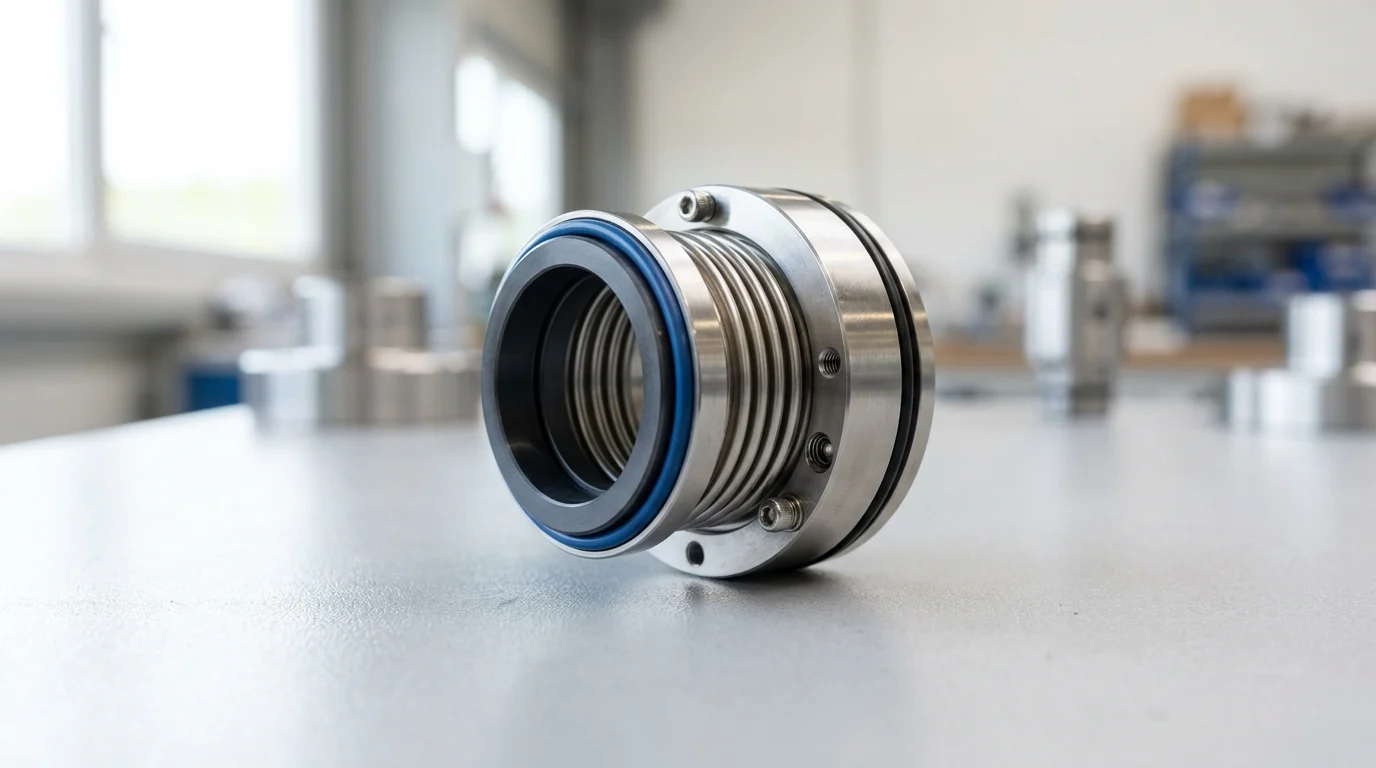
Why Bellows Mechanical Seals Matter in High-Temperature Service
In chemical processing, refining, and power generation, rotating equipment frequently operates under extreme thermal stress. Effectively sealing pumps, agitators, and reactors in these environments is critical to maintaining operational safety, preventing fugitive emissions, and avoiding catastrophic fluid loss. When media temperatures escalate beyond the capabilities of standard elastomeric components, the engineering debate inevitably centers on the selection of the appropriate mechanical seal architecture.
Bellows mechanical seals represent a sophisticated engineering solution designed specifically to address the vulnerabilities inherent in traditional pusher-style seals under high-temperature conditions. By eliminating dynamic elastomers and substituting them with a flexible metallic core, these seals redefine the operational boundaries of rotating equipment. Understanding the mechanical behavior, failure modes, and lifecycle costs associated with high-temperature sealing is essential for reliability engineers tasked with maximizing plant uptime.
Thermal Reliability and Uptime Risk
Thermal reliability is a primary driver of plant profitability. In continuous process industries, the failure of a single pump seal can trigger a cascading shutdown, resulting in lost production that frequently costs between $10,000 and $50,000 per day. When standard elastomeric seals are pushed beyond their thermal limits, the Mean Time Between Failures (MTBF) can plummet to fewer than six months, forcing facilities into a reactive maintenance cycle.
Implementing bellows mechanical seals in appropriate high-temperature applications directly mitigates this uptime risk. Because the metallic bellows assembly acts as both the spring mechanism and the secondary sealing element, it removes the temperature-sensitive dynamic O-ring from the equation. Facilities transitioning from failing pusher seals to edge-welded metal bellows in processes exceeding 200°C (392°F) routinely observe MTBF extensions from a few months to well over 36 months, fundamentally altering the Total Cost of Ownership (TCO) for the asset.
Common High-Temperature Seal Failure Points
The failure of standard mechanical seals in high-temperature environments rarely stems from the primary seal faces; instead, the secondary elastomeric seals are typically the weakest link. As temperatures rise, standard O-rings experience compression set—a permanent deformation that destroys their ability to maintain radial sealing force against the shaft. Once compression set occurs, fluid bypasses the secondary seal, resulting in immediate leakage.
Another critical failure point is elastomer carbonization and extrusion. At elevated temperatures, chemical degradation causes polymers to harden and fracture. Furthermore, high-temperature fluids such as heavy hydrocarbons, heat transfer oils, and asphalt have a tendency to coke or crystallize upon exposure to the atmosphere. In a traditional pusher seal, this coking builds up along the shaft, physically locking the dynamic O-ring in place. This phenomenon, known as ‘hang-up,’ prevents the seal faces from closing as they wear, leading to rapid and catastrophic seal failure.
Metal Bellows Seals vs O-Ring Mechanical Seals
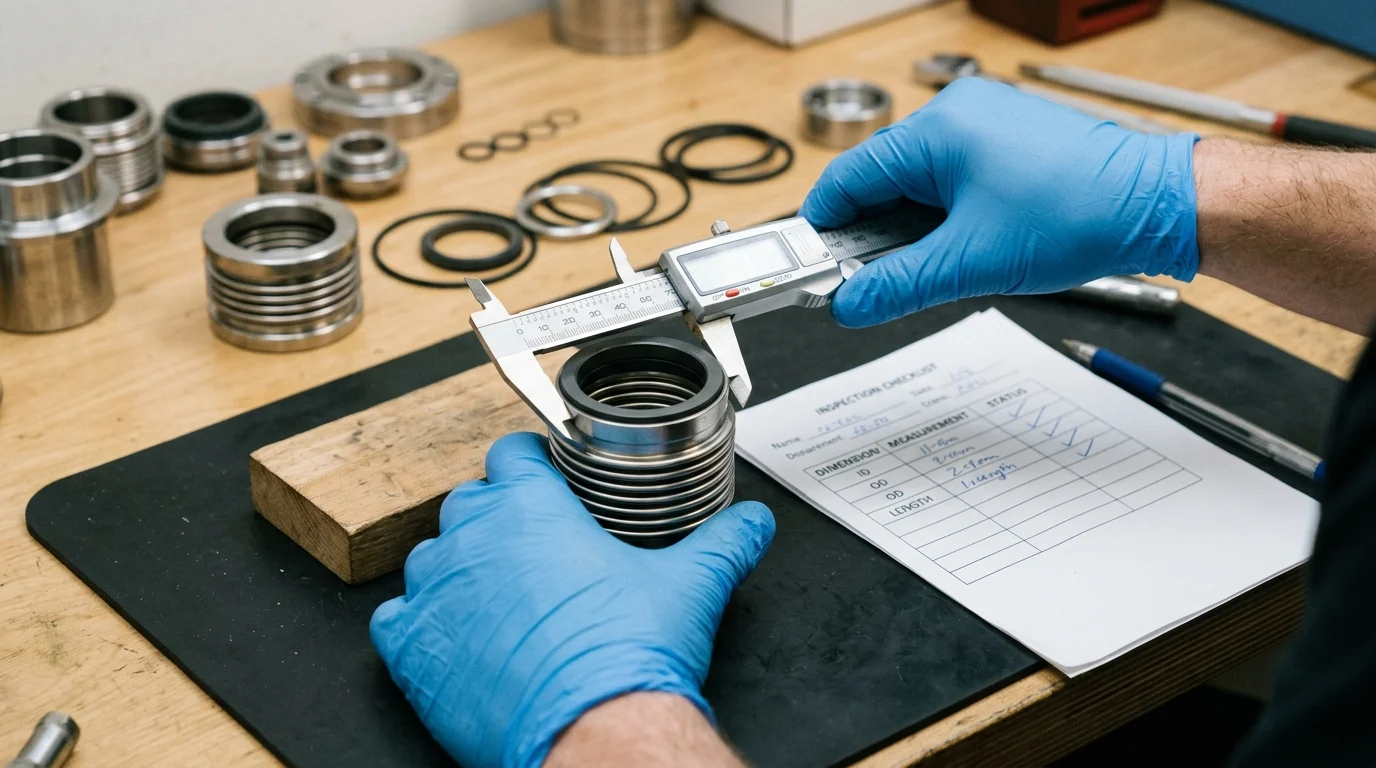
The fundamental distinction between metal bellows seals and O-ring mechanical seals lies in their kinematic response to face wear and shaft movement. This distinction categorizes them into two primary mechanical seal families: non-pusher seals (bellows) and pusher seals (O-ring designs).
While both designs utilize precision-lapped primary faces to maintain a fluid film and prevent leakage, the mechanisms they employ to keep those faces closed under varying operational states dictate their suitability for aggressive, high-temperature applications.
Core Design Differences
Pusher seals utilize a dynamic O-ring that must physically slide—or ‘push’—along the pump shaft or sleeve to compensate for face wear and thermal shaft expansion. This sliding motion requires a clean, smooth shaft surface to function correctly. If the shaft becomes scored, or if process fluid crystallizes behind the seal face, the O-ring cannot advance, and the seal will leak.
Conversely, metal bellows seals are non-pusher designs. They accommodate face wear and shaft movement through the axial flexing of welded metal convolutions. These convolutions are typically constructed from ultra-thin metal plies, ranging from 0.15mm to 0.25mm in thickness, welded at the inner and outer diameters. Because the bellows unit expands and contracts like an accordion, there is no dynamic secondary seal required to slide along the shaft, completely eliminating the risk of shaft fretting and O-ring hang-up.
| Feature | Pusher (O-Ring) Seal | Non-Pusher (Metal Bellows) Seal |
|---|---|---|
| Secondary Seal Motion | Dynamic (slides on shaft) | Static (no sliding required) |
| Wear Compensation | Spring force pushes O-ring forward | Bellows core flexes axially |
| Shaft Fretting Risk | High (due to sliding O-ring) | Eliminated |
| Coking Vulnerability | High (hang-up risk) | Low (no sliding parts to jam) |
Secondary Sealing and Spring Loading
In a standard O-ring mechanical seal, the closing force is provided by a series of coil springs or a single large wave spring. These springs are often exposed to the process fluid, making them highly susceptible to clogging, corrosion, and stress-corrosion cracking. If the springs become packed with particulates or viscous media, they lose their ability to maintain face contact, leading to premature failure.
Metal bellows seals ingeniously integrate the spring loading mechanism directly into the secondary seal. The welded metal convolutions inherently possess a calculated spring rate, providing uniform, 360-degree face loading without the need for auxiliary coil springs. By eliminating the springs, the bellows design creates a cleaner, more open profile that actively resists clogging, making it exceptionally reliable in viscous or particulate-laden high-temperature fluids.
Temperature and Media Compatibility
Temperature and chemical compatibility form the most rigid boundary conditions for seal selection. O-ring seals are strictly limited by polymer chemistry. Standard Fluoroelastomers (FKM) degrade rapidly above 204°C (400°F). Even advanced Perfluoroelastomers (FFKM), which offer exceptional chemical resistance, typically reach their maximum continuous operating limit at 327°C (620°F).
Metal bellows, relying on advanced metallurgy rather than polymer science, easily bypass these limitations. Bellows constructed from materials like AM350 stainless steel or Alloy 20 can operate efficiently up to 315°C (600°F) or 400°C (750°F) depending on the construction. For extreme applications, High-Nickel alloys such as Inconel 718 push the thermal boundary even further, reliably operating in process streams exceeding 425°C (800°F) while maintaining excellent resistance to harsh chemical corrosion.
Where Metal Bellows Mechanical Seals Outperform
While standard pusher seals command the majority of the general-purpose pump market, metal bellows mechanical seals establish definitive superiority in specific, highly demanding process conditions. Their unique architectural advantages translate into measurable performance gains when applied to the correct operational profiles.
Engineers operating within the refining, petrochemical, and high-temperature manufacturing sectors specifically target metal bellows for applications where traditional elastomeric limitations would otherwise dictate unacceptable maintenance intervals and safety risks.
Handling Thermal Expansion
Thermal expansion is an unavoidable reality in high-temperature rotating equipment. As a pump or reactor reaches operating temperature, the metallic shaft elongates. In a pusher seal configuration, the dynamic O-ring must overcome static friction (stiction) to slide along this expanding shaft, which can temporarily disrupt the fluid film between the primary seal faces and cause localized overheating or face blistering.
Metal bellows seals handle thermal transients with exceptional grace. Because the bellows core is highly compliant in the axial direction, it absorbs shaft growth seamlessly. The static secondary seals (typically flexible graphite in high-temperature configurations) remain locked in place, while the bellows flexes to maintain consistent face pressure. This capability makes bellows seals the definitive choice for batch processes or systems that undergo frequent, extreme temperature cycling.
Performance in Pumps and Reactors
In high-temperature centrifugal pumps and agitated reactors handling challenging media—such as vacuum bottoms, hot asphalt, and thermal fluids (e.g., Dowtherm)—metal bellows seals are frequently mandated by corporate reliability standards. The American Petroleum Institute’s API 682 standard explicitly recognizes the necessity of non-pusher seals, categorizing high-temperature metal bellows as Type B or Type C seals.
The open-convolution design of the bellows acts as a natural centrifuge during rotation, throwing off particulates and preventing the accumulation of solids. Furthermore, because there is no sliding pusher element, the localized cooling of hot hydrocarbons that often causes coking at the atmospheric side of the seal does not result in mechanical hang-up. The seal faces remain fully loaded and responsive regardless of external coking.
Temperature Capability Comparison
The performance gap between elastomeric seals and metal bellows is most starkly illustrated by their respective thermal ceilings. The transition from polymers to specialized alloys fundamentally changes the operational envelope of the equipment.
| Material Classification | Specific Material Grade | Maximum Continuous Temp Limit | Typical High-Temp Application |
|---|---|---|---|
| Standard Elastomer | FKM (Viton™) | 204°C (400°F) | General water/oil, low-temp chemicals |
| Advanced Elastomer | FFKM (Kalrez™) | 327°C (620°F) | Aggressive chemicals, moderate hot oil |
| Standard Metal Bellows | AM350 Stainless Steel | 400°C (750°F) | Standard refinery hydrocarbons, asphalt |
| Advanced Metal Bellows | Alloy 718 (Inconel™) | 425°C+ (800°F+) | Extreme high-temp bottoms, corrosive hot media |
When process temperatures exceed 300°C, the reliance on FFKM O-rings becomes financially and technically precarious. At these extremes, the integration of edge-welded metal bellows with flexible graphite secondary seals provides a robust, purely metallurgical and carbon-based sealing envelope that is entirely immune to polymer degradation.
When O-Ring Mechanical Seals Are Still a Better Choice
Despite the clear technical advantages of metal bellows in extreme environments, O-ring mechanical seals remain the dominant technology across the broader industrial landscape. It is critical for engineers to recognize that bellows seals are not a universal upgrade; in many scenarios, deploying a metal bellows seal would be an unnecessary over-specification.
Pusher seals offer a combination of pressure handling capability, material versatility, and economic efficiency that makes them the optimal choice for the vast majority of standard process applications. Understanding the operational thresholds where O-rings outperform bellows is key to maintaining an optimized equipment budget.
Process Conditions That Favor O-Rings
The most significant operational limitation of a standard metal bellows seal is its pressure handling capability. The thin metal plies required for axial flexibility are inherently vulnerable to high differential pressures. Most standard edge-welded bellows seals are rated for maximum pressures of 20 to 25 bar (approx. 300 to 360 psi). If subjected to pressures beyond this limit, the bellows can experience ‘squirm’—a catastrophic distortion of the convolutions.
In contrast, O-ring pusher seals excel in high-pressure environments. Because the O-ring is fully supported within a machined gland and the spring mechanisms are highly robust, pusher seals can be engineered to handle pressures exceeding 100 bar (1,450 psi). For high-pressure boiler feed pumps, pipeline pumps, and deep-well injection systems, robust O-ring mechanical seals are unequivocally the superior and safer engineering choice.
High-Temperature O-Ring Material Options
Advancements in polymer science have significantly narrowed the gap between pusher and non-pusher seals in the moderate-to-high temperature spectrum. Perfluoroelastomers (FFKM), marketed under brand names like Kalrez, Chemraz, and Isolast, offer nearly universal chemical compatibility combined with impressive thermal stability.
For processes operating between 200°C and 300°C that involve clean, non-coking fluids, an O-ring seal equipped with FFKM elastomers is often a highly reliable choice. While FFKM O-rings represent a premium cost over standard FKM, they are still generally less expensive and complex than a fully engineered metal bellows seal. If the fluid does not present a hang-up risk (i.e., no suspended solids or crystallizing tendencies), the dynamic sliding action of the O-ring remains perfectly viable at these elevated temperatures.
Cost, Availability, and Repairability
Commercial realities heavily influence seal selection. O-ring mechanical seals are fundamentally less complex to manufacture than edge-welded metal bellows. Consequently, a standard pusher seal is typically 30% to 50% less expensive upfront than a comparably sized metal bellows seal. Furthermore, pusher seals utilize standardized, interchangeable components that are widely stocked by global distributors.
Repairability and lead times also strongly favor O-ring designs. A standard pusher seal can often be rebuilt locally within a few days by replacing the faces, springs, and inexpensive elastomers. Conversely, if a metal bellows core is damaged or fatigued, the entire bellows assembly must be replaced, requiring specialized welding and manufacturing processes. Custom bellows replacement can easily incur lead times of 6 to 8 weeks, which may be unacceptable for facilities lacking robust spare parts inventory.
How Engineers Should Select the Right Seal
Selecting between a metal bellows seal and an O-ring mechanical seal requires a systematic engineering approach rather than reliance on localized preference. Engineers must evaluate a matrix of thermodynamic, mechanical, and commercial variables to ensure the specified seal achieves the optimal balance of reliability and cost.
A rigorous selection protocol protects the facility from both dangerous under-specification (leading to premature failure and emissions) and wasteful over-specification (tying up capital in unnecessary exotic metallurgy).
Step-by-Step Selection Criteria
The specification process must begin with a comprehensive review of the operating envelope. Engineers should first evaluate the maximum operating temperature; if the fluid consistently exceeds 327°C (620°F), elastomers are disqualified, and a metal bellows with graphite secondary seals is mandatory. Next, the maximum dynamic pressure must be assessed. If the seal chamber pressure exceeds 25 bar (360 psi), standard bellows are at risk of squirm, pushing the selection back toward a heavy-duty pusher seal or a highly customized, multi-ply bellows.
Beyond temperature and pressure, fluid rheology plays a decisive role. Engineers must analyze the media for its tendency to crystallize, polymerize, or coke upon atmospheric contact. If the fluid is a heavy hydrocarbon or contains a high concentration of suspended solids, the non-pusher bellows design is strongly recommended to prevent hang-up, even if the temperature is well within the acceptable range for standard O-rings.
Compliance and Documentation Needs
Regulatory compliance and industry standards frequently dictate the acceptable sealing technology. In the oil and gas sector, API 682 (4th Edition) provides a stringent framework for seal selection. For high-temperature refinery services, API 682 heavily favors Type B (metal bellows, FKM secondary) or Type C (metal bellows, graphite secondary) configurations to ensure maximum containment integrity.
Furthermore, material documentation is critical in hazardous high-temperature applications. Engineers must ensure that the selected bellows materials or high-performance elastomers comply with specific metallurgical requirements, such as NACE MR0175 for sour gas (H2S) environments. Complete Material Test Reports (MTRs) should be mandated during the procurement phase to verify that the specified Alloy 718 or AM350 meets the exact chemical composition required to survive the intended process conditions.
Final Decision Framework
The final decision framework must culminate in a Total Cost of Ownership (TCO) analysis. While capital expenditure (CapEx) for a metal bellows seal is higher, operational expenditure (OpEx) will drastically decrease if the seal resolves chronic O-ring failures. A standard industry benchmark suggests that if an O-ring pusher seal in a high-temperature application demonstrates an MTBF of less than 12 months due to elastomer degradation or coking, upgrading to a metal bellows seal is economically justified.
Ultimately, reliability engineers must weigh the immediate cost and availability of pusher seals against the long-term, maintenance-free operational life offered by metal bellows. By objectively mapping temperature limits, pressure thresholds, and fluid characteristics against these two distinct sealing architectures, facilities can achieve maximum rotating equipment reliability in even the most severe thermal environments.
Key Takeaways
- Use metal bellows mechanical seals when process temperatures exceed about 200°C and elastomer-based pusher seals show shortened service life.
- Treat dynamic O-rings as the likely failure point in hot service because compression set, carbonization, extrusion, and hang-up can cause immediate leakage.
- Evaluate total cost of ownership, not only purchase price, because one failed pump seal can cost a continuous plant $10,000 to $50,000 per day in lost production.
- Consider upgrading from O-ring pusher seals to edge-welded metal bellows when MTBF has fallen below six months in high-temperature applications.
- Match seal architecture to the fluid behavior, since heavy hydrocarbons, heat transfer oils, and asphalt can coke or crystallize and restrict seal movement.
Frequently Asked Questions
Why are metal bellows seals preferred above 200°C?
They eliminate the dynamic elastomer O-ring that commonly hardens, takes compression set, or hangs up at high temperature. The metal bellows provides both spring force and secondary sealing.
What is the main weakness of O-ring mechanical seals in hot service?
The secondary elastomer can lose elasticity, carbonize, extrude, or stick to the shaft. Once it cannot move with face wear, leakage and rapid seal failure can follow.
Can bellows mechanical seals improve pump uptime?
Yes. In suitable high-temperature applications, switching from failing pusher seals to metal bellows designs can extend MTBF from under six months to more than 36 months.
Are bellows seals always better than O-ring seals?
No. O-ring seals can be economical and reliable in moderate temperatures. Metal bellows are usually justified when heat, coking, crystallization, or elastomer compatibility creates failure risk.
What industries commonly use high-temperature bellows seals?
Chemical processing, refining, power generation, marine systems, and heavy hydrocarbon services often use bellows seals where standard elastomeric components cannot tolerate the process conditions.

Post time: Oct-17-2026