


Introduction
Choosing a mechanical seal manufacturer with OEM services affects far more than component cost; it shapes equipment reliability, maintenance intervals, and long-term operating risk. The strongest suppliers do more than produce seals to specification—they provide application engineering, material guidance, quality control, and manufacturing consistency that fit the demands of pumps and rotating equipment. This article explains the practical criteria that separate a capable OEM partner from a basic parts vendor, including customization ability, testing standards, lead times, technical support, and supply stability, so you can evaluate manufacturers with a clearer view of performance, lifecycle value, and procurement risk.
Why Choosing the Right Mechanical Seal Manufacturer Matters
Selecting a mechanical seal manufacturer with comprehensive OEM services is a critical strategic decision for rotating equipment operators and pump builders. Mechanical seals represent a disproportionate point of vulnerability in fluid handling systems; industry data consistently indicates that 60% to 70% of centrifugal pump failures originate at the mechanical seal interface. Partnering with a specialized OEM manufacturer ensures that these critical components are engineered to exact application profiles rather than relying on generic, off-the-shelf alternatives.
Benefits of OEM Services
Engaging a manufacturer that provides OEM services yields significant operational advantages, primarily through component optimization and supply chain integration. OEM partners possess the engineering infrastructure to tailor seal geometries, spring tensions, and face topographies to specific fluid dynamics. This level of customization routinely extends the mean time between failures (MTBF) by 25% to 40% compared to standard aftermarket seals. Furthermore, OEM services often include consolidated inventory management and dedicated production runs, which streamline procurement and reduce total cost of ownership (TCO).
Risks of Choosing the Wrong Supplier
Conversely, procuring seals from substandard manufacturers introduces profound operational and financial risks. Inadequate face flatness—often deviating beyond the acceptable 2 to 3 helium light bands—results in premature wear and fugitive emissions. In high-stakes environments such as petrochemical processing, a catastrophic seal failure can incur downtime costs ranging from $10,000 to $50,000 per hour, excluding the environmental penalties associated with hazardous fluid leaks. A mismatched supplier may also lack the metallurgical traceability required to prevent galvanic corrosion in aggressive chemical applications.
Technical Capabilities to Evaluate
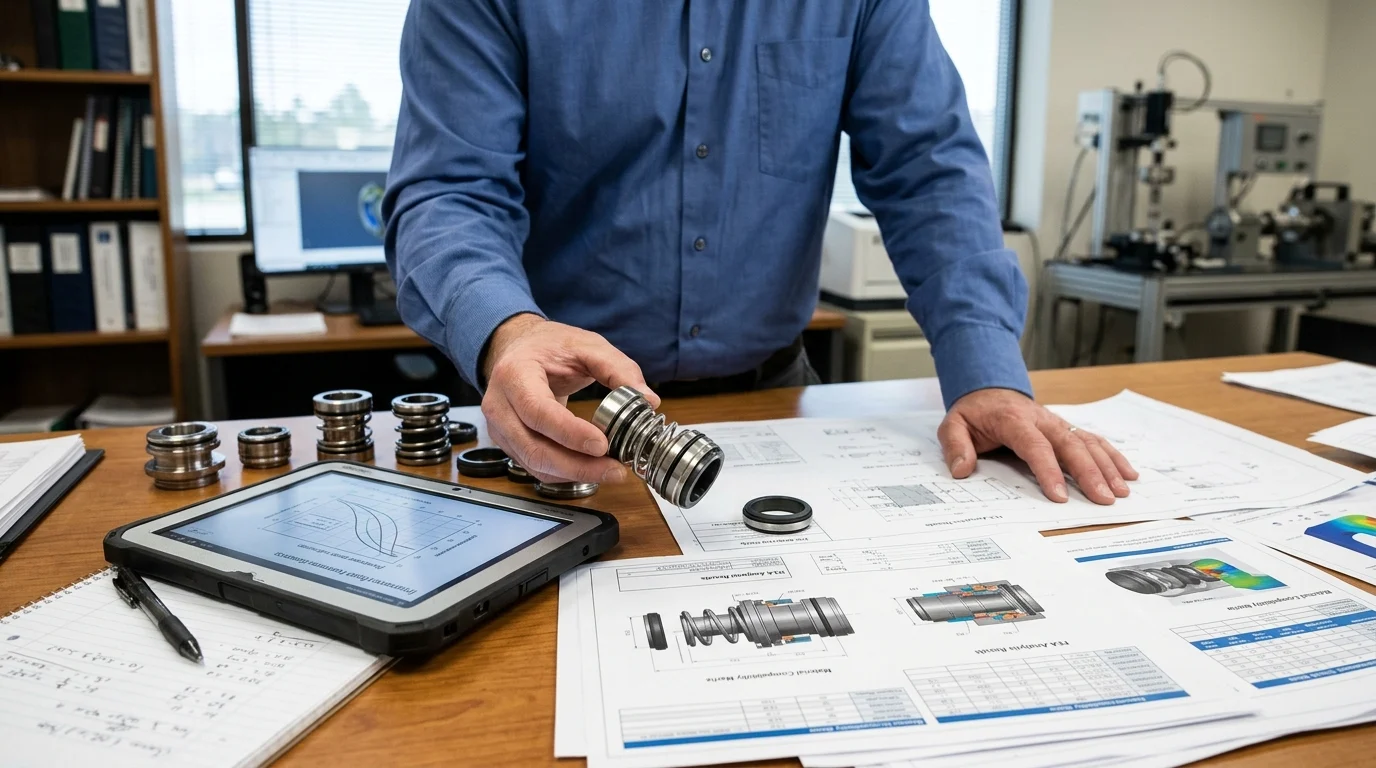
A top-tier mechanical seal manufacturer must demonstrate advanced technical capabilities to address extreme operational envelopes. Evaluating an OEM partner requires scrutinizing their engineering infrastructure, particularly their utilization of finite element analysis (FEA) to predict thermal distortion and computational fluid dynamics (CFD) to model barrier fluid circulation. A competent manufacturer should confidently engineer seals for pressure thresholds exceeding 3,000 psi and temperature extremes ranging from -40°C to 400°C.
Seal Designs and Material Options
The manufacturer’s portfolio must encompass a broad spectrum of seal configurations, including single, double, pusher, and bellows designs. Material science is equally critical. The supplier must source and precisely machine premium face materials such as reaction-bonded silicon carbide (SiC) and nickel-bound tungsten carbide (WC). Secondary sealing elements demand a robust supply chain for high-performance elastomers, ranging from standard FKM (fluoroelastomers) to highly specialized FFKM (perfluoroelastomers) capable of withstanding aggressive solvents at temperatures up to 300°C.
Engineering and Customization Support
True OEM capability extends beyond manufacturing into collaborative engineering. The ideal partner offers comprehensive customization support, including reverse engineering of legacy components and rapid prototyping. Advanced manufacturers can typically transition from a conceptual CAD model to a functional, machined prototype within a 3- to 5-week window. This agility is vital for pump OEMs developing next-generation equipment that requires non-standard shaft diameters or unique gland plate configurations.
How to Compare Technical Capabilities
To systematically evaluate prospective partners, procurement and engineering teams should benchmark technical competencies against industry standards. Utilizing a tiered evaluation matrix helps quantify a supplier’s true capabilities.
| Capability Tier | Design Infrastructure | Material Breadth | Prototyping Speed |
|---|---|---|---|
| Tier 3 (Basic) | 2D CAD, standard templates | Carbon, Ceramic, NBR | 8-12 weeks |
| Tier 2 (Intermediate) | 3D CAD, basic FEA | SiC, FKM, standard bellows | 6-8 weeks |
| Tier 1 (Advanced OEM) | Full 3D modeling, FEA, CFD | WC, FFKM, custom alloys (Hastelloy) | 2-4 weeks |
Quality Systems and Compliance
Rigorous quality management systems are the bedrock of reliable mechanical seal manufacturing. Because fluid containment relies on microscopic tolerances, any deviation in the manufacturing process can lead to immediate operational failure. Top-tier manufacturers must operate with defect rates measured strictly in parts per million (PPM), typically targeting a threshold of <50 PPM for precision-machined seal faces.
Certifications and Traceability
Foundational to any OEM partnership is ISO 9001:2015 certification, but specialized manufacturers must go further. Complete metallurgical and elastomeric traceability is mandatory. Buyers should require EN 10204 3.1 material test reports (MTRs) for all metallic components to verify alloy composition and heat treatment processes. This traceability ensures that components subjected to corrosive environments, such as duplex stainless steel springs or Hastelloy C-276 bellows, meet precise chemical specifications and are immune to unexpected stress corrosion cracking.
API, ISO, and Industry Requirements
Depending on the end-user market, the manufacturer must demonstrate compliance with stringent industry standards. For the oil and gas sector, adherence to API 682 (4th Edition) is a prerequisite. This standard dictates rigorous qualification parameters, including dynamic testing of the seal at 110% of its maximum allowable working pressure for a minimum of 100 hours without exceeding strict emission limits. Similarly, manufacturers serving the pharmaceutical or food processing sectors must provide elastomers compliant with FDA 21 CFR 177.2600 and USP Class VI toxicity standards, ensuring zero contamination of process fluids.
Commercial and Service Factors
While technical and quality metrics dictate the physical performance of a mechanical seal, commercial terms govern the financial viability of the OEM partnership. An effective manufacturer must align their production capabilities with the buyer’s inventory strategies, cash flow requirements, and time-to-market demands. Assessing these commercial factors requires a deep dive into the supplier’s supply chain elasticity and cost structures.
MOQ, Lead Time, and Tooling Terms
Minimum order quantities (MOQs) and lead times are primary commercial friction points. A flexible OEM partner will offer tiered MOQs, accommodating pilot runs of 20 to 50 units before scaling to production volumes of 1,000 or more units. Tooling costs for custom elastomeric boots or unique stamped metal components must be clearly amortized. Furthermore, standard production lead times of 10 to 14 weeks should be supplemented by formalized expedited programs, allowing for emergency fulfillment within 3 to 4 weeks when supply chain disruptions occur.
Main Cost Drivers
Understanding the manufacturer’s pricing architecture is essential for long-term cost control. Material selection is the most volatile cost driver; upgrading a secondary O-ring from standard FKM to a specialized FFKM compound can increase the unit cost of that specific component by over 500%. Secondary cost drivers include the complexity of face topography—such as laser-machined hydrodynamic grooves for non-contacting gas seals—and the necessity for specialized surface treatments like diamond-like carbon (DLC) coatings to reduce frictional heat.
Supplier Evaluation Steps
Establishing a rigorous commercial evaluation process ensures objective supplier selection. The following table illustrates a standard commercial weighting matrix used by procurement professionals to rank competing manufacturers.
| Evaluation Metric | Target Benchmark | Commercial Weighting |
|---|---|---|
| Standard Lead Time | < 10 weeks | 25% |
| Custom MOQ | < 100 units | 20% |
| Tooling Amortization | Spread over 1st year | 15% |
| Cost Competitiveness | Within 10% of market median | 40% |
How to Make the Final Supplier Decision
Transitioning from the evaluation phase to a finalized OEM partnership requires synthesizing disparate data points into a cohesive decision-making framework. The objective is to select a mechanical seal manufacturer that not only meets current technical specifications but possesses the organizational maturity to scale alongside future product developments and market expansions.
Weighted Decision Criteria
Engineering and procurement teams should utilize a weighted decision matrix to eliminate subjective biases. A standard industrial scorecard often allocates 40% of the total score to technical and engineering capabilities, 30% to quality assurance and historical defect rates, 20% to commercial pricing and terms, and 10% to geographic logistics and communication responsiveness. Manufacturers scoring above an 85% threshold on this composite index are generally considered viable candidates for deep OEM integration.
Final Selection Priorities
The final selection process must prioritize physical validation over theoretical capability. Shortlisted manufacturers should undergo a rigorous pilot testing phase, typically involving the procurement of 10 to 20 prototype seals subjected to accelerated life cycle testing on the buyer’s test rigs. Concurrently, a formal plant audit—conducted in accordance with ISO 19011 guidelines—should be executed to verify the manufacturer’s machining tolerances, lapping capabilities, and cleanroom assembly conditions. To mitigate long-term supply chain risks, many large-scale buyers ultimately establish a dual-source strategy, awarding 70% to 80% of the volume to the primary OEM partner while retaining a secondary validated supplier for the remainder.
Key Takeaways
- The most important conclusions and rationale for mechanical seal manufacturer
- Specs, compliance, and risk checks worth validating before you commit
- Practical next steps and caveats readers can apply immediately
Frequently Asked Questions
Why choose a mechanical seal manufacturer with OEM services?
OEM support helps match seal design, materials, and dimensions to your pump and fluid, reducing leakage, unplanned downtime, and replacement frequency.
What technical capabilities should I check in a mechanical seal manufacturer?
Look for broad seal types, material options like SiC, WC, FKM, and FFKM, plus 3D design, reverse engineering, and prototype support for custom pumps.
Can Victor Seals provide OEM-compatible replacements for major pump brands?
Yes. Victor Seals supplies OEM-compatible seals and replacement parts for brands including IMO, Alfa Laval, Grundfos, APV, Flygt, Fristam, Lowara, and Allweiler.
How do I verify quality when selecting a seal supplier?
Check for consistent dimensional control, material traceability, application review, and a stable production setup. Ask for drawings, material details, and inspection records before ordering.
Which industries benefit most from custom mechanical seals?
Custom seals are especially useful in chemical, mining, oil and gas, petrochemical, power, pulp and paper, shipbuilding, and water applications with demanding pump conditions.
Post time: May-28-2026