


Introduction
A water pump seal does more than stop coolant leaks: it protects the boundary between rotating pump components and the engine’s pressurized cooling circuit. When that seal degrades, coolant loss, bearing contamination, reduced circulation, and overheating can follow in quick succession. Understanding how these seals work is essential for diagnosing pump failures, improving service life, and maintaining stable engine temperatures under modern operating demands. This article explains the seal’s role in cooling efficiency, the stresses it faces from heat, pressure, friction, and coolant chemistry, and the failure patterns that most often lead to water pump replacement.
Why Automotive Water Pump Seals Matter in Engine Cooling
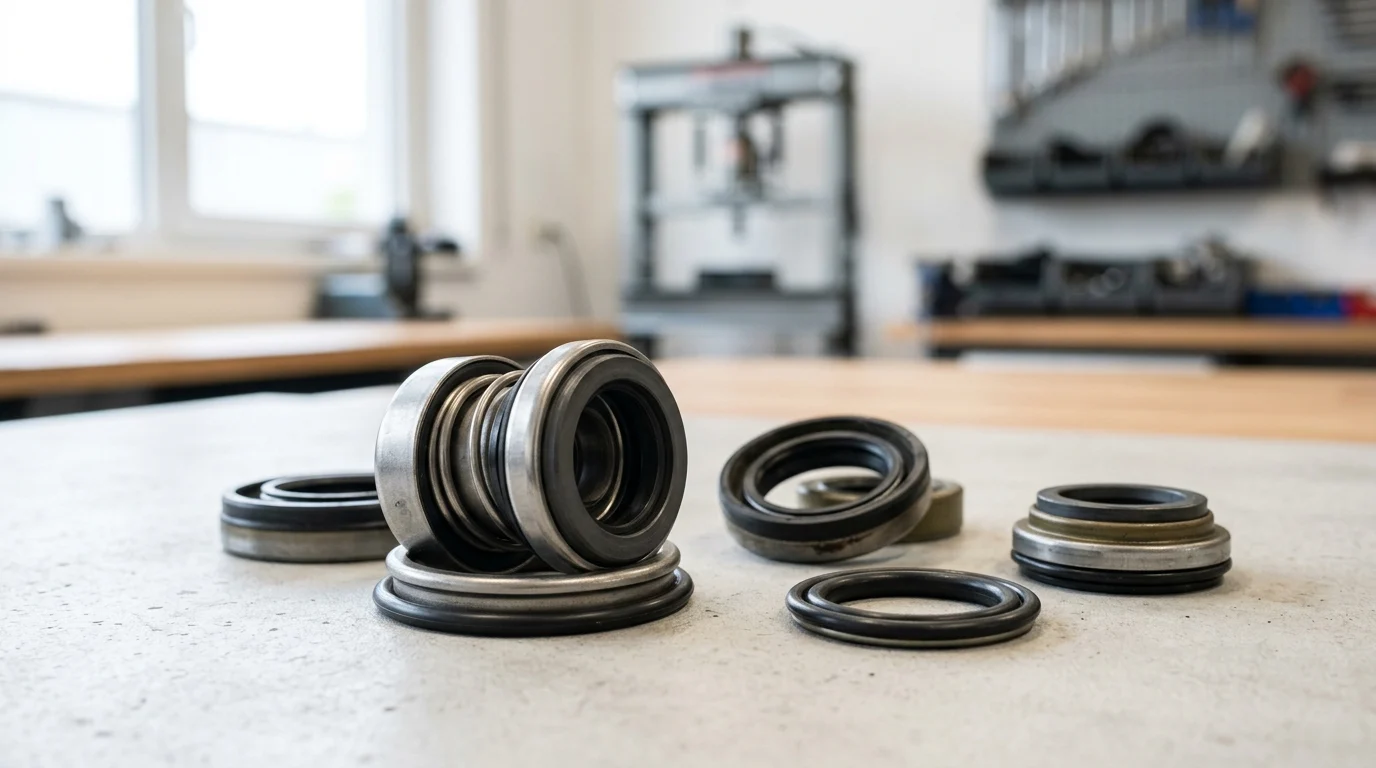
Automotive water pump seals serve as the primary defensive barrier within engine cooling systems, bridging the gap between rotating mechanical components and the pressurized fluid environment. As modern internal combustion engines and electric vehicle (EV) thermal management systems demand higher thermal efficiency (often operating at sustained temperatures of 105°C to 115°C), the performance of the coolant circulation system becomes paramount. The mechanical seal prevents coolant from escaping the pump volute into the bearing assembly and the broader engine environment.
Engineering an effective sealing interface is highly complex due to simultaneous exposure to rotational friction, chemical attack from coolant additives, and extreme thermal cycling. A compromised seal not only degrades cooling efficiency but also acts as the primary catalyst for catastrophic water pump failure, accounting for an estimated 60% to 70% of premature pump replacements and leading to engine overheating and severe mechanical damage.
How seals maintain coolant containment
Mechanical face seals operate on a precise balance of hydraulic and mechanical forces to maintain coolant containment. The assembly typically consists of a stationary mating ring pressed into the pump housing and a primary rotating ring attached to the impeller shaft. An internal spring or elastomeric bellows applies a continuous axial force—generally ranging from 15 to 25 Newtons—keeping the seal faces in constant contact even when the engine is off.
During operation, the micro-roughness of the seal faces allows a microscopic layer of coolant to penetrate the sealing interface. This hydrodynamic fluid film, typically measuring between 0.5 and 2.0 microns in thickness, is critical. It lubricates the mating surfaces to reduce friction and wear, while surface tension and localized vaporization prevent bulk liquid from escaping. By carefully engineering the face topography, manufacturers ensure the seal weeps just enough vapor to lubricate the faces without causing measurable fluid loss.
Which failures turn seal problems into pump damage
The transition from normal operation to catastrophic failure usually begins when this delicate hydrodynamic balance is disrupted. If the fluid film boils off or is displaced by particulate matter, dry running occurs. This spikes the interfacial temperature, causing thermal cracking in the ceramic or carbon faces. Once face integrity is compromised, leakage rates easily exceed the acceptable vapor threshold of 3 grams per 1,000 operating hours.
When active leakage occurs, pressurized coolant breaches the pump’s bearing cavity. Automotive coolants contain water and glycol, which rapidly degrade the specialized polyurea grease lubricating the bearings. Once the grease washes out, the bearing rollers experience metal-to-metal contact. This inevitably leads to bearing seizure or shaft fracture—typically within 1,000 to 5,000 miles of the initial fluid breach—transforming a minor seal degradation into a complete accessory drive failure.
Design Types, Materials, and Performance Specs
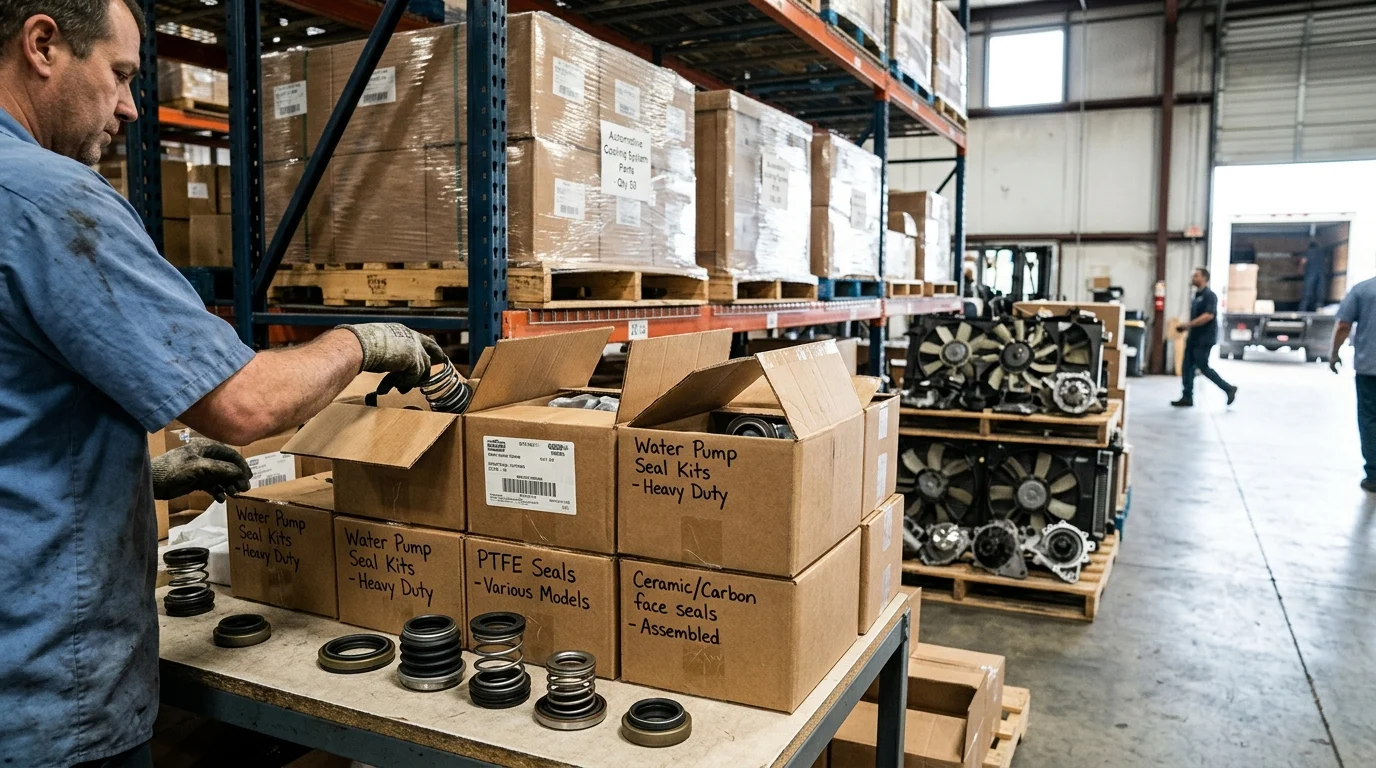
The evolution of automotive water pump seals has moved from basic rubber lip seals to highly engineered, unitized mechanical face seals. Modern designs integrate the spring, bellows, rotating face, and stationary seat into a single pre-assembled cartridge. This unitized approach protects the sensitive lapped faces from contamination during handling and ensures precise alignment upon installation into the pump housing.
Selecting the correct combination of materials and design geometries dictates the seal’s operational limits. Engineers must balance thermal conductivity, hardness, chemical compatibility, and cost when specifying the bill of materials for a cooling pump application.
How seal designs and materials affect performance
The performance of a water pump seal is fundamentally tied to the tribological properties of its face materials and the resilience of its secondary elastomeric components. The primary ring is often manufactured from a carbon-graphite composite, chosen for its excellent self-lubricating properties and conformability. The stationary mating ring requires high hardness and thermal stability, typically utilizing high-alumina ceramic or silicon carbide (SiC).
Secondary sealing components, such as bellows and O-rings, rely on advanced elastomers to absorb shaft vibrations and accommodate angular misalignment. Hydrogenated Nitrile Butadiene Rubber (HNBR) is standard due to its resistance to modern Organic Acid Technology (OAT) coolants and a broad operating range of -40°C to 150°C. Meanwhile, Fluoroelastomers (FKM, rated up to 200°C) or Ethylene Propylene Diene Monomer (EPDM, rated down to -50°C) are specified for applications encountering extreme temperature spikes or specialized dielectric fluids.
Which performance criteria matter most
When specifying a mechanical seal, engineers prioritize several critical performance criteria to ensure longevity in under-hood environments. The Pressure-Velocity (PV) limit is paramount; it defines the maximum load and rotational speed the face materials can withstand without overheating. Typical automotive coolant seals require a PV rating between 10 and 15 MPa·m/s. In passenger vehicle applications, water pump seals must routinely handle shaft speeds reaching 8,000 to 10,000 RPM.
Operating temperature ranges and system pressures dictate material selection. A standard automotive cooling loop operates at 1.0 to 1.5 bar, occasionally peaking at 2.5 bar during thermal expansion. The seal must maintain integrity across a temperature gradient ranging from cold starts at -40°C to sustained operational peaks of +150°C. Furthermore, the seal’s ability to withstand dynamic shaft runout (typically limited to <0.05 mm) without losing face contact is a critical metric for long-term durability.
Seal material and leakage resistance comparison
Different material pairings yield distinct operational advantages and leakage resistance profiles. The choice between standard and premium face materials heavily influences both the upfront cost and the warranty lifecycle of the water pump.
| Face Material Pairing (Rotating / Stationary) | Relative Cost Multiplier | Max Operating Temp | Wear Resistance | Dry-Running Tolerance |
|---|---|---|---|---|
| Carbon Graphite / Alumina Ceramic | 1.0x (Baseline) | 120°C | Moderate | Good |
| Carbon Graphite / Silicon Carbide | 1.8x | 150°C | High | Very Good |
| Silicon Carbide / Silicon Carbide (SiC/SiC) | 3.5x | 200°C+ | Exceptional | Poor (Requires constant fluid) |
| Tungsten Carbide / Silicon Carbide | 4.2x | 200°C+ | Exceptional | Moderate |
Silicon carbide pairings offer unmatched hardness, making them virtually immune to abrasive wear from suspended silicates or casting sand in the coolant. However, SiC/SiC configurations lack the self-lubricating properties of carbon. This makes them highly susceptible to thermal shock if the pump experiences a dry-run condition due to low coolant levels.
How Buyers Should Evaluate Automotive Water Pump Seals
Procuring automotive water pump seals requires a stringent evaluation process that balances technical validation with supply chain economics. Buyers must navigate an ecosystem of global suppliers, distinguishing between manufacturers relying on legacy tooling and those employing advanced metrology and automated assembly lines.
Because the cost of a water pump failure far exceeds the unit price of the seal, procurement engineers heavily weigh quality assurance frameworks, historical reliability data, and rigorous dynamic testing protocols before awarding contracts.
Quality controls, validation tests, and traceability
A supplier’s quality control infrastructure is the primary indicator of long-term reliability. Buyers should demand IATF 16949 certification, which ensures automotive-grade quality management systems are strictly enforced. Validation testing must include dynamic endurance runs, typically requiring seals to survive 1,000-hour test cycles that simulate severe thermal shock—rapidly fluctuating between -40°C and 135°C—while monitoring for micro-leakage (targeting defect rates below 10 to 50 Parts Per Million, or PPM).
Traceability is non-negotiable in automotive supply chains. High-tier suppliers utilize laser etching on brass or stainless-steel seal casings to record batch codes, manufacturing dates, and material lots. In the event of a warranty claim or field failure, this traceability allows engineers to isolate the exact production run, identifying whether the root cause was a material defect, an assembly error, or a specific batch of non-conforming elastomers.
How cost, service life, compatibility, and supply affect selection
Total cost of ownership (TCO) extends far beyond the piece price. While a standard Carbon/Ceramic seal might cost $0.60 per unit at high volumes (e.g., MOQ 50,000), upgrading to a premium Carbon/SiC configuration at $1.50 can extend the pump’s service life from 100,000 miles to over 200,000 miles, drastically reducing warranty claims.
Compatibility with evolving coolant chemistries also drives selection. The shift toward Hybrid Organic Acid Technology (HOAT) and specialized EV battery coolants demands strict elastomer compatibility validation. Furthermore, buyers must evaluate supply chain resilience. Sourcing from localized or highly automated facilities mitigates the risk of line-down situations caused by global shipping disruptions, often justifying a slight premium in unit cost for guaranteed just-in-time (JIT) delivery and standard lead times of 8 to 12 weeks versus 16+ weeks from overseas.
Practical steps for comparing samples and suppliers
When comparing samples from prospective suppliers, practical inspection steps yield immediate insights into manufacturing precision. Buyers should request optical flatness reports for the seal faces. High-quality mating rings must measure within 2 to 3 helium light bands (approximately 0.6 to 0.9 microns) of perfect flatness to guarantee hydrodynamic film stability.
Additionally, physical teardowns of sample seals can reveal assembly quality. Inspecting the crimp quality of the unitized casing, verifying the concentricity of the internal spring, and analyzing the surface finish of the elastomeric bellows for molding flash or parting line defects are essential steps. Suppliers should also provide statistical process control (SPC) data demonstrating their capability index (Cpk) for critical dimensions like the outer press-fit diameter, where a Cpk of 1.33 (4 sigma) to 1.67 (5 sigma) is the automotive industry standard.
Installation, Operation, and Maintenance Best Practices
Even the most precisely engineered mechanical seal will suffer premature failure if installation protocols and operational parameters are ignored. The interface between the seal cartridge, the pump housing, and the impeller shaft dictates the concentricity and stability of the entire assembly.
Original Equipment Manufacturers (OEMs) and aftermarket rebuilders must adhere to strict assembly guidelines and recognize the early warning signs of system degradation to prevent catastrophic engine cooling failures.
Assembly conditions, shaft surfaces, and coolant requirements
Installation requires precise environmental and mechanical controls. The seal must be pressed into the pump housing using a calibrated arbor press with specialized tooling that applies force only to the outer flange. Applying uneven pressure can distort the casing, altering spring tension and causing uneven face wear. The press-fit bore in the pump housing must be machined to strict tolerances, ensuring an interference fit (typically utilizing an H7/r6 tolerance class) without galling the seal shell.
The condition of the impeller shaft is equally critical. The shaft surface finish where the elastomer bellows seats must be maintained at an Ra of 0.2 to 0.4 micrometers. Any scratches or machining marks can create a leak path beneath the elastomer. Furthermore, the maximum allowable shaft runout should not exceed 0.05 mm; excessive vibration will physically bounce the seal faces apart. Operationally, the system relies on a proper coolant mixture—typically a 50/50 ratio of distilled water and ethylene glycol—to prevent silicate dropout and provide necessary lubricity for the seal faces.
How to diagnose leakage, cavitation, and contamination
Diagnosing water pump issues requires differentiating between normal operational characteristics and active failure modes. A small amount of fluid loss is normal; a properly functioning seal will weep vapor that condenses in the pump’s weep chamber. However, if liquid coolant actively drips from the weep hole at a rate exceeding 10 ml per hour (roughly one drop every 15 seconds), the primary seal face has failed.
Cavitation is a frequent, destructive operational issue. When system pressure drops or temperatures spike, coolant vaporizes near the impeller blades. The subsequent collapse of these vapor bubbles creates localized shockwaves that erode the impeller and induce severe pressure pulsations, which can forcefully unseat the seal faces. Contamination is another leading cause of failure. Residual casting sand from engine blocks or excess RTV silicone from gasket installations acts as an abrasive slurry, deeply scoring the carbon face and destroying the hydrodynamic film.
Selection Priorities and Final Decision Framework

Finalizing the specification for an automotive water pump seal requires a holistic assessment of the engine architecture, intended duty cycle, warranty targets, and anticipated production volumes. No single seal design is universally optimal; the selection process is inherently an exercise in engineering trade-offs.
By applying a structured decision framework, procurement and engineering teams can align the technical capabilities of
Key Takeaways
- The most important conclusions and rationale for Automotive Water Pump Seals
- Specs, compliance, and risk checks worth validating before you commit
- Practical next steps and caveats readers can apply immediately
Frequently Asked Questions
Why is the water pump seal critical to engine cooling efficiency?
It keeps coolant inside the pump while protecting bearings from leaks. A healthy seal maintains flow, stable operating temperature, and helps prevent overheating or premature pump failure.
What are common signs of a failing automotive water pump seal?
Watch for coolant weep at the vent hole, sweet coolant odor, low coolant level, bearing noise, or rising engine temperature. Replace the pump or seal assembly before bearing damage spreads.
Which seal materials work best for modern coolant systems?
Common choices are carbon vs. ceramic or silicon carbide faces with HNBR elastomers. For higher heat or special fluids, FKM or EPDM may be better, depending on coolant chemistry and temperature range.
Can contaminated coolant damage a water pump seal?
Yes. Dirt, rust, or incorrect coolant can disrupt the lubricating film between seal faces, causing dry running, wear, and leakage. Use the specified coolant and keep the system clean during service.
Can Victor Seals support OEM-compatible pump seal requirements?
Yes. Victor Seals manufactures mechanical seals and OEM-compatible sealing parts, including custom options, for pump maintenance needs. Share pump model, shaft size, fluid, temperature, and speed for matching.
Post time: May-28-2026