


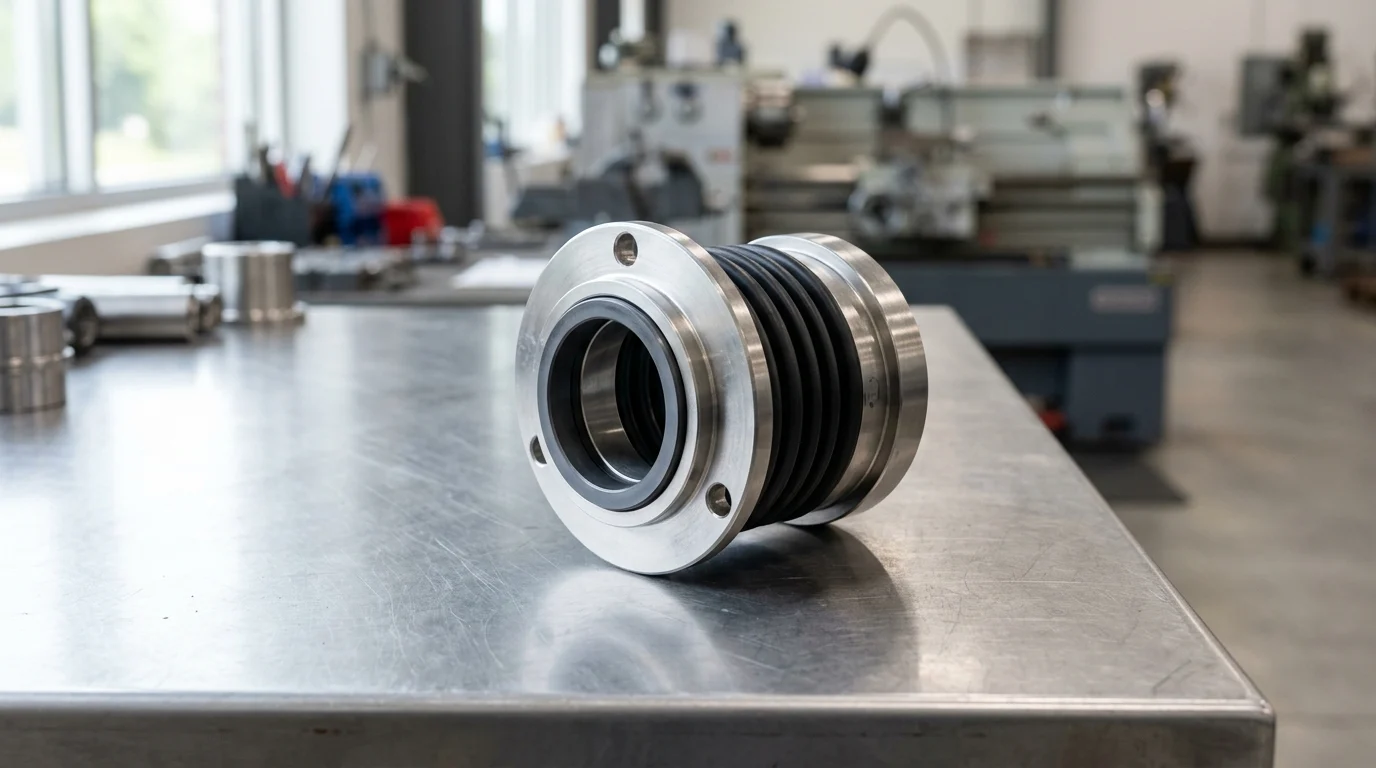
What Is an Elastomer Bellow Mechanical Seal
An elastomer bellow mechanical seal is a highly specialized end-face sealing device engineered for rotating equipment, primarily centrifugal pumps, mixers, and agitators. Unlike traditional pusher seals that rely on dynamic O-rings or V-rings sliding along a shaft, this design utilizes a convoluted elastomeric tube—the bellow—to bridge the gap between the rotating shaft and the primary sealing face. This architecture inherently eliminates the need for a sliding secondary seal, thereby mitigating shaft fretting and associated maintenance failures.
Standard elastomer bellow seals are typically manufactured for shaft diameters ranging from 10 mm up to 100 mm, though custom dimensions exist for specialized industrial apparatus. By combining the secondary sealing function, rotational drive transmission, and axial flexibility into a single polymeric component, engineers can achieve a robust, compact, and highly efficient sealing mechanism suitable for a wide array of low-to-medium pressure fluid handling systems.
Core components and working principle
The architecture of an elastomer bellow mechanical seal centers on four primary components: the rotating primary ring, the stationary mating ring, the elastomer bellow itself, and a mechanical spring mechanism. The primary and mating rings constitute the primary sealing interface, lapped to a flatness typically measured in helium light bands to ensure microscopic conformity. These faces are separated only by a hydrodynamic fluid film generated by the pumped medium.
The mechanical spring—often a single, robust coil spring—is positioned behind the primary face. It provides the necessary closing force to maintain face contact during equipment startup, shutdown, and periods of low system pressure. Because the spring is often housed externally to the pumped fluid or protected by the bellow, it is less susceptible to clogging or corrosion compared to the multiple small springs found in some pusher seal designs.
How the bellow provides secondary sealing and flexibility
The defining characteristic of this seal category is the bellow’s dual functionality. At the shaft interface, the tail end of the elastomer bellow features an interference fit. This tight static grip acts as the secondary seal against the shaft, preventing fluid bypass while simultaneously transmitting rotational torque to the primary sealing face without the need for set screws or drive pins.
Axially, the convolutions of the bellow provide critical flexibility. As the primary seal faces undergo inevitable wear over thousands of operational hours, the bellow extends to maintain contact. A standard elastomer bellow can typically compensate for up to 2.0 mm of axial play or face wear. Furthermore, this flexibility absorbs angular misalignment and shaft runout, ensuring the primary faces remain parallel and the hydrodynamic film remains stable under dynamic operating conditions.
Why Elastomer Bellow Mechanical Seals Matter
The industrial significance of elastomer bellow mechanical seals stems from their unique ability to resolve chronic reliability issues inherent in dynamic O-ring designs. In fluid handling environments, the reliability of rotating equipment is directly proportional to the integrity of its shaft seals. Elastomer bellows address the root causes of premature seal failure, translating directly into extended operational uptime and reduced maintenance expenditures.
Because these seals drive the rotating face through the static friction of the bellow on the shaft, they eliminate the phenomenon of shaft fretting. Fretting occurs when a dynamic O-ring continuously micro-slides back and forth along the shaft due to vibration or face wear, eventually grooving the shaft or sleeve. By removing this failure mode, facilities avoid the costly and time-consuming process of replacing or remachining pump shafts.
How they affect leakage control
Leakage control in mechanical seals relies on maintaining uninterrupted contact between the primary faces. Traditional pusher seals are prone to “hang-up,” a condition where the dynamic O-ring becomes stuck on the shaft due to debris buildup, scale formation, or localized fretting. When hang-up occurs, the internal spring cannot push the primary face forward to compensate for wear, resulting in catastrophic leakage.
Elastomer bellow seals are immune to hang-up because the secondary seal is static relative to the shaft. The flexing action of the bellow continuously accommodates face wear and shaft movement without requiring any component to slide. In properly aligned systems operating within specified parameters, this design reliably maintains fugitive emission and leak rates below 0.1 mL/hour, ensuring compliance with stringent environmental and safety regulations.
Common applications and use cases
These seals are ubiquitous in industries requiring high reliability under moderate operational parameters. They are the standard choice for municipal water and wastewater treatment, HVAC circulation pumps, swimming pool and spa filtration systems, and food and beverage processing where moderate chemical compatibility is required. Their robust nature makes them particularly well-suited for non-Newtonian fluids or media containing particulate matter.
Because there is no dynamic sliding secondary seal to clog, elastomer bellow seals can effectively handle fluids with suspended solids up to 10% by weight, provided the primary seal faces are constructed from hard materials like Silicon Carbide or Tungsten Carbide. This debris-handling capability makes them indispensable in raw water intake pumps and agricultural irrigation systems where fluid purity cannot be guaranteed.
How Elastomer Bellow Mechanical Seals Compare with Other Seals
Specifying the correct mechanical seal requires understanding the operational trade-offs between different sealing technologies. Elastomer bellow seals occupy a distinct and highly valuable middle ground between low-cost, high-maintenance pusher seals and high-cost, extreme-duty metal bellow seals.
While they offer significant advantages over standard O-ring pusher seals in terms of reliability and shaft preservation, they are constrained by the physical limitations of the elastomeric materials from which they are constructed. Evaluating these differences is critical for engineers tasked with optimizing plant reliability and controlling procurement budgets.
Key performance differences
The primary performance distinction between seal types lies in their response to shaft dynamics and extreme process conditions. Pusher seals are inexpensive but susceptible to hang-up and fretting. Edge-welded metal bellow seals, constructed from alloys like Hastelloy or Inconel, eliminate fretting and can withstand extreme temperatures (often exceeding 400°C), but they carry a capital cost that can be ten to twenty times higher than elastomeric alternatives.
| Seal Technology | Max Temperature Limit | Max Pressure Limit | Shaft Fretting Risk | Relative Cost Index |
|---|---|---|---|---|
| Pusher (O-Ring) | 200°C+ (Elastomer dependent) | > 40 bar (Balanced) | High | 1.0x |
| Elastomer Bellow | 120°C – 200°C | 12 – 16 bar | Zero | 1.2x – 1.5x |
| Metal Bellow | > 400°C | > 25 bar | Zero | 10.0x – 15.0x |
As demonstrated in the comparison matrix, elastomer bellow seals provide the operational benefits of a non-fretting bellow design without the prohibitive capital expense of metal bellows, making them the optimal choice for the vast majority of standard fluid transfer applications.
Pressure, temperature, and chemical compatibility
The operational envelope of an elastomer bellow seal is strictly dictated by the polymer composition of the bellow. Nitrile Rubber (NBR) is standard for water and mild oils, offering a maximum continuous operating temperature of approximately 90°C. Ethylene Propylene Diene Monomer (EPDM) extends this threshold to 120°C and provides excellent resistance to hot water, steam, and mild alkalis, though it degrades rapidly in the presence of petroleum-based fluids.
For more aggressive chemicals or higher temperatures, Fluorocarbon elastomers (FKM/Viton) are utilized, pushing the thermal limit to roughly 200°C. Pressure limitations are equally critical; because the elastomer bellow is a flexible polymer, it is susceptible to ballooning or extrusion under high system pressure. Consequently, most unsupported elastomer bellow seals are rated for maximum operating pressures between 12 and 16 bar (1.2 to 1.6 MPa). Exceeding these limits requires transitioning to a balanced seal design or a metal bellow.
Selection, Installation, and Operating Factors
The successful deployment of an elastomer bellow mechanical seal relies heavily on rigorous selection protocols and exacting installation standards. Even the most precisely engineered seal will suffer premature failure if the process fluid parameters exceed the material specifications, or if mechanical best practices are ignored during assembly.
Engineers and maintenance technicians must approach seal replacement as a highly controlled procedure, evaluating thermodynamic limits and ensuring the pump housing and shaft meet strict dimensional and surface finish tolerances.
How to evaluate fluid, temperature, and pressure
Evaluating process parameters requires calculating the PV (Pressure-Velocity) factor, which represents the frictional heat generated at the seal faces. For a standard elastomer bellow seal utilizing Carbon graphite against Aluminum Oxide (Ceramic) faces, the operational limit is typically around 10 to 15 MPa·m/s. If the pump operates at high speeds or elevated pressures that exceed this PV limit, the fluid film will vaporize, leading to dry running and rapid thermal degradation of the elastomer.
Fluid evaluation must also account for transient states. A fluid that is benign at 20°C may become highly corrosive to the chosen elastomer at 80°C. Furthermore, liquids that crystallize upon cooling or exposure to atmosphere can cement the bellow in place during pump shutdowns, tearing the polymer when the equipment is restarted. In such cases, quench and drain environmental controls may be necessary.
Installation practices and common failure modes
Installation practices directly dictate the lifespan of the seal. The pump shaft must be free of burrs, scratches, and sharp edges that could slice the inner diameter of the bellow during insertion. Industry standards dictate a shaft surface finish typically in the range of Ra 0.8 to 1.2 µm for optimal static sealing and torque transmission.
A common failure mode is torsional tearing of the bellow, often caused by improper lubrication during assembly. Technicians must use lubricants compatible with the specific elastomer; for instance, applying a petroleum-based grease to an EPDM bellow will cause the rubber to swell, soften, and ultimately fail under rotational torque. Use of approved silicone lubricants or simple soapy water is mandatory to ensure the bellow seats correctly without twisting.
Standards, limits, and supplier qualification
To ensure interchangeability and reliable performance, buyers should specify seals that conform to recognized dimensional standards, most notably EN 12756 (formerly DIN 24960). Adherence to these standards guarantees that the seal will fit within standard pump stuffing boxes without the need for custom machining or specialized gland plates.
Supplier qualification is equally critical. Industrial buyers should mandate that seal manufacturers hold ISO 9001 certification and can provide material traceability for both the elastomers and face materials. High-quality manufacturers typically maintain manufacturing defect rates well below 0.5%. Requesting statistical process control (SPC) data for face flatness and bellow concentricity can further safeguard against receiving substandard components.
How Buyers Should Decide

Procuring elastomer bellow mechanical seals requires a strategic balance between upfront unit costs and long-term operational reliability. While these seals are generally viewed as consumable commodities, treating them solely as a low-cost line item can lead to excessive maintenance downtime and inflated total cost of ownership (TCO).
Buyers must evaluate the specific demands of their rotating equipment fleet and establish purchasing criteria that prioritize Mean Time Between Failures (MTBF) over minor savings in initial capital expenditure. A structured decision framework ensures that seal specifications align with plant reliability goals.
Purchasing and lifecycle cost criteria
The initial purchase price of an elastomer bellow seal is highly dependent on volume and material configuration. Standard NBR/Carbon/Ceramic seals purchased in high volumes (Minimum Order Quantities of 100 to 500 units) can cost as little as $10 to $50 per unit. However, upgrading to premium face materials like Silicon Carbide (SiC) or Tungsten Carbide (TC) to combat abrasive wear will increase the upfront cost by 30% to 50%.
| Face Material Combination | Elastomer Type | Relative Cost Index | Estimated MTBF (Clean Water) |
|---|---|---|---|
| Carbon / Ceramic | NBR | 1.0x | 12,000 – 18,000 hours |
| Carbon / Silicon Carbide | EPDM | 1.3x | 18,000 – 24,000 hours |
| Silicon Carbide / Silicon Carbide | FKM (Viton) | 1.8x | 25,000+ hours |
As the lifecycle cost matrix indicates, the moderate increase in initial procurement cost for harder face materials and more resilient elastomers is easily justified by the substantial extension in MTBF.
Key Takeaways
- The most important conclusions and rationale for Elastomer Bellow Mechanical Seal
- Specs, compliance, and risk checks worth validating before you commit
- Practical next steps and caveats readers can apply immediately
Frequently Asked Questions
What is an elastomer bellow mechanical seal used for?
It seals rotating equipment such as centrifugal pumps, mixers, and agitators, mainly in low-to-medium pressure services where reliable leakage control and easy maintenance are needed.
How is an elastomer bellow seal different from a pusher seal?
It uses a flexible elastomer bellow instead of a sliding secondary O-ring, which helps prevent shaft fretting, reduces hang-up risk, and simplifies operation in dirty or scaling fluids.
What are the main benefits of elastomer bellow mechanical seals?
They offer compact design, fewer moving secondary-seal parts, good wear compensation, and better protection against leakage caused by O-ring sticking on the shaft.
Which industries commonly use elastomer bellow seals?
They are widely used in water treatment, chemical processing, marine systems, pulp and paper, power plants, and general industrial pump maintenance.
Can Victor Seals supply replacement elastomer bellow seals for OEM pumps?
Yes. Victor Seals provides elastomer bellow and OEM-compatible replacements for brands like Grundfos, Flygt, Alfa Laval, IMO, Lowara, and Allweiler for maintenance and repair.
Post time: Jun-10-2026