


Why Seal Selection Matters
The operational reliability of centrifugal pump systems relies fundamentally on the integrity of their mechanical seals. Serving as the primary barrier between the internal process fluid and the external atmosphere, mechanical seals operate under extreme hydrodynamic and thermal stresses. Industry reliability data consistently indicates that up to 70% of all centrifugal pump failures are directly attributed to mechanical seal degradation or catastrophic leakage.
Selecting the optimal sealing technology—specifically choosing between rubber bellows and spring-loaded pusher seals—is not merely a maintenance preference but a core engineering requirement. The mechanical architecture of the chosen seal dictates the pump’s ability to handle pressure fluctuations, tolerate shaft misalignment, and resist chemical attack, making seal specification a critical component of overall plant design.
Uptime and leakage control
Maximizing mean time between failures (MTBF) is the primary objective of any rotating equipment reliability program. A well-specified mechanical seal should achieve a target MTBF of 24 to 36 months under continuous operation. Achieving this baseline requires maintaining a stable, microscopic fluid film—often measuring less than 1 to 3 microns in thickness—between the rotating and stationary seal faces.
When a seal is incorrectly specified for the hydraulic conditions, this fluid film vaporizes or breaks down, leading to dry running, excessive frictional heat, and rapid thermal cracking of the seal faces. Rubber bellows and spring seals manage face loading and compensate for wear differently; selecting the wrong loading mechanism for a specific fluid severely compromises face tracking, directly resulting in premature leakage and unplanned system downtime.
Commercial and operational risks
Beyond mechanical downtime, the commercial and operational implications of seal failure are substantial. In heavy industrial environments, the financial impact of unexpected pump failure can easily exceed $10,000 per hour in lost production, far outweighing the initial procurement cost of the mechanical seal itself.
Furthermore, environmental and occupational safety regulations strictly govern fluid containment. Regulatory frameworks developed by the Environmental Protection Agency (EPA) and the Occupational Safety and Health Administration (OSHA) mandate stringent controls on volatile organic compound (VOC) emissions. Fugitive emission limits are frequently capped at under 500 parts per million (ppm) for hazardous air pollutants. A failing spring or bellows seal pumping hazardous chemicals not only risks costly regulatory fines but also exposes plant personnel to toxic or high-pressure fluid hazards.
Rubber Bellows and Spring Seals Defined
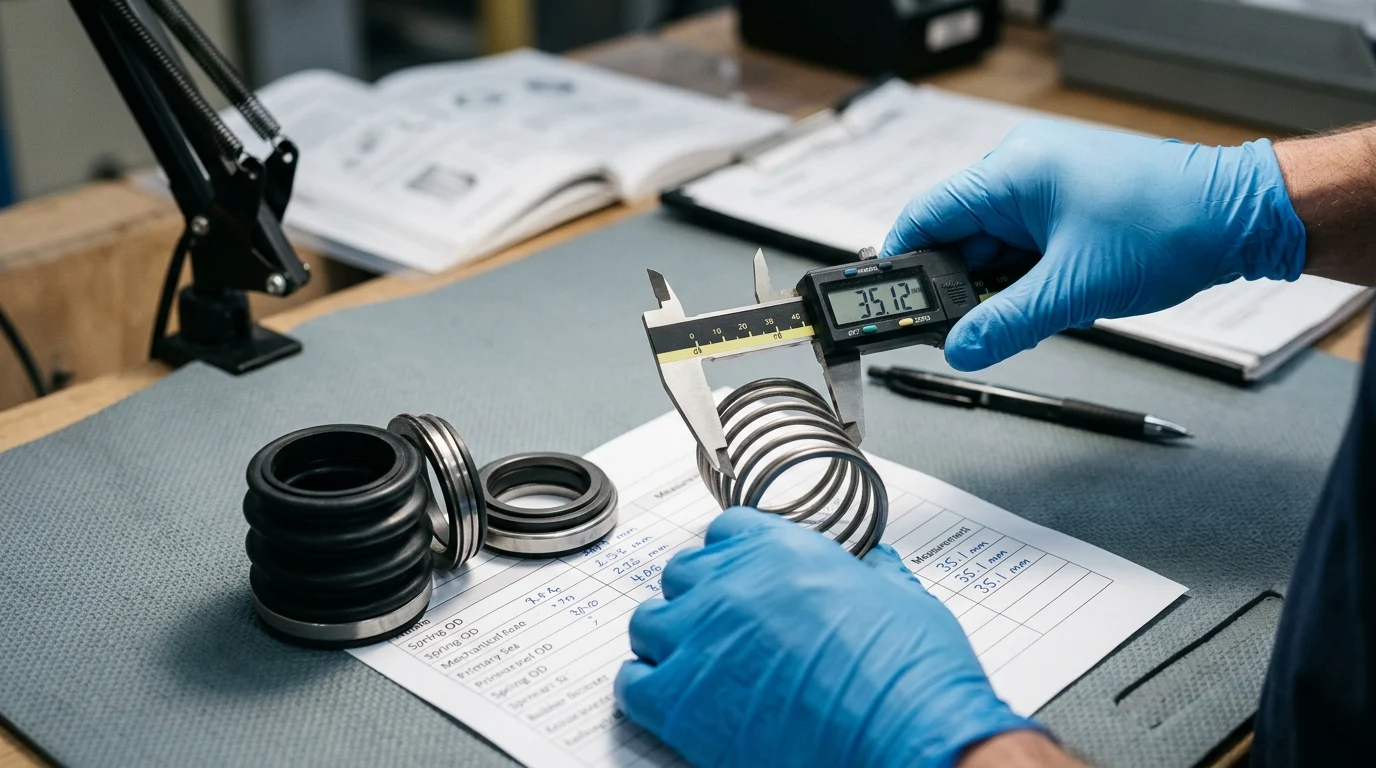
At their core, all mechanical seals serve the same fundamental purpose: preventing pressurized fluid from escaping along the rotating pump shaft. They achieve this utilizing two primary mating faces—one stationary and one rotating—that are lapped to an extreme flatness, typically measured at 2 to 3 helium light bands (approximately 0.00003 inches).
While the primary sealing faces (often composed of carbon, silicon carbide, or tungsten carbide) are conceptually similar across designs, the secondary sealing elements and the mechanical mechanisms used to maintain constant face pressure differ drastically between rubber bellows and spring seals.
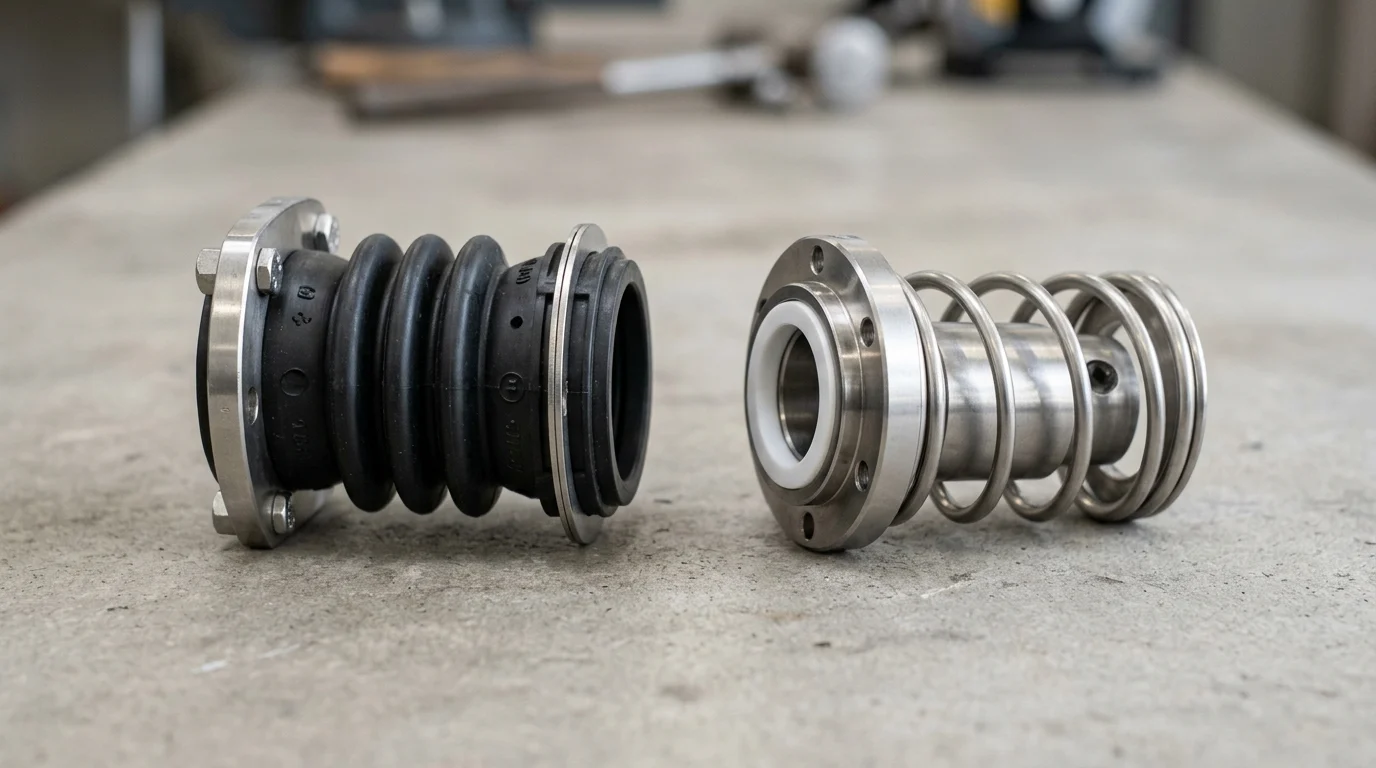
Rubber bellows seal construction
A rubber bellows seal utilizes a continuous elastomeric tube—the bellows—that acts as both the secondary dynamic seal and the primary loading mechanism. This elastomer is typically manufactured from materials such as Nitrile (NBR), Ethylene Propylene Diene Monomer (EPDM), or Fluoroelastomer (FKM), formulated to a specific durometer, usually between 70 and 80 Shore A hardness.
The tail of the bellows grips the pump shaft via a tight interference fit, meaning the entire bellows assembly rotates synchronously with the shaft. A large, single coil spring is typically wrapped around the exterior of the bellows to provide additional mechanical closing force to the seal faces. Because the elastomer body flexes to accommodate axial movement and face wear, there are no sliding O-rings that must move along the metal shaft, completely eliminating the risk of shaft fretting corrosion.
Spring seal construction
Spring seals, most commonly configured as O-ring pusher seals, rely on distinct, separated components for secondary sealing and face loading. In this architecture, a dynamic O-ring or a Polytetrafluoroethylene (PTFE) wedge acts as the secondary seal. As the primary seal faces inevitably wear down during operation, the springs physically push the dynamic O-ring forward along the shaft—typically by 0.1 mm to 0.5 mm over the seal’s lifecycle—to maintain face contact.
The loading mechanism in these seals consists of either a single large coil spring or a multi-spring arrangement. In multi-spring configurations, numerous small coil springs (often manufactured from 316L Stainless Steel or Hastelloy C-276) are arranged circumferentially around the seal housing. This multi-spring design provides highly uniform face loading across the entire circumference of the primary seal rings, which is critical for maintaining the fluid film at high rotational speeds.
Key comparison assumptions
To evaluate these two sealing technologies objectively, certain baseline parameters and mechanical assumptions must be established. The comparative analysis assumes the use of single-acting mechanical seals installed in standard centrifugal pumps conforming to ANSI B73.1 or DIN 24256 dimensional specifications.
Furthermore, the evaluation assumes standard industrial shaft diameters ranging from 12 mm to 100 mm (0.5 to 4.0 inches) operating at standard motor speeds of 1,500 to 3,600 revolutions per minute (RPM). Complex dual-pressurized (back-to-back) cartridge seals and specialized gas-lubricated seals are excluded from this baseline comparison to focus strictly on the fundamental differences in secondary sealing and loading architectures.
Key Specification Differences
The technical specifications defining the operational limits of rubber bellows and spring seals dictate their suitability for distinct industrial environments. Selecting a seal outside of its engineered performance envelope guarantees premature failure.
Understanding the exact boundary conditions—specifically regarding pressure maximums, thermal limits, and susceptibility to physical wear—is essential to prevent catastrophic loss of containment and to optimize the lifecycle economics of the pump system.
Pressure and temperature limits
Rubber bellows seals are fundamentally constrained by the thermal and mechanical limits of their elastomeric components. Standard EPDM bellows typically reach their thermal limit at 120°C (248°F), while high-grade FKM variants can push this boundary to approximately 200°C (392°F). Pressure ratings for standard bellows designs generally plateau between 12 and 15 bar (175 to 220 psi). Exceeding this pressure threshold risks elastomeric extrusion, where the rubber is forced into the microscopic clearances of the seal chamber, causing immediate failure.
Conversely, spring-loaded pusher seals offer significantly broader performance envelopes. Unbalanced O-ring pusher designs comfortably manage internal pressures up to 40 bar (580 psi). When engineered into balanced configurations—where the hydraulic forces acting on the seal faces are mathematically reduced—spring seals can handle environments exceeding 75 bar (1,080 psi). Thermally, spring seals equipped with Perfluoroelastomer (FFKM) secondary O-rings operate reliably at continuous temperatures up to 260°C (500°F).
| Specification Metric | Rubber Bellows Seals | Spring Seals (O-Ring Pusher) |
|---|---|---|
| Maximum Pressure Limit | 12 – 15 bar (175 – 220 psi) | Up to 40 bar (580 psi) unbalanced |
| Maximum Temperature | 120°C (EPDM) to 200°C (FKM) | 260°C+ (with FFKM elastomers) |
| Shaft Speed Capability | Up to 15 m/s (3,000 fpm) | Up to 25 m/s (5,000 fpm) |
| Axial Play Tolerance | High (± 0.15 mm to 0.20 mm) | Low (± 0.05 mm to 0.10 mm) |
| Secondary Sealing Action | Non-pusher (static on shaft) | Dynamic pusher (slides on shaft) |
Clogging, corrosion, and wear risks
Fluid contamination and particulate loads pose a significant threat to mechanical seal integrity. Rubber bellows excel in environments with high particulate concentrations. Because the elastomeric bellows rotates as a single, unitized component without sliding axially over the shaft, there are no dynamic O-rings to hang up on debris. Consequently, bellows seals can effectively handle slurries or wastewater containing up to 5% suspended solids by weight without requiring external flush systems.
Spring seals, particularly multi-spring variants, are highly susceptible to clogging. Particulates exceeding 1% to 2% by weight easily pack into the small spring cavities, immobilizing the springs and preventing them from providing the necessary closing force to the seal faces. Furthermore, the dynamic O-ring in a pusher seal must slide along the shaft to compensate for primary face wear. If the shaft becomes coated in abrasive debris or experiences chemical pitting, the O-ring will stick (a condition known as hang-up), leading to rapid, unrecoverable leakage.
Lifecycle cost factors
Lifecycle cost analysis must account for both the initial capital expenditure and long-term maintenance requirements. Rubber bellows seals represent a lower initial procurement cost, typically priced 30% to 50% lower than equivalent multi-spring seals. Their unitized, forgiving design also reduces installation time and minimizes the risk of installation errors by plant technicians, driving down immediate labor costs.
However, spring seals frequently deliver a superior total cost of ownership (TCO) in aggressive or high-temperature applications where a rubber bellows would experience rapid thermal degradation. Furthermore, high-end spring seals are designed for modular repairability. Replacing worn silicon carbide faces and fatigued springs costs significantly less than procuring a completely new seal assembly, shifting the long-term economic advantage toward spring seals over a 5-to-10-year operational lifecycle in critical process applications.
How to Choose the Right Seal
Selecting the optimal mechanical seal requires engineers to meticulously match the seal’s mechanical architecture to the precise hydraulic and chemical realities of the pumping system.
Relying on a standardized selection methodology ensures that complex variables such as fluid viscosity, chemical aggressiveness, and mechanical vibration are appropriately weighted, preventing costly misapplications before procurement.
Fluid chemistry and operating conditions
The primary driver of seal selection is the exact chemical composition and physical state of the pumped fluid. Fluids exhibiting high kinematic viscosity, approaching limits of 2,500 centistokes (cSt), exert extreme shear forces on rotating seal components. Rubber bellows are generally preferred for highly viscous or coagulating fluids because the absence of exposed micro-springs prevents the loading mechanism from becoming immobilized by the thick medium.
Chemical aggressiveness dictates the specification of the secondary sealing elements. While standard elastomers like NBR or EPDM are entirely sufficient for water, coolants, or mild alkaline solutions, aggressive hydrocarbons, strong acids, and aromatic solvents require highly resilient materials. In severe chemical environments, spring seals equipped with PTFE wedges or specialized FFKM O-rings provide the absolute chemical inertness that standard elastomeric bellows cannot achieve.
When to choose rubber bellows seals
Rubber bellows seals are the undisputed industry standard for the water, wastewater, and agricultural sectors. Their unique ability to tolerate high levels of turbidity and fibrous materials makes them the optimal choice for sewage processing, raw water intake, and industrial effluent management. Plant engineers reliably specify bellows seals when pumping dirty fluids containing up to 5% solids, as the non-clogging design ensures consistent face loading without complex filtration.
Additionally, rubber bellows are the optimal choice for older, heavily utilized pumping equipment exhibiting significant mechanical wear. When a pump shaft experiences high runout, deflection, or axial play—often exceeding 0.15 mm—the inherent flexibility of a rubber bellows compensates for the mechanical misalignment. The elastomer acts as a dynamic shock absorber, maintaining critical face contact without transmitting excessive radial loads back into the pump bearings.
When to choose spring seals
Spring seals are the mandatory specification for high-pressure, high-temperature, and hazardous chemical processing applications. Heavy-duty boiler feed pumps operating at 160°C and 25 bar necessitate the robust, heat-resistant construction of a multi-spring pusher seal, as a rubber bellows would rapidly vulcanize, embrittle, and shatter under such extreme thermal stress.
Furthermore, facilities adhering to the rigorous American Petroleum Institute (API) 682 standards for centrifugal pumps in the petroleum refining and petrochemical industries rely exclusively on spring seal architectures. When handling volatile organic compounds or flammable hydrocarbons, engineers must deploy highly engineered single or dual spring seals integrated with API flush plans (such as Plan 11, Plan 52, or Plan 53A) to manage seal chamber thermodynamics and guarantee zero fugitive emissions.
Final Decision Framework
Systematic seal selection minimizes premature pump failures, optimizes maintenance budgets, and ensures regulatory compliance. Engineers must continuously balance initial component costs against the harsh operational realities of the fluid system.
By categorizing application parameters into a strict, data-driven decision framework, plant managers can standardize their procurement processes, reduce inventory complexity, and significantly extend the mean time between failures for their rotating equipment.
Selection checklist
A robust selection checklist evaluates four critical parameters: fluid condition, thermal load, pressure envelope, and equipment condition. If the fluid contains abrasive particulates or the pump exhibits significant shaft vibration, the checklist pushes the recommendation strongly toward a non-pusher bellows design. Conversely, if the application demands handling hazardous chemicals at elevated pressures, the checklist mandates a spring-loaded pusher seal.
| Application Variable | Rubber Bellows Recommendation | Spring Seal Recommendation |
|---|---|---|
| Suspended Solids Content | > 2% by weight (Slurries/Sewage) | < 1% by weight (Clean process fluids) |
| Continuous Operating Temp | Below 120°C (Standard EPDM limit) | 150°C to 260°C+ (High-temp processing) |
| System Operating Pressure | Low to Medium (< 15 bar) | High Pressure (15 to 40+ bar) |
| Mechanical Shaft Condition | High runout / worn bearings | Tight tolerances / minimal deflection |
| Fluid Chemical Profile | Water, mild chemicals, glycols | Hydrocarbons, strong acids, solvents |
Utilizing this matrix ensures that mechanical seals are not over-specified for basic water transport applications, nor under-specified for critical chemical processing tasks, thereby maintaining an optimal balance between mechanical reliability and capital expenditure.
Application-based recommendation
For municipal wastewater treatment, agricultural irrigation, paper pulp processing, and general HVAC cooling water applications, rubber bellows seals remain the most pragmatic and cost-effective solution. Their inherent tolerance for mechanical misalignment, combined with their unmatched resistance to particulate clogging, guarantees reliable performance in less-than-ideal hydraulic conditions where standard spring seals would rapidly fail.
Conversely, for power generation, petrochemical refining, high-purity pharmaceutical manufacturing, and aggressive chemical processing, spring seals are the definitive and necessary choice. The ability to customize spring metallurgy, specify advanced fluoroelastomer O-rings, and operate safely under extreme pressures ensures that spring seals meet the rigorous safety and performance thresholds required in critical industrial sectors. Ultimately, matching the mechanical architecture of the seal to the precise thermodynamic and chemical realities of the process fluid is the single most effective strategy for extending pump lifecycle and ensuring plant safety.
Key Takeaways
- Treat seal selection as an engineering decision because mechanical seal degradation contributes to up to 70% of centrifugal pump failures.
- Specify the seal type around operating pressure, fluid chemistry, temperature, shaft movement, and contamination risk rather than purchase price alone.
- Maintain a stable 1–3 micron fluid film between seal faces to prevent dry running, thermal cracking, leakage, and rapid face wear.
- Use a realistic MTBF target of 24 to 36 months for properly selected and installed pump mechanical seals in continuous service.
- Account for the cost of failure because unplanned pump downtime in heavy industry can exceed $10,000 per hour.
- Match rubber bellows or spring-loaded designs to regulatory and safety needs, especially where hazardous fluid emissions must remain below strict ppm limits.
Frequently Asked Questions
When should I choose a rubber bellows mechanical seal?
Choose a rubber bellows seal for many water, wastewater, marine, and light chemical pump duties where simple installation, good shaft movement tolerance, and elastomer compatibility are priorities.
When is a spring seal the better option?
A spring-loaded pusher seal is often better for higher pressures, wider temperature ranges, and applications needing more controlled face loading, provided the spring area is protected from clogging or corrosion.
Why does seal selection affect pump uptime?
Mechanical seal issues are linked to up to 70% of centrifugal pump failures. The right seal maintains a stable 1–3 micron fluid film, reducing heat, face wear, leakage, and unplanned downtime.
What MTBF should a properly specified pump seal achieve?
A well-matched mechanical seal should commonly target 24 to 36 months of mean time between failures under continuous service, assuming correct installation, materials, lubrication, and operating conditions.
Are rubber bellows seals available from Victor Seals?
Yes. Victor Seals manufactures standard and OEM mechanical sealing solutions, including rubber bellow designs such as Type 502 replacements and elastomer bellow seals for industrial and marine pump applications.

Post time: Sep-25-2026