


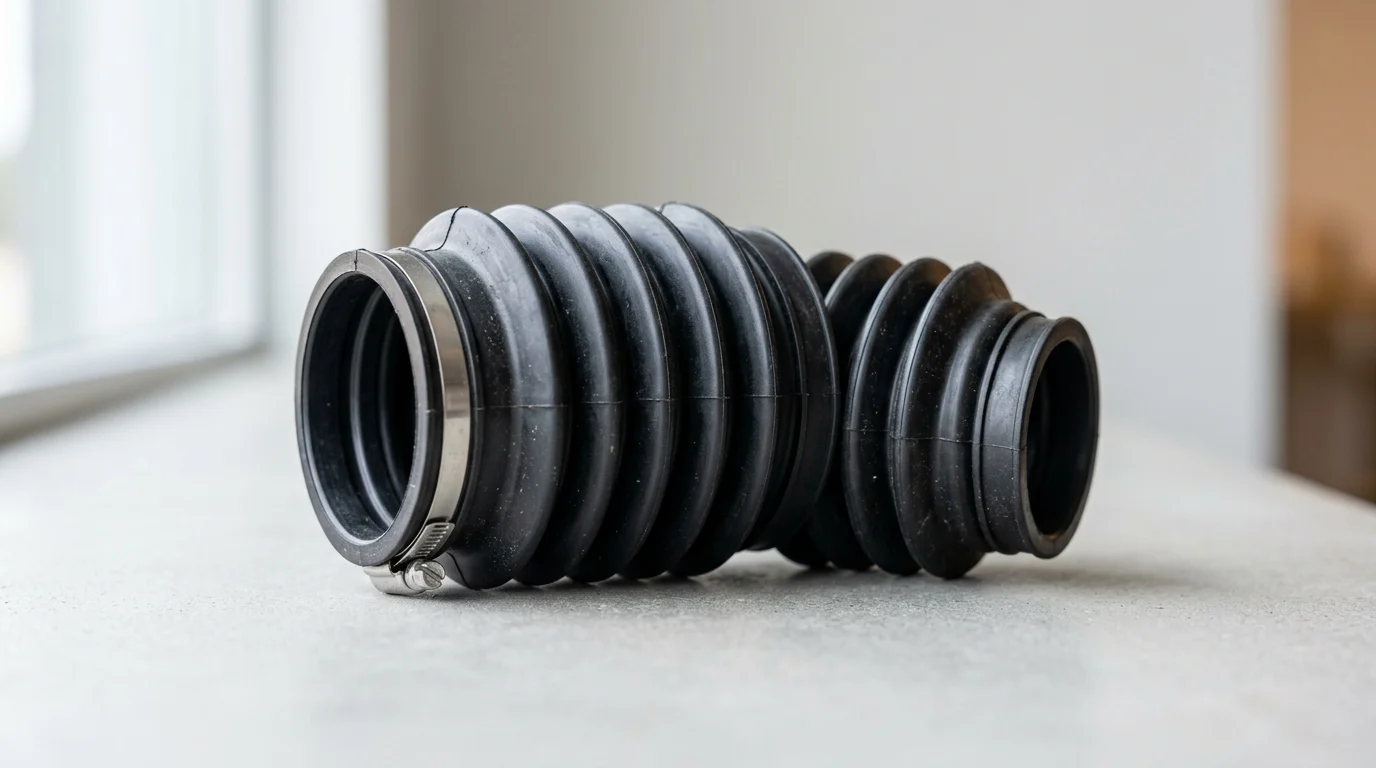
Strategic Use of Rubber Bellows Seals in Corrosive Service
Rubber bellows seals are foundational components in fluid handling systems, engineered to provide dynamic sealing along rotating shafts. In environments characterized by corrosive media, the elastomeric bellows must simultaneously accommodate axial shaft movement, radial runout, and misalignment, all while maintaining an impermeable barrier against aggressive chemicals. Precise elastomer specification directly impacts the Mean Time Between Failures (MTBF) of rotating equipment in chemical processing.
Standard rubber bellows seals are typically rated for baseline pressures up to 1.2 MPa (12 bar) and shaft speeds up to 15 m/s, making them highly effective for low- to medium-duty applications where metallic components would rapidly degrade. In corrosive environments, selecting the correct material dictates whether a pump operates continuously for years or suffers a catastrophic leak within days.
Role of rubber bellows seals in sealing systems
In a mechanical sealing system, the rubber bellows serves a highly specialized dual purpose. It acts as the secondary dynamic seal, preventing fluid from bypassing the primary seal faces along the shaft, while simultaneously functioning as the driving mechanism that transmits torque from the shaft to the rotating seal face.
Unlike pusher-type mechanical seals that rely on dynamic O-rings and metallic springs exposed directly to the fluid, rubber bellows seals utilize the elastomer’s inherent resilience to provide face-closing force. This distinctive design eliminates the need for a metallic spring in the fluid path, thereby preventing spring clogging, pitting, or chloride stress corrosion cracking. The convolute design of the bellows allows for significant axial flexibility, automatically compensating for primary seal face wear and thermal expansion without fretting the pump shaft.
Key definitions and application boundaries
The application boundaries of rubber bellows seals are defined by the intersection of dimensional standards, thermal limits, and mechanical stresses. Typically manufactured for shaft diameters ranging from 10 mm to 100 mm, these seals are strictly bounded by the physical properties of the chosen elastomer.
Temperature limits span from -40°C for specialized low-temperature grades to +220°C for advanced perfluoroelastomers. Pressure limits are governed by the bellows’ unsupported span; without metallic support rings, standard elastomeric bellows are susceptible to extrusion or ballooning at pressures exceeding the 1.2 MPa baseline.
In vacuum applications, internal support mechanisms are mandatory to prevent the convolutes from collapsing inward. Furthermore, rubber bellows are fundamentally unsuitable for certain extremes: multiphase abrasive slurries, cryogenic applications below -40°C, and rapidly permeating small-molecule fluids (such as anhydrous ammonia or certain ketones) often require non-elastomeric solutions regardless of polymer selection. Understanding these parameters is critical, as aggressive chemical attack invariably lowers the elastomer’s physical strength, thereby shrinking its safe operational envelope.
Elastomer Material Selection

Elastomer material selection is the most consequential engineering decision when deploying rubber bellows seals in corrosive service. The polymer’s macromolecular backbone determines its resistance to chemical degradation, thermal aging, and mechanical fatigue. Selecting an incompatible elastomer guarantees rapid volume swell, loss of tensile strength, and catastrophic seal failure.
EPDM, FKM, FFKM, NBR, HNBR, CR, and CSM comparison
The industrial sealing market relies on a spectrum of elastomeric compounds, each offering distinct advantages and limitations. Nitrile (NBR) and Hydrogenated Nitrile (HNBR) provide excellent resistance to petroleum-based fluids, with HNBR offering extended thermal stability up to 150°C and superior resistance to sour gas (H2S). Ethylene Propylene Diene Monomer (EPDM) is the standard for hot water, steam, and caustic alkalis, operating reliably up to 150°C, though it degrades rapidly in hydrocarbon environments. Fluorocarbon (FKM) is highly versatile, resisting a broad array of acids, oils, and aliphatic hydrocarbons up to 200°C.
Chloroprene (CR) and Chlorosulfonated Polyethylene (CSM) offer balanced resistance to moderate chemicals and ozone. For the most severe chemical environments, Perfluoroelastomer (FFKM) provides near-universal chemical inertness comparable to PTFE, with an impressive thermal ceiling of 327°C.
| Material | Base Polymer | Temperature Range | Primary Resistance | Weakness |
|---|---|---|---|---|
| EPDM | Ethylene Propylene Diene | -40°C to 150°C | Hot water, steam, alkalis, ketones | Degrades rapidly in petroleum/hydrocarbons |
| FKM | Fluorocarbon | -20°C to 200°C | Acids, aliphatic hydrocarbons, oils | Vulnerable to hot steam, amines, polar solvents |
| FFKM | Perfluoroelastomer | -20°C to 327°C | Universal chemical resistance | Extremely high cost, poor low-temp flexibility |
| HNBR | Hydrogenated Nitrile | -30°C to 150°C | Sour gas (H2S), oils, abrasion | Poor resistance to strong acids and chlorinated solvents |
| CR | Chloroprene | -40°C to 120°C | Moderate chemicals, ozone, weather | Limited high-temperature and strong acid resistance |
Chemical compatibility by fluid type
Chemical compatibility must be evaluated against the specific fluid type, concentration, and phase. Acidic environments require careful matching; for instance, while FKM exhibits excellent resistance to 98% sulfuric acid at ambient temperatures, it is rapidly attacked by hot hydrofluoric acid or concentrated nitric acid.
Conversely, highly alkaline solutions, such as 50% sodium hydroxide, dictate the use of EPDM or FFKM, as standard FKM is vulnerable to base-catalyzed dehydrofluorination, leading to severe embrittlement. Solvents present another critical challenge: polar solvents like ketones (e.g., acetone) and esters will swell FKM by over 50% in volume, necessitating the use of EPDM. Non-polar solvents like toluene and xylene require FKM or FFKM to maintain dimensional stability.
In multiphase flows or batch chemical processes where the seal is exposed to alternating acidic and basic media—such as CIP/SIP cycles in pharmaceutical processing—FFKM often becomes the only viable option to prevent accelerated degradation across fluctuating pH levels.
Effects of fillers, curing systems, and additives
The base polymer is only one component of the final elastomeric compound. Fillers, curing systems, and plasticizers drastically alter the physical and chemical profile of the bellows. Curing systems are particularly critical in corrosive media. Sulfur-cured EPDM, while cost-effective, offers inferior heat and chemical resistance compared to peroxide-cured EPDM, which maintains its compression set properties up to 150°C and highly resists chloramine degradation in water treatment applications.
Similarly, FKM compounds can be cured with bisphenol or diamine, but peroxide-cured FKM provides vastly superior resistance to steam, aqueous acids, and aggressive biofuels. Fillers also play a structural role; carbon black is standard for enhancing tensile strength and abrasion resistance. However, in highly oxidative environments or high-purity semiconductor applications, mineral fillers like silica or barium sulfate are utilized to prevent particulate contamination and unwanted chemical reactivity.
Operating Conditions and Failure Risks
Even the most chemically compatible elastomer will fail if the operating conditions exceed its mechanical and thermal thresholds. In corrosive environments, the combination of mechanical stress and chemical exposure creates a synergistic effect, drastically accelerating the rate of polymer degradation. The Arrhenius equation principle applies directly to elastomer longevity: for roughly every 10°C increase in operational temperature, the rate of chemical attack and thermal aging doubles.
Temperature, pressure, shaft speed, and vibration limits
The mechanical limits of a rubber bellows seal are strictly defined by temperature, pressure, shaft speed, and vibration. As temperatures approach the elastomer’s upper limit, its tensile strength drops significantly. For example, FKM may lose up to 50% of its ambient tensile strength at 150°C, making the bellows highly susceptible to pressure-induced extrusion.
Operating beyond the established baselines of 1.2 MPa and 15 m/s introduces severe risks. Exceeding pressure limits causes the convolutes to balloon, distorting the secondary seal and leading to immediate leakage. Excessive shaft speeds generate frictional heat at the primary seal faces, which conducts directly into the rubber bellows, causing localized thermal degradation.
Excessive shaft vibration or radial runout (exceeding 0.1 mm) induces high-frequency cyclic fatigue in the convolutes, leading to flex cracking, particularly if the elastomer has already been embrittled by chemical exposure.
Common failure modes in corrosive environments
Failure modes in corrosive environments are distinctly different from standard mechanical wear. Volume swell is the most common issue, occurring when the elastomer absorbs the pumped fluid. A volume swell exceeding 15% alters the dimensional geometry of the bellows, increasing the closing force on the seal faces to the point of dry-running, or causing the bellows to seize entirely on the shaft.
Embrittlement and hardening result from an increase in cross-link density due to thermal aging or chemical oxidation. When an elastomer’s Shore A hardness increases by more than 10 points, the bellows loses its spring-like flexibility, failing to compensate for face wear and causing leakage.
Explosive decompression is another catastrophic failure mode in high-pressure gas applications (e.g., CO2 or methane above 5.0 MPa). When pressure is rapidly released, gas trapped within the polymer matrix expands instantly, tearing the elastomer from the inside out and destroying seal integrity.
Compatibility, immersion, and aging test methods
Rigorous testing is mandatory to validate elastomer selection for critical corrosive applications. The industry standard is ASTM D471 (Standard Test Method for Rubber Property—Effect of Liquids). This involves immersing elastomeric test buttons or dogbones in the specific process fluid at operational temperatures for defined periods, typically 70 or 168 hours.
Post-immersion analysis measures changes in volume, mass, Shore A hardness, and tensile strength. For a material to be deemed compatible, volume swell should generally remain below 10%, and hardness change should not exceed +/- 5 points.
However, standard immersion tests have limitations: static soaking does not perfectly predict long-term dynamic performance under actual convolute flexing conditions. Accelerated aging tests, such as ASTM D573 for thermal degradation in air, help predict the long-term flex fatigue life of the bellows. Advanced techniques, including Fourier Transform Infrared Spectroscopy (FTIR) and Thermogravimetric Analysis (TGA), are routinely used during failure analysis to confirm chemical attack mechanisms and verify compound formulations.
Comparison with Alternative Sealing Options
While rubber bellows seals offer exceptional value and operational flexibility, highly aggressive corrosive environments often push these components beyond their physical limits. Process engineers must evaluate the technical trade-offs between elastomeric bellows, traditional pusher-type mechanical seals, and fully metallic or fluoropolymer alternatives to ensure optimal equipment reliability.
Rubber bellows seals vs mechanical seals and O-rings
Rubber bellows seals are frequently compared against O-ring pusher seals and metallic bellows seals. Pusher seals utilize a dynamic O-ring that must slide along the shaft to compensate for face wear. In corrosive media, if the shaft suffers from localized pitting or fretting corrosion, the O-ring will hang up and fail to seal.
Furthermore, the metallic springs driving the pusher mechanism are highly vulnerable to chloride stress corrosion cracking in seawater or acidic applications. Rubber bellows eliminate both the sliding O-ring and the fluid-exposed spring, offering superior reliability in dirty or moderately corrosive fluids.
However, rubber bellows lack the extreme high-pressure capability of metal bellows seals, which can easily operate above 2.0 MPa, and the absolute chemical inertness of PTFE bellows seals, which are completely unaffected by virtually all industrial chemicals.
Best-fit applications and trade-offs
The selection between these sealing technologies depends on the specific operational envelope and capital budget. Rubber bellows are the best-fit solution for water treatment, paper pulp, and mild chemical processing where equipment misalignment is common and pressures remain below 1.2 MPa.
PTFE bellows are ideal for highly concentrated acids and glass-lined pumps but suffer from poor flex fatigue life and a high susceptibility to cold flow under pressure, which can limit their effective temperature range despite the polymer’s high inherent thermal stability. Metal bellows constructed from exotic alloys like Hastelloy C-276 or Inconel 718 provide the ultimate high-temperature (up to 400°C) and high-pressure performance but come at a premium cost and require precise shaft alignment to prevent fatigue failure of the welded convolutes.
| Bellows Type | Maximum Pressure | Temperature Limit | Chemical Resistance | Flex Fatigue Life | Relative Cost |
|---|---|---|---|---|---|
| Rubber Bellows | 1.2 MPa | Up to 220°C (FFKM) | Good to Excellent (material dependent) | Excellent | Low to High |
| PTFE Bellows | 1.0 MPa | Up to 200°C (pressure dependent) | Outstanding (near universal) | Poor (susceptible to cold flow) | Medium |
| Metal Bellows | >2.0 MPa | Up to 400°C+ | Excellent (alloy dependent, e.g., Hastelloy) | Good (sensitive to vibration) | Very High |
When to upgrade to advanced sealing materials
Upgrading to advanced sealing materials becomes an economic imperative when the Mean Time Between Failures (MTBF) drops below acceptable thresholds. If a standard FKM rubber bellows seal requires replacement every six months due to chemical embrittlement, upgrading to a peroxide-cured FKM or an FFKM compound is justified despite the higher initial component cost.
The transition from elastomeric bellows to metal bellows is warranted when process temperatures consistently exceed 220°C, or when system pressures surpass 1.5 MPa, rendering rubber components structurally inadequate.
Upgrades should always be triggered by rigorous root cause failure analysis rather than direct replacement, ensuring that the new material explicitly addresses the thermal, chemical, or mechanical failure mode of the previous seal.
Final Selection and Procurement Checklist
Procuring rubber bellows seals for corrosive service requires a systematic approach that bridges engineering specifications with supply chain validation. A rigorous procurement checklist ensures that the specified elastomer matches the operational reality, and that the delivered components meet stringent quality and compliance standards.
Step-by-step material selection workflow
The material selection workflow must follow a structured, step-by-step methodology to mitigate risk. Step one involves defining the fluid profile in its entirety: primary chemical constituents, trace contaminants, pH levels, and whether the fluid contains abrasive particulates.
Step two requires mapping the thermal and pressure envelope, including normal operating conditions, transient spikes, and aggressive CIP/SIP (Clean-In-Place / Sterilize-In-Place) washdown cycles. Step three assesses the mechanical constraints, specifically shaft speed, expected runout, and available stuffing box dimensions.
Step four is the final elastomer selection, where engineers must specify not only the base polymer (e.g., EPDM) but also the required curing system (e.g., peroxide-cured) and durometer (typically 60 to 75 Shore A) to ensure optimal convolute flexibility and chemical resistance. Crucially, this workflow must account for material degradation over time even in “compatible” fluids, the risks of compound batch variation, and the necessity of re-evaluating and re-testing whenever process fluid compositions change.
Sourcing, compliance, and documentation requirements
Sourcing components for highly regulated industries requires comprehensive compliance and documentation. Seals intended for food, beverage, or pharmaceutical processing must comply with FDA 21 CFR 177.2600 or USP Class VI standards, dictating strict limits on extractables and leachables in the elastomer compound.
Dimensional tolerances should adhere to ISO 3601 or equivalent standards to guarantee precise fitment and reliable compression. Procurement contracts must mandate the provision of Material Test Reports (MTRs) and batch traceability documentation, such as EN 10204 Type 3.1 certificates.
This traceability ensures that in the event of a premature failure, the specific polymer batch, curing profile, and manufacturing date can be audited, preventing systemic contamination across the processing plant.
Balancing performance, risk, and total cost
The final procurement decision must balance thermodynamic performance, operational risk, and Total Cost of Ownership (TCO). While advanced perfluoroelastomers (FFKM) offer unparalleled chemical resistance, their unit cost can be an order of magnitude more expensive than standard FKM.
However, in critical petrochemical operations where unexpected pump failure results in substantial hourly downtime costs, the premium for FFKM is negligible compared to the mitigated risk. Procurement teams must establish acceptable defect rates with suppliers, often enforcing strict quality targets for critical sealing components.
By analyzing the lifecycle cost—including initial purchase price, MTBF, maintenance labor, and lost production time—facilities can justify the strategic procurement of high-performance rubber bellows seals tailored precisely for their specific corrosive environments.
Key Takeaways
- Match the bellows elastomer to the exact chemical, temperature, and concentration because incompatibility can cause swelling, strength loss, and rapid leakage.
- Use standard rubber bellows seals mainly within baseline limits of about 1.2 MPa pressure and 15 m/s shaft speed unless the manufacturer confirms a higher rating.
- Check operating temperature against the elastomer range, from approximately -40°C for low-temperature grades to about +220°C for advanced perfluoroelastomers.
- Avoid rubber bellows seals in severe abrasive slurries, cryogenic service below -40°C, and rapidly permeating fluids such as anhydrous ammonia unless a specialist design is validated.
- Consider internal support for vacuum service because unsupported elastomer convolutes can collapse under reverse pressure conditions.
- Select rubber bellows seals when eliminating exposed metal springs from the fluid path helps reduce clogging, pitting, and chloride stress corrosion risks.
Frequently Asked Questions
What pressure and speed range suits standard rubber bellows seals?
Standard rubber bellows seals are commonly used up to about 1.2 MPa (12 bar) and shaft speeds up to 15 m/s, depending on elastomer, seal size, temperature, and media compatibility.
Why is elastomer selection critical in corrosive media?
The elastomer controls chemical resistance, swelling, tensile strength, thermal aging, and fatigue life. An incompatible material can soften, crack, swell, or leak within a short time, even if the seal design is otherwise correct.
When should FFKM be considered instead of FKM or EPDM?
FFKM is appropriate for highly aggressive chemicals, elevated temperatures, or mixed chemical services where standard elastomers may fail. It offers broad resistance but costs more, so it should be justified by process risk and lifecycle cost.
Are rubber bellows seals suitable for abrasive slurry service?
Usually not. Multiphase abrasive slurries can damage seal faces and rapidly wear elastomer bellows. Such duties often require a different seal design, harder faces, flush plans, or non-elastomeric sealing solutions.
Can rubber bellows seals handle vacuum applications?
They can, but vacuum service may require internal support to prevent bellows collapse. Always confirm the pressure direction, vacuum level, elastomer stiffness, and seal construction before specifying the seal.

Post time: Sep-24-2026