


Introduction
Pump mechanical seal replacement cost is shaped by far more than the price of the seal itself. The final bill can vary widely depending on pump type, seal design, materials, labor, operating conditions, and whether the job is planned maintenance or an emergency repair. In many cases, downtime, leakage risk, and damage to nearby components drive costs much higher than the replacement part alone. This article breaks down the main cost factors, typical price ranges, and the hidden expenses that often surprise operators, so you can estimate replacement costs more accurately and make better maintenance and purchasing decisions.
Why Pump Mechanical Seal Replacement Cost Matters
Mechanical seals serve as the critical boundary component in centrifugal and positive displacement pumps, maintaining fluid containment under extreme dynamic forces. While the direct procurement price of a replacement seal is easily quantified, the true financial impact of seal failure extends far beyond the hardware itself.
Industrial operators must evaluate pump mechanical seal replacement cost through a total cost of ownership (TCO) lens. Direct component costs rarely account for more than 15% to 25% of the total financial burden of a seal failure, making strategic procurement and engineering analysis essential for facility profitability.
How downtime and leakage risk affect total cost
The most substantial financial impacts of mechanical seal failure stem from lost production and environmental liabilities. In high-output continuous processing facilities, such as petrochemical refineries or large-scale pharmaceutical plants, unexpected pump downtime can incur costs ranging from $10,000 to over $50,000 per hour. When a critical feed pump experiences a catastrophic seal blowout, the resulting production bottleneck rapidly overshadows the cost of the seal itself.
Furthermore, leakage introduces severe regulatory and safety risks. Fugitive emissions from volatile organic compounds (VOCs) are strictly monitored by environmental agencies. Under EPA Method 21, leak thresholds as low as 500 parts per million (ppm) can trigger mandatory repair orders and substantial fines. Toxic or flammable fluid leaks also demand specialized hazardous material cleanup, adding thousands of dollars in indirect labor and disposal costs to the baseline replacement expense.
Which operating environments increase replacement frequency
A pump’s operating environment dictates mean time between failures (MTBF), which directly governs annualized replacement costs. In clean, ambient-temperature water applications, a standard mechanical seal may achieve an MTBF of 3 to 5 years. However, when deployed in severe service conditions, the replacement frequency accelerates dramatically.
High-temperature environments exceeding 200°C (392°F) degrade standard elastomers rapidly, while abrasive slurries with high particulate concentrations cause premature wear on seal faces. In these aggressive applications, an unprotected seal may fail in under six months. Upgrading to specialized environmental controls, such as API Plan 53 or 54 barrier fluid systems, increases upfront capital expenditure but drastically reduces the annualized replacement frequency by isolating the seal faces from the destructive process fluid.
What Determines Pump Mechanical Seal Replacement Cost
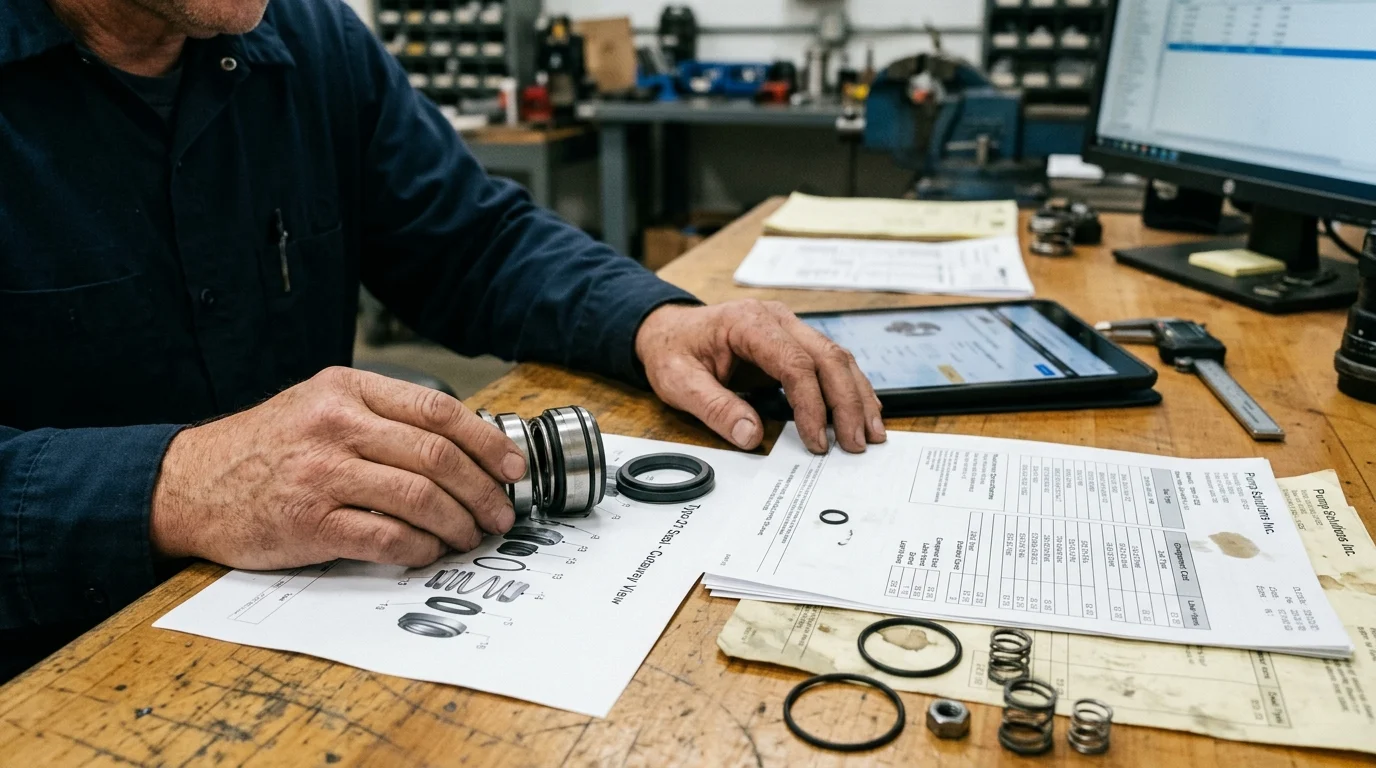
Calculating the true cost of mechanical seal replacement requires dissecting the expenditure into three primary categories: the seal hardware, the direct maintenance labor, and the necessary ancillary repairs required to restore the pump to operational standards.
How seal type, material, and pump design affect price
The engineering specifications of the seal fundamentally dictate its baseline price. Single component seals are highly economical but offer limited protection, whereas dual (double) cartridge seals provide superior containment for hazardous fluids at a premium price point. Cartridge seals, which are pre-assembled and pre-set on a sleeve, eliminate installation measurement errors but typically cost 40% to 80% more than their component counterparts.
Material selection is another primary cost driver. Standard carbon and ceramic seal faces are inexpensive, but upgrading to Silicon Carbide (SiC) or Tungsten Carbide (WC) for abrasion resistance multiplies the face cost. Elastomer selection also creates significant price variance; standard Viton (FKM) O-rings may cost a few dollars, whereas specialized perfluoroelastomers (FFKM) like Kalrez, required for aggressive chemical resistance, can add $500 to $1,500 to the total seal cost.
What labor, disassembly, alignment, and shaft repair add to cost
Replacing a mechanical seal is an invasive maintenance procedure. For standard end-suction pumps, mechanics must decouple the motor, drain the casing, and remove the impeller. This disassembly and reassembly process typically requires 4 to 12 labor hours, depending on pump size and accessibility.
Beyond simple replacement, precision alignment and shaft restoration are mandatory to prevent immediate premature failure of the new seal. Laser alignment of the pump and motor shafts to tolerances as tight as 0.002 inches is required to prevent radial deflection. If the previous seal failure caused fretting or scoring on the pump shaft, operators face additional costs for shaft metal spraying, machining, or sleeve replacement, which can add $400 to $1,200 in machine shop expenses.
How parts and labor costs compare
The ratio of parts to labor costs shifts dramatically depending on the pump’s complexity and the required safety standards of the facility. For standard commercial pumps, labor often dominates the repair ticket. For heavy industrial pumps, the highly engineered hardware constitutes the bulk of the expense.
| Application Scenario | Typical Hardware Cost | Typical Labor/Machining Cost | Parts-to-Labor Ratio |
|---|---|---|---|
| Standard HVAC Water Pump (10 HP) | $150 – $300 | $600 – $900 | 20% Parts / 80% Labor |
| ANSI Chemical Process Pump | $800 – $2,500 | $1,200 – $1,800 | 50% Parts / 50% Labor |
| API 682 Refinery Pump | $4,000 – $12,000+ | $3,000 – $5,000 | 75% Parts / 25% Labor |
Typical Pump Mechanical Seal Replacement Cost Ranges
Because mechanical seals are deployed across industries ranging from commercial plumbing to offshore oil production, establishing a universal cost is impossible. However, segmenting costs by seal architecture and application provides procurement teams with realistic budgetary benchmarks.
How costs vary by seal type and application
Cost scales directly with the severity of the application and the complexity of the seal architecture. Light-duty applications utilizing Type 1 or Type 21 elastomer bellows component seals represent the lowest cost tier, often treated as disposable items. Mid-range applications, such as chemical processing and food manufacturing, rely on single cartridge seals utilizing durable metallurgy and engineered elastomers.
At the highest tier, high-pressure boiler feed pumps and volatile hydrocarbon pumps require API 682 compliant dual seals, often incorporating dry gas backup seals or complex pumping rings for barrier fluid circulation. These highly engineered units undergo rigorous testing and are manufactured from exotic alloys like Hastelloy or Alloy 20, pushing costs into the tens of thousands of dollars.
What typical commercial replacement cost ranges look like
Commercial and industrial replacement costs generally fall into three distinct bands based on pump classification and seal complexity.
| Seal Classification | Typical Cost Band (USD) | Common Applications |
|---|---|---|
| Basic Component Seals | $50 – $400 | HVAC, Water Treatment, Light Irrigation |
| Standard Cartridge Seals | $500 – $3,500 | Chemical Processing, Pulp & Paper, Food & Beverage |
| Engineered / API 682 Seals | $4,000 – $25,000+ | Oil & Gas, Power Generation, Toxic Chemical Containment |
When seal replacement costs less than full pump replacement
Maintenance managers must frequently decide whether to replace the mechanical seal or replace the entire bare-shaft pump. Industry best practice dictates utilizing the “50% Rule”: if the total cost of the seal replacement—including bearings, shaft machining, and labor—exceeds 50% to 60% of the cost of a brand new bare-shaft pump, total replacement is the superior economic choice.
For example, a standard fractional-horsepower centrifugal pump may cost $800 new. If a seal failure leads to shaft scoring and bearing contamination, the $600 repair estimate makes seal replacement economically irrational. Conversely, a large ANSI B73.1 pump casing and impeller may cost $15,000, making a $2,500 cartridge seal replacement highly cost-effective.
How to Evaluate Replacement Options
Procuring a replacement mechanical seal should never be a blind “like-for-like” transaction, particularly if the failed seal did not achieve its expected MTBF. Evaluating replacement options requires rigorous root cause analysis and a comparative assessment of sourcing channels.
What inspections confirm the root cause before replacement
Before authorizing a replacement purchase, reliability engineers must conduct a failure analysis on the damaged seal. Replacing a seal without addressing the underlying mechanical or hydraulic issue guarantees a repeat failure.
Inspectors should look for thermal cracking or blistering on carbon faces, which indicates dry running or inadequate flush plans. Elastomer extrusion suggests over-pressurization or chemical attack. Crucially, mechanics must dial-indicate the pump shaft before installing the new seal; radial shaft deflection exceeding 0.002 inches (0.05 mm) at the seal face will destroy even the highest-quality replacement seal within weeks.
How to compare OEM, aftermarket, and engineered seals
Buyers must navigate the choice between Original Equipment Manufacturer (OEM) seals, aftermarket alternatives, and custom-engineered upgrades. OEM seals guarantee exact fitment and preserve equipment warranties, but typically carry a 30% to 50% price premium.
Aftermarket seals from reputable third-party manufacturers can offer substantial cost savings and equivalent performance, provided the buyer verifies dimensional tolerances and material equivalence. For chronic problem pumps, partnering with a seal manufacturer for a custom-engineered upgrade—such as transitioning from a component seal to a robust cartridge design—incurs a higher initial cost but dramatically lowers long-term lifecycle expenses.
Which compliance and installation checks buyers should review
Depending on the industry, seal replacements must adhere to strict regulatory and compliance standards. In pharmaceutical and food processing, replacement seals must feature FDA-compliant or USP Class VI certified elastomers to prevent batch contamination.
In the hydrocarbon sector, replacement seals must often comply with API 682 4th Edition standards and ATEX directives for explosive environments. Furthermore, procurement teams should verify that high-pressure engineered replacement seals are supplied with documentation proving they successfully passed hydrostatic testing at 1.5 times the maximum allowable working pressure (MAWP) prior to shipment.
Decision Framework for Managing Seal Replacement
Effectively managing mechanical seal expenditures requires transitioning from reactive maintenance to a proactive, condition-based monitoring strategy. Establishing a clear decision framework optimizes maintenance budgets and minimizes the risk of catastrophic failures.
When to replace immediately versus schedule maintenance
Not all seal leaks demand immediate pump shutdown. A decision matrix based on leakage rates and barrier fluid monitoring helps operators distinguish between normal wear and impending catastrophic failure.
Immediate replacement is mandated if operators observe a pressure drop exceeding 10% per day in an API Plan 52/53 reservoir, or if there is visible, uncontainable leakage of hazardous process fluid. Conversely, if condition monitoring detects a gradual upward trend in vibration (e.g., crossing a threshold of 0.15 in/sec RMS) or a slow but steady increase in barrier fluid consumption, maintenance can be safely scheduled for the next planned facility outage, avoiding the massive costs of emergency downtime.
How lifecycle cost planning reduces future seal expenses
Modern reliability engineering emphasizes Life Cycle Cost (LCC) analysis over a 5- to 10-year horizon rather than minimizing initial purchase price. Upgrading seal support systems and investing in premium seal materials upfront radically alters the LCC trajectory.
For instance, if a standard $800 seal fails every 12 months, the 10-year direct cost is $8,000, plus ten instances of labor and operational disruption. Investing in a $2,500 upgraded cartridge seal and a $3,000 API Plan 11 flush system might extend the MTBF to 48 months. Over a 10-year period, the upgraded system requires only two replacements. The $5,500 initial capital outlay achieves positive Return on Investment (ROI) within the first avoided failure cycle, proving that engineered reliability is the most effective method for controlling seal replacement costs.
Key Takeaways
- The most important conclusions and rationale for pump mechanical seal replacement
- Specs, compliance, and risk checks worth validating before you commit
- Practical next steps and caveats readers can apply immediately
Frequently Asked Questions
What is the typical cost range for pump mechanical seal replacement?
It varies by seal type, materials, and labor. Standard single seals are usually the lowest cost, while cartridge, double, or OEM-compatible seals for brands like Grundfos or Flygt cost more.
What factors increase pump mechanical seal replacement cost?
Main drivers are seal design, face materials like SiC or WC, elastomer grade, pump accessibility, alignment work, and any shaft sleeve or rotor repair needed.
Is a cartridge seal worth the higher price?
Often yes for industrial maintenance teams. Cartridge seals install faster, reduce setting errors, and can lower downtime, which may outweigh the higher purchase price.
Can Victor Seals supply OEM-compatible replacements for my pump brand?
Yes. Victor Seals offers OEM-compatible seals and spare parts for brands including IMO, Alfa Laval, Grundfos, APV, Flygt, Fristam, Lowara, and Allweiler.
How can I reduce future seal replacement costs?
Match seal materials to the fluid, verify shaft condition and alignment, and choose the correct seal type for the duty. For harsh services, upgrading the seal plan can extend service life.

Post time: Jun-22-2026