


Introduction
In high-heat pumping and processing systems, seal failure often begins long before a visible leak appears. A high temperature mechanical seal is designed to keep sealing faces stable as heat, pressure, and fluid conditions push standard designs beyond their limits. This article explains how these seals prevent common failure modes such as dry running, vapor formation, thermal distortion, and accelerated material wear. You will see which design features matter most, why temperature changes sealing behavior, and how the right seal choice improves reliability, reduces downtime, and protects equipment in demanding industrial service.
Why High Temperature Mechanical Seals Matter for Reliability
In demanding industrial environments, fluid handling systems are frequently pushed to their thermal limits. A high temperature mechanical seal is engineered specifically to maintain integrity where standard sealing solutions rapidly degrade, preventing catastrophic leaks, fugitive emissions, and unplanned downtime.
When process fluids surpass the operational thresholds of conventional elastomers and face materials, the dynamic stability of the seal becomes highly volatile. Implementing specialized high temperature sealing technology is a fundamental requirement for plant reliability, directly extending the Mean Time Between Failures (MTBF) from a matter of weeks to well over 24 months in extreme applications.
How high temperature seals reduce failure
High temperature mechanical seals reduce failure by actively managing the fluid film between the rotating and stationary faces, preventing phase changes that lead to dry running. Standard mechanical seals often fail when the pumped fluid flashes into vapor—a common occurrence when handling water or light hydrocarbons above 150°C (300°F). By utilizing advanced metallurgy and optimized seal face geometries, high temperature variants dissipate generated heat more effectively and maintain a stable liquid film.
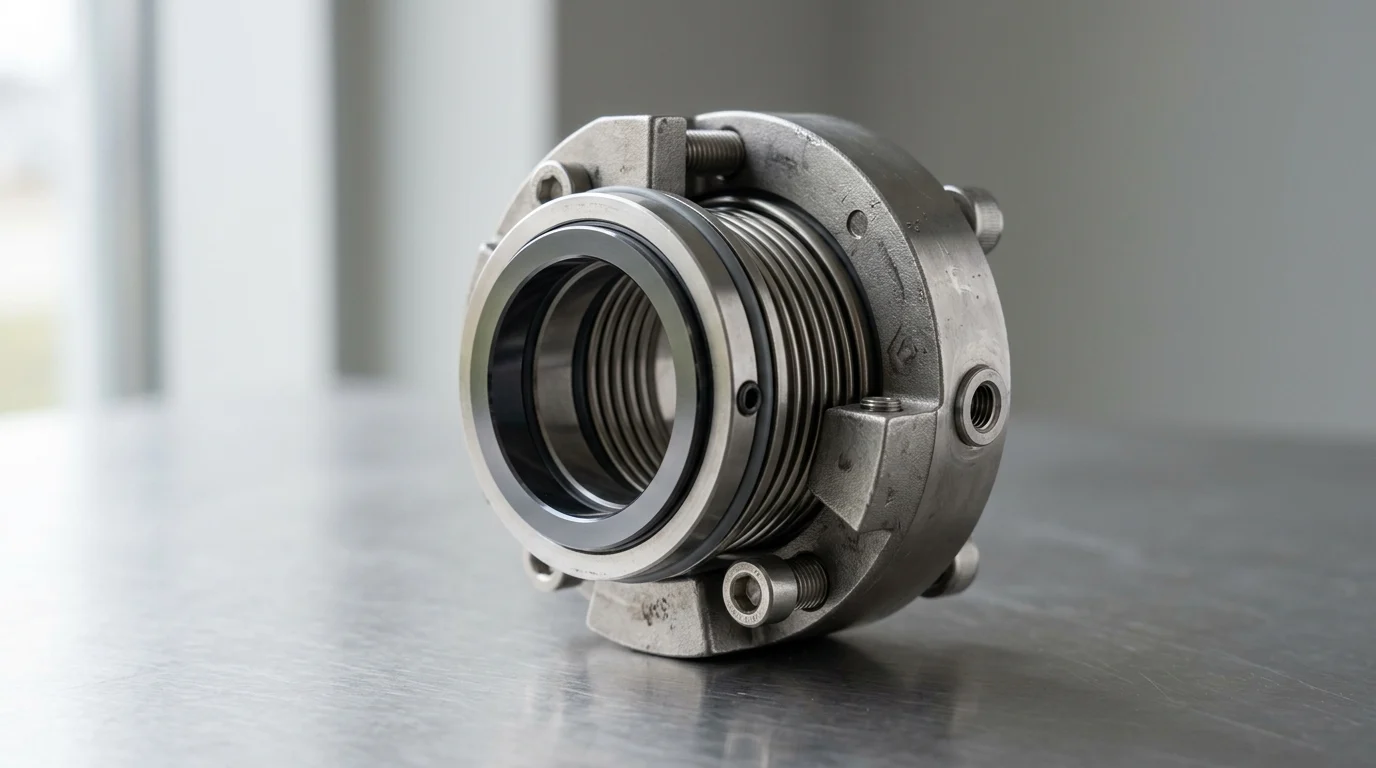
Furthermore, these seals mitigate the mechanical stresses associated with extreme heat. Standard pusher seals rely on dynamic O-rings that can harden, extrude, or melt, causing the seal faces to hang up and leak. High temperature designs frequently eliminate these dynamic elastomers in favor of flexible metal bellows, ensuring consistent face loading even as the pump shaft undergoes thermal expansion.
Which operating conditions drive thermal seal failure
Several operating conditions accelerate thermal seal failure if not properly addressed by the seal design. Process temperatures exceeding 200°C (392°F) represent the most direct threat, degrading standard secondary sealing elements and altering the viscosity of the lubricating fluid film. At these temperatures, the margin between the fluid’s operating pressure and its vapor pressure narrows significantly, increasing the risk of flashing.
Thermal transients, or thermal shock, also drive failure. When a pump experiences rapid temperature fluctuations exceeding 50°C per minute, standard seal faces can suffer from uneven thermal expansion, leading to instantaneous face distortion and leakage. Additionally, pumping hydrocarbons at temperatures around 175°C (347°F) and above introduces the risk of coking, where the fluid oxidizes on the atmospheric side of the seal, creating abrasive sludge that restricts seal movement and destroys the lapped faces.
What Defines a High Temperature Mechanical Seal

Defining a high temperature mechanical seal requires looking beyond basic dimensions to the core materials and structural engineering. Unlike general-purpose seals, these units are characterized by the complete elimination of temperature-sensitive polymers in dynamic locations, utilizing robust metallurgies and specialized face combinations designed to handle extreme thermal loads without warping.
Which materials and face combinations are used
The selection of face materials is critical for high temperature service. Silicon Carbide (SiC) and Tungsten Carbide (TC) are heavily favored for their exceptional hardness and thermal conductivity, which allows them to pull heat away from the sealing interface. Premium high-temperature seals often pair a SiC rotating face with an antimony-impregnated carbon stationary face, providing excellent dry-running survivability and blister resistance under marginal lubrication conditions.
Secondary sealing elements—the components that seal the faces to the shaft and gland—must also be upgraded. While standard Fluoroelastomers (FKM) fail around 200°C, Perfluoroelastomers (FFKM) can be deployed up to 327°C (620°F). For temperatures exceeding this threshold, flexible graphite becomes the industry standard, offering stability in oxidizing environments up to 450°C (842°F) and in reducing environments well beyond 1000°C.
| Secondary Seal Material | Max Operating Temperature | Chemical Compatibility | Primary Application |
|---|---|---|---|
| Standard FKM (Viton) | 200°C (392°F) | Broad (Aqueous/Oils) | General utility pumps |
| FFKM (Kalrez) | 327°C (620°F) | Near-universal | Chemical processing |
| Flexible Graphite (Grafoil) | 450°C (842°F) | Excellent (except strong oxidizers) | High-temp refining/boiler feed |
How thermal expansion, lubrication limits, and pressure balance affect design
Thermal expansion dictates the geometric design of high temperature seals. Different materials expand at different rates; for instance, Silicon Carbide has a Coefficient of Thermal Expansion (CTE) of approximately 4.0 µm/m-°C, which is significantly lower than most stainless steel shafts (CTE ~16.0 µm/m-°C). If the seal design does not accommodate this differential, shrink-fit components can loosen, or faces can be subjected to severe compressive stress, leading to cracking.
Pressure balancing is another defining characteristic. At elevated temperatures, fluid viscosity drops, making the lubricating film thinner and more fragile. High temperature seals are heavily balanced to reduce the hydraulic closing force on the seal faces. This minimizes friction and heat generation, ensuring the fluid film does not boil away. Advanced designs also utilize specialized face topographies, such as shallow hydropads, to promote hydrodynamic lift and sustain lubrication limits even under high-pressure, high-heat conditions.
How High Temperature Mechanical Seals Prevent Failure
The primary function of a high temperature mechanical seal is to prevent the cascade of failure modes triggered by excessive heat. By maintaining micro-level dimensional stability and utilizing specialized flush plans, these seals prevent the fluid film from collapsing, which is the root cause of most catastrophic mechanical seal failures.
Which comparison points to include in a performance table
When evaluating high temperature mechanical seals, engineers must compare several critical performance points to ensure reliability. A performance table should contrast standard pusher seals against edge-welded metal bellows and gas-lubricated non-contacting seals. Key metrics include maximum temperature thresholds, susceptibility to face deflection, and the risk of dynamic O-ring hang-up.
| Seal Design Type | Maximum Temperature Limit | Face Deflection Risk | Coking/Hang-up Risk |
|---|---|---|---|
| Standard Pusher Seal | 200°C (with FKM) | High (due to elastomer limits) | High (dynamic O-ring restricts movement) |
| Edge-Welded Metal Bellows | 400°C+ (with Graphite) | Low (uniform face loading) | Low (no dynamic elastomers to hang up) |
| Gas-Lubricated Dual Seal | 450°C+ | Very Low (non-contacting faces) | Zero (inert gas barrier prevents fluid contact) |
What failure modes are most common at elevated temperature
The most common failure mode at elevated temperatures is heat checking. This phenomenon occurs when localized face temperatures exceed the fluid’s boiling point by just 10-15°C, causing the fluid film to micro-flash. The rapid cycle of heating and cooling creates severe thermal fatigue, resulting in microscopic radial cracks across the seal face that act like cutting tools, rapidly destroying the opposing face.
Other prevalent high-temperature failure modes include carbon blistering and elastomer extrusion. Blistering occurs when heavy hydrocarbons penetrate the pores of a carbon seal face; as the temperature rises, the trapped fluid expands and fractures the carbon surface. Elastomer extrusion happens when high temperatures soften O-rings, causing process pressure to push the elastomer into hardware clearances, stripping the seal of its secondary barrier and causing immediate leakage.
How to Specify, Install, and Monitor High Temperature Mechanical Seals
A high temperature mechanical seal is only as reliable as its surrounding system. Proper specification, precise installation, and rigorous condition monitoring are required to ensure the seal operates within its designed thermal and hydraulic envelopes, preventing premature wear and sudden failure.
Which specification inputs and sizing steps are required
Specifying a high temperature seal begins with precise inputs: stuffing box temperature, maximum dynamic pressure, shaft speed (RPM), and the exact vapor pressure margin of the process fluid. For heavy-duty refining applications operating up to 40 bar (600 psi) and 400°C, engineers must calculate the estimated heat generation at the seal faces to determine the required cooling capacity.
Sizing steps must account for thermal expansion of the pump shaft and casing. The seal chamber must provide adequate radial clearance to accommodate larger metal bellows assemblies and allow for sufficient fluid circulation. If the clearance is too tight, heat cannot dissipate, and the seal will fail regardless of its metallurgical grade.
What installation, startup, flush plan, inspection, and condition monitoring practices matter
Installation and startup procedures are critical. High temperature seals must be installed with absolute cleanliness, as any debris can prevent the faces from mating perfectly. During startup, the pump must be properly vented to prevent dry running, and thermal conditioning (gradual warm-up) is required to prevent thermal shock to the carbide faces.
The environmental control system, defined by API 682 piping plans, is the lifeline of the seal. API Plan 23 is widely considered the most efficient for hot water and boiler feed applications, recirculating fluid through a cooler and reducing the heat load on the plant’s cooling water system by up to 80% compared to a standard Plan 21. For hot hydrocarbons, a Plan 62 steam quench is often applied to the atmospheric side of the seal to prevent oxidation and coking. Condition monitoring should include flush temperature tracking; a sustained increase of +10°C above the established baseline is a reliable early indicator of face distress or cooler fouling.
How to Choose the Best High Temperature Mechanical Seal
Choosing the optimal high temperature mechanical seal requires balancing upfront capital expenditure against the long-term operational costs of the pumping system. The right choice aligns the seal’s metallurgical and design capabilities with the specific thermal realities of the process, ensuring maximum uptime.
How to weigh total cost of ownership and maintenance
When weighing the total cost of ownership (TCO), plant operators must look beyond the initial purchase price. A premium edge-welded metal bellows seal with flexible graphite secondary sealing may carry a 2x to 4x upfront cost multiplier compared to a standard pusher seal. However, this capital cost is rapidly offset by the elimination of unplanned downtime.
A single catastrophic seal failure in a high-temperature refining unit can incur $10,000 to $30,000 in lost production, maintenance labor, and environmental cleanup. Furthermore, maintenance costs are heavily influenced by cooling utilities. An improperly selected seal that relies on a highly inefficient open-loop cooling system can consume over $15,000 per year in utility costs alone, whereas investing in a high-temperature seal paired with a closed-loop Plan 23 system yields a rapid return on investment.
What decision guidance helps match seal design to the application
Decision guidance for matching a seal to an application relies on strict temperature banding and fluid characteristics. For applications below 150°C (300°F), a standard balanced pusher seal with upgraded FKM or EPDM elastomers is typically sufficient. In the transitional zone of 150°C to 200°C, pusher seals can still be utilized if equipped with premium FFKM elastomers and robust API flush plans.
However, once process temperatures enter the 200°C to 400°C+ range, the decision matrix strongly dictates the use of stationary metal bellows seals utilizing flexible graphite. If the fluid is a heavy hydrocarbon prone to coking, a steam quench must be specified. By adhering to these strict thermal thresholds and prioritizing lifecycle reliability over initial hardware costs, engineers can permanently eliminate one of the most common sources of high-temperature pump failure.
Key Takeaways
- The most important conclusions and rationale for high temperature mechanical seal
- Specs, compliance, and risk checks worth validating before you commit
- Practical next steps and caveats readers can apply immediately
Frequently Asked Questions
What makes a high temperature mechanical seal different from a standard seal?
It uses heat-resistant face materials like SiC or TC and often replaces dynamic elastomers with metal bellows or graphite, helping the seal stay stable above standard temperature limits.
At what temperature should I switch to a high temperature mechanical seal?
If process temperatures regularly exceed 200°C, standard FKM-based seals can degrade quickly. Upgrading earlier is also wise when fluids flash, coke, or face rapid thermal cycling.
Which face materials work best for high temperature mechanical seals?
Common choices are silicon carbide, tungsten carbide, and antimony-impregnated carbon. The best pair depends on fluid, pressure, and lubrication, so material matching is critical.
How does a high temperature mechanical seal prevent premature failure?
It manages seal-face heat better, maintains a stable fluid film, and resists thermal distortion. This reduces dry running, face cracking, elastomer damage, and leakage during hot service.
Can Victor Seals supply high temperature replacements for OEM pump seals?
Yes. Victor Seals provides OEM-compatible and replacement mechanical seals for many industrial pump brands, supporting maintenance teams in chemical, oil and gas, marine, and water applications.

Post time: Jun-20-2026