


How Multi Spring Mechanical Seals Reduce Leakage
Design features that improve sealing performance
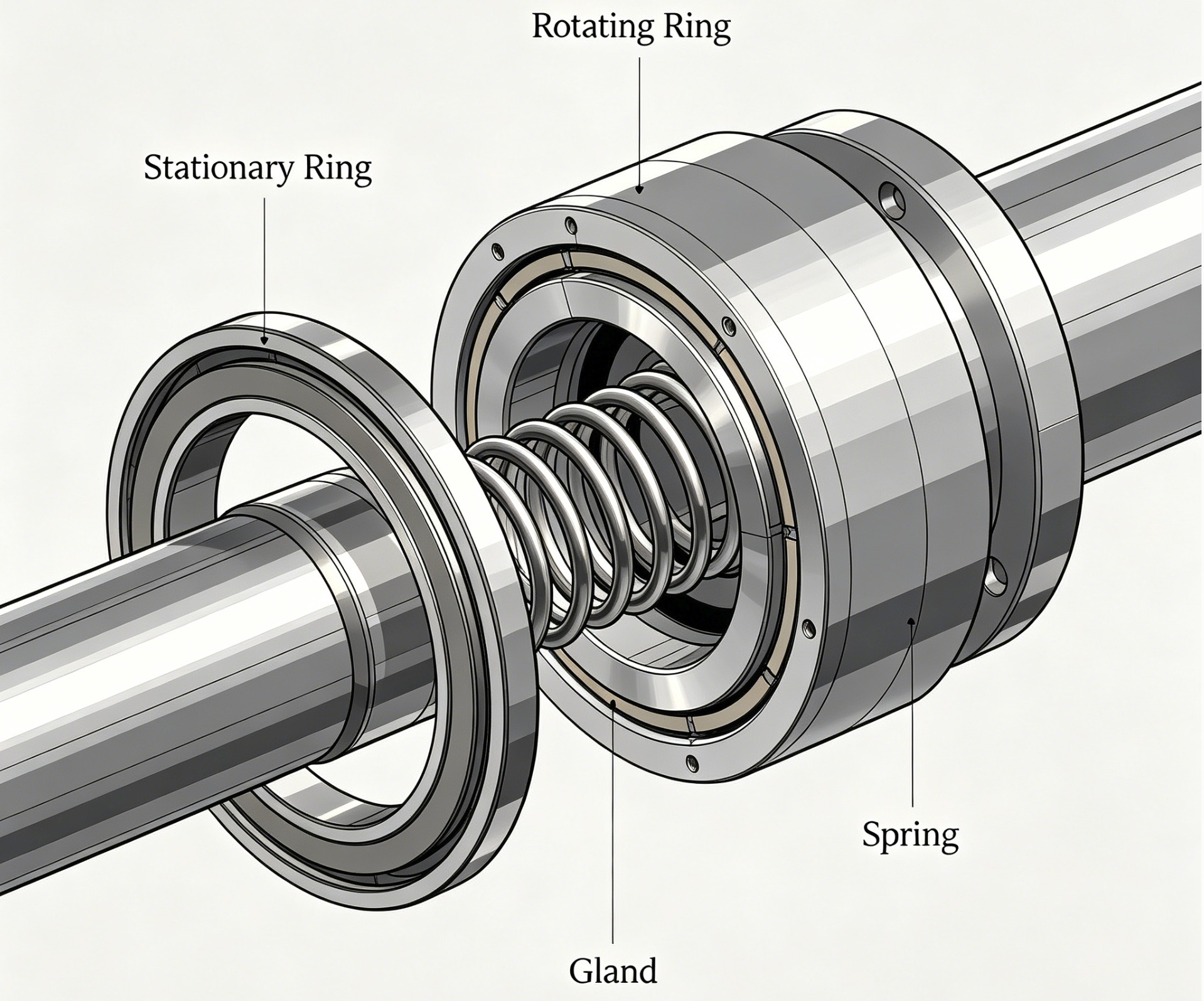
The primary design advantage of this configuration is the uniform distribution of closing force. Typically, a multi spring arrangement exerts a specific face pressure ranging from 15 to 25 psi, ensuring that the primary sealing surfaces remain in parallel alignment without localized high-friction zones. This even loading minimizes uneven wear patterns that frequently cause fluid bypass in other seal types.
Additionally, using multiple smaller springs requires a significantly shorter axial operating length compared to a single large coil spring. This compact footprint reduces the overhung load on the pump shaft, which inherently decreases shaft deflection and vibration, further stabilizing the sealing interface.
Balanced vs unbalanced seal designs
Managing fluid pressure is critical to minimizing leakage without inducing premature wear. In an unbalanced multi spring seal, the full hydraulic pressure of the stuffing box acts on the seal faces. This configuration is generally acceptable for low-pressure applications operating below 150 psi, where the fluid itself provides adequate lubrication.
For higher-pressure environments exceeding 400 psi, balanced seal designs are strictly required. A balanced multi spring seal features a stepped shaft or sleeve that reduces the hydraulic closing area, typically achieving a balance ratio between 0.65 and 0.85. This reduction in closing force lowers the heat generated at the seal faces, preventing fluid vaporization and the subsequent dry-running leakage that destroys seal integrity.
Operating conditions that affect leakage
The efficacy of a multi spring seal is highly dependent on the operating conditions of the fluid system. Viscosity, temperature fluctuations, and mechanical vibration directly influence seal performance. Standard multi spring seals can accommodate temperature ranges from -40°C up to 205°C when equipped with appropriate elastomeric components.
However, strict mechanical tolerances must be maintained for the seal to function correctly. Shaft runout, for instance, should not exceed a Total Indicator Reading (TIR) of 0.002 inches. Excessive runout or high-amplitude vibration forces the springs to constantly adjust; over time, this leads to spring fatigue, loss of parallel face alignment, and eventual fluid bypass.
Multi Spring vs Single Spring Mechanical Seals
Selecting the appropriate mechanical seal requires a thorough understanding of the operational differences between single spring and multi spring configurations. While both serve the primary function of containing process fluids, their distinct mechanical architectures dictate their suitability for specific industrial applications and failure modes.
Key comparison criteria
Evaluating these two designs involves analyzing face loading uniformity, spatial requirements, and resistance to fluid contamination. Single spring seals utilize one large, heavy-gauge coil that grips the shaft, offering robust performance in heavily contaminated or viscous fluids. In contrast, multi spring seals provide superior high-speed stability and perfectly distributed face pressure but require cleaner operating environments to prevent fouling.
| Feature | Multi Spring Mechanical Seal | Single Spring Mechanical Seal |
|---|---|---|
| Face Load Uniformity | Excellent (Evenly distributed) | Moderate (Prone to uneven wear) |
| Axial Space Required | Highly compact | Extended/Bulky |
| Clogging Resistance | Low (Small pockets can foul) | High (Open coil sheds debris) |
| Max RPM Stability | > 3,600 RPM | Generally < 2,500 RPM |
When a multi spring seal is the better choice
A multi spring mechanical seal is the definitive choice for applications involving clean fluids, tight spatial constraints, and high rotational speeds. Because the smaller springs are protected from severe centrifugal distortion, they provide reliable performance in high-velocity pumps operating at or above 3,600 RPM.
Furthermore, in highly corrosive chemical applications, manufacturing an array of small springs from exotic alloys—such as Hastelloy C, Alloy 20, or Titanium—is significantly more cost-effective than forging a massive single coil spring from the same premium materials. However, multi spring designs should be avoided in heavy slurry or high-particulate applications unless they are protected by an external clean flush plan, as solid matter can quickly pack into the compact spring pockets and restrict movement.
Specification, Installation, and Maintenance Best Practices
Achieving the optimal MTBF target of 36 to 60 months for a multi spring mechanical seal requires rigorous adherence to specification, installation, and maintenance protocols. Even the most advanced, perfectly balanced seal designs will fail prematurely if subjected to improper material selection or poor installation practices.
Material and secondary seal selection
The selection of primary face materials and secondary sealing elements dictates the seal’s thermal and chemical resilience. For abrasive or high-pressure environments, paired hard faces such as Silicon Carbide (SiC) against Tungsten Carbide (WC) are preferred due to their high modulus of elasticity and exceptional wear resistance.
Secondary seals, typically O-rings or wedges, must be precisely matched to the fluid’s temperature profile and chemical makeup. Standard FKM (Viton) elastomers are generally limited to operating temperatures of 200°C. In contrast, premium FFKM (Kalrez) compounds can withstand continuous exposure up to 320°C and resist aggressive solvents, though they represent a significantly higher initial material cost.
Installation checks and tolerance requirements
Precision during installation is non-negotiable for multi spring mechanical seals. Technicians must rigorously verify the concentricity and perpendicularity of the stuffing box relative to the pump shaft. Radial shaft deflection must be tightly controlled, typically limited to a maximum of 0.002 inches (0.05 mm) during dynamic operation.
Additionally, the surface finish of the shaft or sleeve located under the dynamic O-ring must meet strict micro-inch specifications—usually polished to between 16 and 32 Ra. A surface that is too rough will cause elastomer fretting and secondary leakage, while a surface that is too smooth will prevent the O-ring from properly seating and maintaining its sealing extrusion gap.
Monitoring and maintenance for leak prevention
Continuous monitoring of the seal environment is essential for early leak detection and long-term prevention. Implementing standardized API piping plans, such as Plan 11 for seal chamber flushing or Plan 53A for pressurized barrier fluids, ensures adequate cooling, lubrication, and debris removal from the seal faces.
In a dual multi spring seal arrangement utilizing API Plan 53A, the barrier fluid pressure must be strictly maintained at 15 to 30 psi above the maximum stuffing box pressure. Routine monitoring of barrier fluid levels and temperatures provides actionable, predictive indicators of seal face wear, allowing operators to schedule maintenance before a catastrophic blowout or major product loss occurs.
How to Evaluate the Right Multi Spring Mechanical Seal
The procurement of a multi spring mechanical seal should be treated as a strategic investment in plant reliability rather than a simple transactional purchase. Evaluating the right seal involves a comprehensive lifecycle analysis that weighs initial capital expenditures against projected operational uptime and maintenance reductions.
Matching seal selection to fluid and service conditions
Accurate seal specification requires matching the seal geometry and materials to the fluid’s vapor pressure margin and inherent lubricity. Engineers must calculate the Pressure-Velocity (PV) value of the application to ensure the seal faces will not generate excessive frictional heat. Systems exceeding a PV limit of 100,000 psi-ft/min necessitate highly optimized multi spring designs featuring premium face materials and advanced cooling flush plans.
Failing to account for low fluid lubricity or inadequate vapor pressure margins will result in fluid flashing at the seal faces. This phase change removes the critical lubricating film, leading to rapid thermal degradation, face scoring, and immediate leakage.
Balancing purchase price with service life
While the upfront cost of advanced sealing technologies can be significant, the return on investment is realized through extended operational life and a drastic reduction in maintenance interventions.
| Seal Configuration | Initial Cost Index | Expected MTBF (Clean Fluid) | Primary Operational Benefit |
|---|---|---|---|
| Standard Component Seal | $400 – $800 | 12 – 24 months | Low initial capital expenditure |
| Cartridge Multi Spring Seal | $1,500 – $3,000 | 36 – 60+ months | Eliminates installation errors, maximum uptime |
| Dual Pressurized Cartridge | $3,500 – $6,000 | 48 – 72+ months | Zero emissions, handles hazardous fluids |
A standardized cartridge multi-spring seal may carry an initial cost of $1,500, compared to a $400 basic component seal. However, the cartridge design virtually eliminates installation errors and often outlasts the component seal by a factor of three. In critical process industries where unplanned downtime can easily exceed $10,000 per hour, the higher initial investment in a precisely engineered multi spring seal is rapidly offset by the mitigation of leakage events and the stabilization of production schedules.
Key Takeaways
- The most important conclusions and rationale for Multi Spring Mechanical Seal
- Specs, compliance, and risk checks worth validating before you commit
- Practical next steps and caveats readers can apply immediately
Frequently Asked Questions
What should buyers compare first when sourcing Multi Spring Mechanical Seal?
Start with airflow/spec range, compliance requirements, installation constraints, and after-sales spare-part policy. These four factors usually determine total risk and margin quality.
How can readers control landed cost for Multi Spring Mechanical Seal?
Break down unit FOB, packaging volume, container utilization, duty/tax, and expected return rate. A simple landed-cost model by SKU tier helps avoid margin surprises.
Which certifications are commonly required for Multi Spring Mechanical Seal in key markets?
Requirements vary by destination market; verify applicable electrical/safety and material compliance standards before PO confirmation, and keep lab reports tied to exact SKU versions.
How should distributors set MOQ and inventory targets for Multi Spring Mechanical Seal?
Use channel demand split and lead time to set tiered MOQ. Keep fast-moving SKUs deeper in stock while limiting long-tail variants with slower turns and higher holding costs.
What is a practical quality-control checklist for Multi Spring Mechanical Seal orders?
Define AQL, critical defect list, function tests, and packaging drop checks. Run pre-shipment inspection and keep a traceable defect feedback loop with the factory.
Post time: Jun-10-2026