


Introduction
Mechanical seal performance depends heavily on how closing force is generated, and spring design is one of the most important variables. When comparing single spring and multi spring arrangements, the differences go beyond part count: they affect reliability, contamination resistance, shaft fit, and behavior under vibration, wear, and thermal movement. This article focuses on the single spring mechanical seal while placing it against the multi spring alternative, so you can see where each design performs best. By the end, you’ll have a practical basis for selecting the right seal configuration for pump service, operating conditions, and maintenance priorities.
Single vs Multi Spring Mechanical Seals
Mechanical seals rely on their spring mechanisms to maintain constant face contact during dynamic operation, compensating for face wear, shaft runout, and thermal expansion. The choice between single and multiple spring configurations significantly alters the mechanical response, spatial requirements, and vulnerability to media contamination of the sealing system. Understanding these distinct architectures is critical for optimizing the mean time between failures (MTBF) in industrial pump applications, where improper spring selection can lead to catastrophic leakage and unplanned downtime.
While both designs serve the same purpose of providing the necessary closing force to the primary seal faces, their geometric execution dictates their suitability for specific industrial environments. Plant engineers must evaluate these designs not merely as interchangeable components, but as engineered subsystems that interact directly with the pumped fluid.
Key design differences
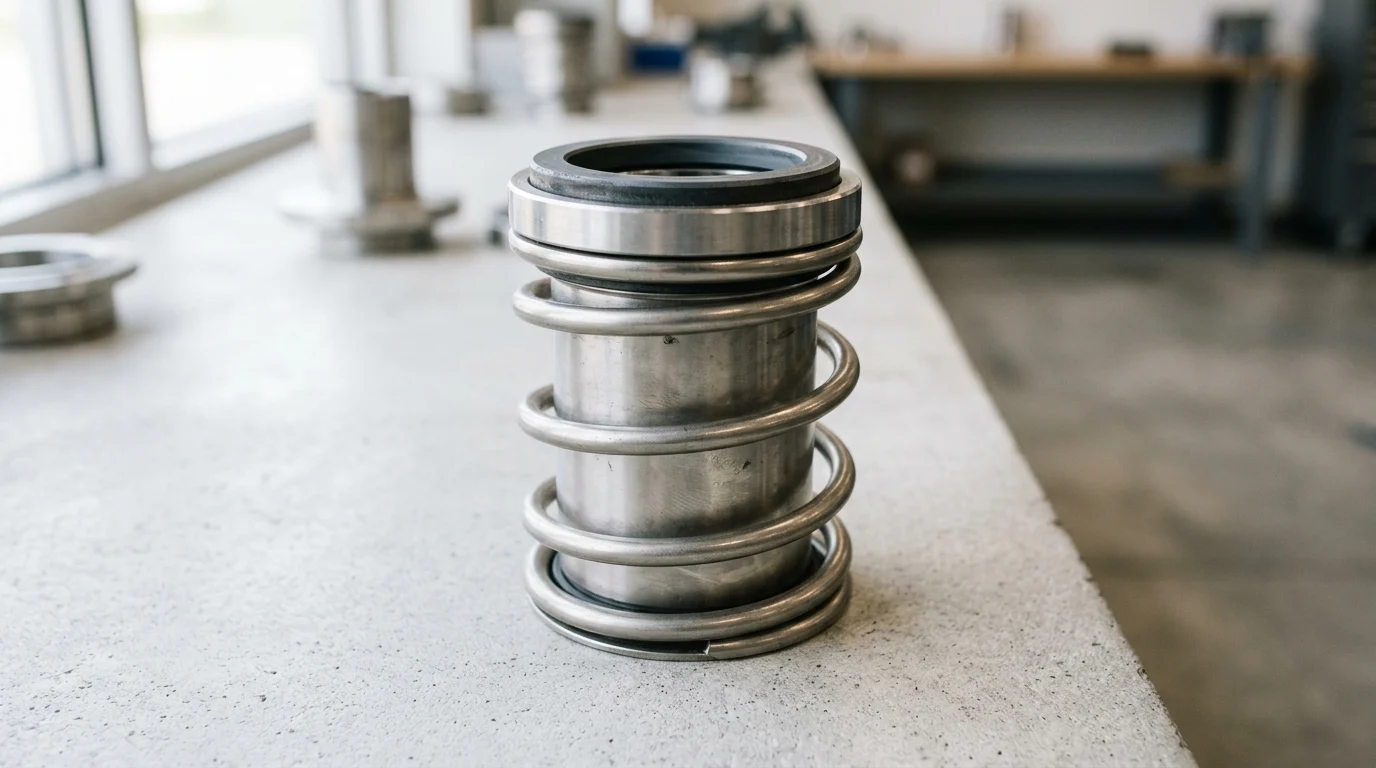
A single spring mechanical seal utilizes one large, heavy-duty coil spring to apply closing force against the primary seal ring. This single coil is typically manufactured from heavy-gauge wire, often ranging from 3.0 to over 5.0 millimeters in diameter depending on the specific shaft size. Because of its massive cross-section, the single spring is inherently rugged and highly resistant to structural degradation.
In contrast, a multi-spring seal employs a series of smaller coil springs—usually between 6 and 20 individual springs depending on the seal diameter—housed within a machined retainer ring. These smaller springs utilize significantly thinner wire, typically 1.0 to 2.0 millimeters in diameter, arranged circumferentially around the seal faces. This distributed architecture requires a more complex manufacturing process but results in a highly compact axial and radial footprint.
Performance and leakage control
The distribution of closing force is the primary performance differentiator between these two designs. Multi-spring seals deliver a highly uniform 360-degree face loading profile. This design is typically engineered to maintain a precise and constant face pressure, generally between 0.15 and 0.25 MPa. This even distribution minimizes face distortion and ensures parallel tracking, which is particularly vital at high rotational speeds where hydrodynamic fluid films must be strictly maintained.
Conversely, a single spring mechanical seal applies force from one continuous, helical coil. Because the force originates from a single wire wrapping around the shaft, it can result in slightly uneven face pressure distribution. At extreme velocities, this asymmetric loading can cause microscopic face distortion, leading to uneven wear or localized heat generation. However, the heavy-duty nature of the single spring provides superior resistance to centrifugal unwinding, making it highly stable at standard and lower operating speeds.
Service limits and media suitability
Media characteristics ultimately dictate the absolute service limits of each spring design. Single springs excel in harsh, abrasive, or highly viscous environments. Their large, open-coil architecture resists clogging from suspended particulates, coagulating fluids, or crystallizing media. Fluids with high solids content can easily wash through the large gaps in a single spring without impeding its mechanical flexibility.
Multi-spring designs, while superior in clean fluids, are highly susceptible to fouling. Solid particles, slurries, or polymerizing liquids can easily pack into the small spring pockets within the retainer. Once these pockets fill, the small springs become jammed or “choked,” rendering the seal rigid. This loss of flexibility prevents the seal from tracking the shaft, leading to immediate and severe leakage.
| Feature | Single Spring Mechanical Seal | Multi-Spring Mechanical Seal |
|---|---|---|
| Spring Wire Diameter | Large (3.0 – 5.0+ mm) | Small (1.0 – 2.0 mm) |
| Face Load Distribution | Moderate/Asymmetrical | Highly Uniform/Symmetrical |
| Clogging Resistance | Excellent (Open Architecture) | Poor (Enclosed Pockets) |
| Typical Speed Limit | Moderate (< 15 m/s) | High (> 20 m/s) |
How to Compare Seal Options
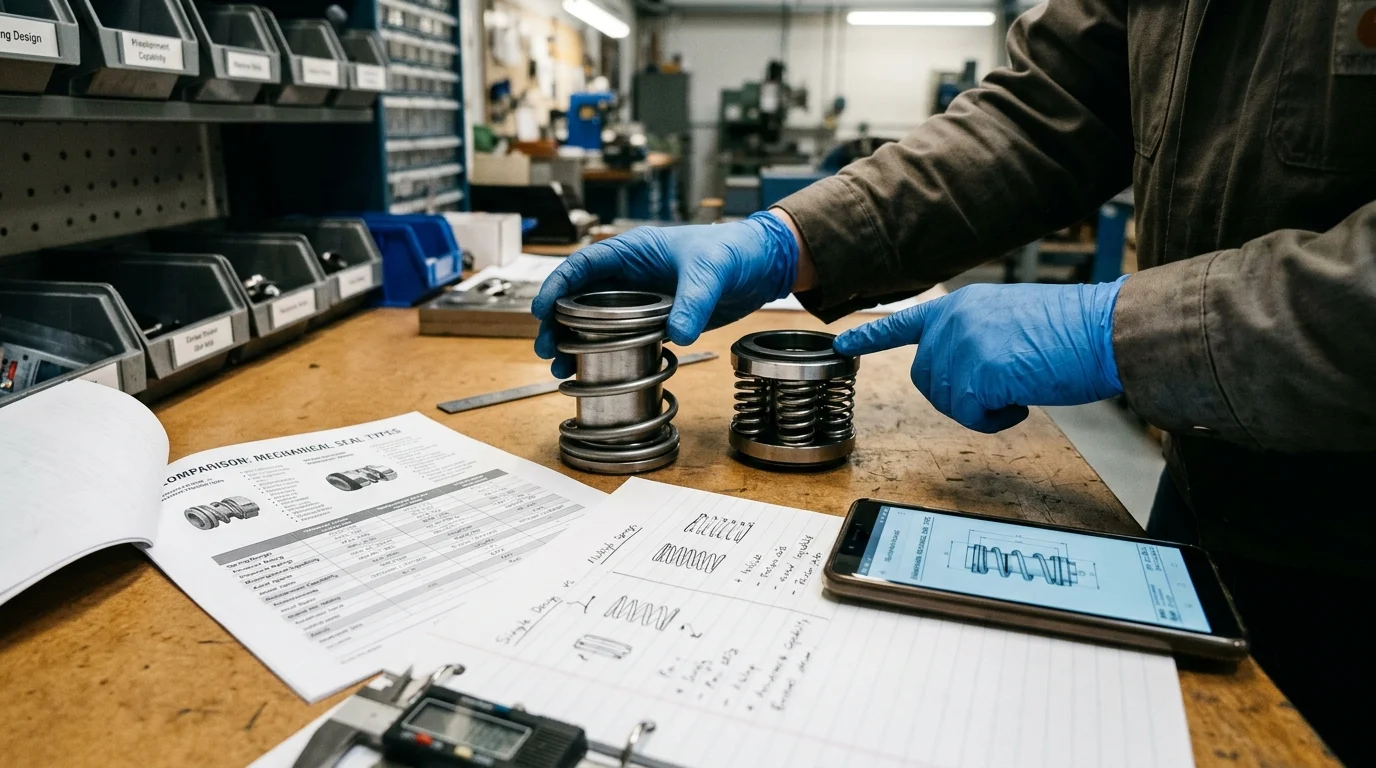
Evaluating and comparing seal options requires a rigorous analysis of mechanical, thermodynamic, and spatial constraints. Engineers must align the physical characteristics of the seal with the operational demands of the rotating equipment, frequently referencing stringent industry standards such as API 682 for critical petrochemical and refinery applications. Proper comparison ensures that the selected seal architecture will not only fit the equipment but also survive the specific dynamic conditions of the process.
Selection criteria
Primary selection criteria revolve around shaft diameter, rotational speed, and operating pressure. Multi-spring seals are generally the preferred standard for shaft speeds exceeding 3000 RPM or face velocities above 20 meters per second. Their compact, distributed mass prevents the centrifugal distortion that can plague larger single coils at high speeds.
Pressure ratings also play a decisive role in the comparison. While both designs can be engineered in balanced or unbalanced configurations, standard unbalanced single spring mechanical seals are typically limited to stuffing box pressures below 1.0 MPa (145 psi). For higher pressure applications, balanced multi-spring seals are frequently specified. They comfortably handle pressures up to 3.0 MPa (435 psi) in standard configurations by utilizing an optimized balance ratio—typically engineered between 0.70 and 0.85—to reduce heat generation at the seal faces.
Failure modes and installation sensitivity
Installation sensitivity and failure modes vary significantly between the two architectures. A single spring mechanical seal is historically recognized for being highly forgiving regarding axial installation tolerances. It can often accommodate shaft end-play, thermal growth, or installation setting errors of $\pm 2.0$ millimeters without catastrophic loss of face load. However, single conical springs are often directional—meaning they rely on the specific direction of shaft rotation (right-hand or left-hand wound) to tighten during operation. Installing a directional spring on a reverse-rotating shaft will cause the spring to unwind and fail instantly.
Multi-spring seals eliminate the rotational directionality problem, as their linear compression springs operate independently of shaft rotation direction. However, they demand precise installation. The axial tolerance for a multi-spring seal is often rigidly restricted to $\pm 0.5$ millimeters. If installed too loosely, the seal will leak on startup; if over-compressed, the thin springs will bind, leading to excessive face wear and rapid thermal failure.
Materials and balance considerations
Material selection for the springs is a critical comparison point, heavily influenced by the corrosion allowance of the wire. Because multi-springs utilize thin wire (1.0 to 2.0 mm), they possess a very low tolerance for pitting or uniform corrosion. Consequently, standard multi-springs are frequently manufactured from high-grade exotic alloys like Hastelloy C-276, Alloy 20, or Inconel 718 to ensure longevity in aggressive chemical environments.
Single springs benefit from a massive cross-sectional area, providing a high built-in corrosion allowance. This allows engineers to frequently specify standard 316 Stainless Steel for single springs even in moderately corrosive environments, as it would take years for corrosion to penetrate the 4.0 mm wire sufficiently to cause structural failure.
| Specification | Single Spring Configuration | Multi-Spring Configuration |
|---|---|---|
| Axial Installation Tolerance | $\pm 2.0$ mm (Forgiving) | $\pm 0.5$ mm (Strict) |
| Rotational Directionality | Often Directional (Conical) | Non-Directional |
| Standard Spring Material | 316 Stainless Steel | Hastelloy C-276 / Alloy 20 |
| Pressure Limit (Unbalanced) | $\le 1.0$ MPa | $\le 1.2$ MPa |
How to Select the Right Seal
The procurement and engineering specification process relies on the rigorous validation of field application data against manufacturer performance curves. Selecting the right seal architecture is not a matter of generic preference, but a strict technical matching process that prevents premature equipment degradation. A systematic decision path must be followed to eliminate variables and isolate the optimal sealing technology.
Application data to validate
Fluid properties serve as the strictest arbiter of seal selection. Engineers must accurately validate the dynamic viscosity, crystallization point, and particulate concentration of the pumped media. Thresholds are highly specific: if the fluid viscosity exceeds 500 cSt, or if the particulate concentration is greater than 5% by weight, a single spring mechanical seal becomes the mandatory baseline specification.
Failing to validate this data can result in specifying a multi-spring seal for a slurry application, guaranteeing premature failure as the springs clog. Conversely, validating that a fluid is a clean, non-polymerizing hydrocarbon with a viscosity below 10 cSt provides the green light to leverage the high-speed stability of a multi-spring design.
Supplier and compatibility checks
Once fluid compatibility is established, engineers must conduct dimensional and supplier checks. Radial and axial space limitations within the pump’s stuffing box dictate physical compatibility. Multi-spring seals feature a significantly smaller radial cross-section, making them ideal for modern, compact API or ANSI pump designs, or older equipment with restrictive seal chambers.
Suppliers must provide certified dimensional drawings for verification. Attempting to retrofit a bulky single spring mechanical seal into a narrow stuffing box may require machining the pump housing to provide adequate radial clearance. Additionally, procurement teams must verify supplier lead times and minimum order quantities (MOQs). Standard single springs in 316 SS often have lead times of 1 to 2 weeks, while specialized multi-spring cartridges utilizing Hastelloy may require 6 to 8 weeks for delivery.
Decision path for seal selection
The decision path for selection follows a strict, hierarchical logic designed to mitigate risk. The first step is assessing fluid cleanliness and viscosity; dirty, fibrous, or highly viscous fluids immediately route the decision to a single spring design. The second step evaluates rotational speed and face velocity; if the fluid is clean but the pump operates above 3600 RPM or 20 m/s, the decision pivots to a multi-spring design to ensure dynamic stability.
The final step evaluates the dimensional constraints of the stuffing box and the available maintenance expertise. This systematic approach ensures that fundamental operational reliability is prioritized over generic component selection, matching the mechanical reality of the seal to the physical reality of the process.
Decision Factors and Final Guidance
The final specification of a mechanical seal must balance technical suitability with lifecycle economics. Total cost of ownership (TCO) encompasses not only the initial procurement capital but also installation complexity, maintenance intervals, inventory standardization, and the cost of unplanned downtime. Navigating these trade-offs ensures the selected seal delivers maximum value over its operational lifespan.
Cost, reliability, and maintenance tradeoffs
From a direct commercial standpoint, a single spring mechanical seal is typically 15% to 30% less expensive to procure than a comparable multi-spring design, owing to simpler manufacturing processes and fewer internal components. Maintenance teams often favor single spring designs for field repairs; their robust, open nature makes them easier to clean, inspect, and rebuild on-site without highly specialized tooling.
Conversely, multi-spring seals carry a higher initial capital expenditure and are notoriously difficult to refurbish in the field, often requiring a return to an OEM facility for cartridge rebuilding. However, in clean, high-speed applications, multi-spring seals offset their higher initial cost by offering superior reliability. The uniform face loading reduces wear rates on expensive silicon carbide or tungsten carbide faces, frequently extending the MTBF from a standard 18 months to over 36 months, thereby lowering the long-term TCO through reduced maintenance interventions.
When to choose single spring vs multi spring
The overarching guidance for industrial operators is to match the spring architecture directly to the physical state of the fluid and the speed of the equipment. Choose a single spring mechanical seal for slurries, wastewater, paper stock, and high-viscosity resins. In these harsh environments, the risk of spring clogging is the primary failure mode, and the robust, open-coil design provides the highest probability of uninterrupted service.
Opt for a multi-spring seal in clean chemical processing, high-speed boiler feed water pumps, and light hydrocarbon applications. When the fluid is clean and devoid of particulates, the uniform face pressure, high-speed stability, and compact dimensional footprint of the multi-spring design become critical assets for maintaining long-term, emission-free sealing integrity.
Key Takeaways
- The most important conclusions and rationale for single spring mechanical seal
- Specs, compliance, and risk checks worth validating before you commit
- Practical next steps and caveats readers can apply immediately
Frequently Asked Questions
When should I choose a single spring mechanical seal?
Choose it for abrasive, viscous, or dirty fluids, lower to moderate speeds, and services where clogging resistance matters more than very uniform face loading.
Why would a multi spring seal be better than a single spring seal?
Use a multi spring seal for clean fluids, compact spaces, and higher shaft speeds where even face pressure and stable tracking improve leakage control.
Can single spring seals handle slurry or crystallizing media?
Yes. Their open, large-coil design resists choking, so solids and crystals are less likely to jam the spring during pump operation.
Does Victor Seals supply both single spring and multi spring replacements?
Yes. Victor Seals supplies single spring, multi spring, OEM-compatible seals, spare parts, and pump seal replacements for many industrial applications.
What information should I send Victor Seals before selecting a seal?
Provide pump model, shaft size, fluid type, temperature, pressure, speed, and whether the media contains solids. This helps match the right seal design quickly.
Post time: Jun-12-2026