


Introduction
Buying OEM mechanical seals involves more than matching part numbers or comparing quotes. The right choice affects leak prevention, pump reliability, maintenance intervals, and whether equipment warranties remain valid under real operating conditions. Before placing an order, buyers should verify the technical and commercial details that most often lead to early seal failure, unplanned downtime, or costly rework. This article outlines five practical checks—from operating parameters and material compatibility to supplier authenticity and support—so you can evaluate options with a clearer view of performance, risk, and total lifecycle cost.
Why OEM Mechanical Seals Need More Than a Simple Price
Procuring OEM mechanical seals](https://www.victor-seals.com)s is a critical engineering investment rather than a standard commodity transaction. Because these components form the primary barrier between process fluids and the atmosphere, their selection dictates the operational reliability of industrial pumping systems.
Relying strictly on the lowest initial purchase price frequently obscures the long-term financial implications of substandard sealing solutions. An effective procurement strategy requires evaluating the entire operational ecosystem surrounding the seal.
Lifecycle cost, downtime risk, and warranty exposure
The true cost of a mechanical seal is measured over its lifecycle, heavily factoring in the Mean Time Between Failures (MTBF). While a standard OEM seal might carry a unit cost of $1,200, a premature failure of an inferior alternative can trigger unplanned downtime costing between $5,000 and $50,000 per hour in lost production, depending on the facility’s output.
Furthermore, utilizing non-OEM or unverified seals in critical rotating equipment often voids manufacturer warranties. This leaves operators fully exposed to the financial burden of subsequent pump repairs, environmental remediation fines, and extensive maintenance labor.
Operating conditions buyers should confirm first
Before initiating a purchase, procurement and engineering teams must rigorously define the baseline operating conditions. This requires documenting the exact fluid properties, including specific gravity, viscosity, and the presence of abrasive particulates.
A critical metric to establish is the vapor pressure margin. Maintaining at least a 50 psi (3.4 bar) margin above the fluid’s vapor pressure at the seal chamber temperature is essential to prevent flashing, which leads to immediate loss of fluid film and catastrophic dry-running failures.
Technical Specifications to Verify Before Purchase
Transitioning from operational context to hard technical specifications is the next critical phase in the procurement cycle. Exacting tolerances and precise material combinations are required to manage the dynamic and static forces within the seal chamber.
Failure to verify these specifications against the pump’s operational curve inevitably results in premature wear, excessive heat generation, or immediate catastrophic failure upon startup.
Material compatibility, pressure, temperature, and shaft speed
Material selection dictates the thermal and mechanical limits of the seal. Engineers must calculate the Pressure-Velocity (PV) value to ensure the chosen face materials will not exceed thermal thresholds. For instance, Silicon Carbide (SiC) offers excellent heat dissipation and hardness, making it suitable for shaft speeds exceeding 3,600 RPM and harsh chemical environments.
Conversely, elastomer limits are strictly temperature-dependent. Standard FKM (Viton) is typically restricted to maximum operating temperatures of 204°C (400°F), whereas perfluoroelastomers (FFKM) like Kalrez are mandated for high-heat applications reaching up to 327°C (620°F).
Seal face design, elastomers, and hardware configuration
The mechanical configuration of the seal faces and supporting hardware must align with the system’s pressure profile. Unbalanced seals are generally restricted to lower-pressure applications, typically capping out at 150 psig (10 bar). For pressures exceeding this threshold, balanced seal designs are required to reduce the hydraulic load on the seal faces, thereby lowering heat generation and extending operational life.
| Seal Face Material | Typical PV Limit (psi-ft/min) | Hardness (Knoop) | Best Application |
|---|---|---|---|
| Carbon Graphite | 50,000 | 100 – 150 | General water/oil, self-lubricating |
| Tungsten Carbide | 100,000 | 1,800 | High pressure, high torque |
| Silicon Carbide | 500,000 | 2,500 | Abrasives, high speed, high heat |
| Ceramic (Alumina) | 20,000 | 2,000 | Mild chemicals, low cost |
Drawings, part numbers, and interchangeability claims
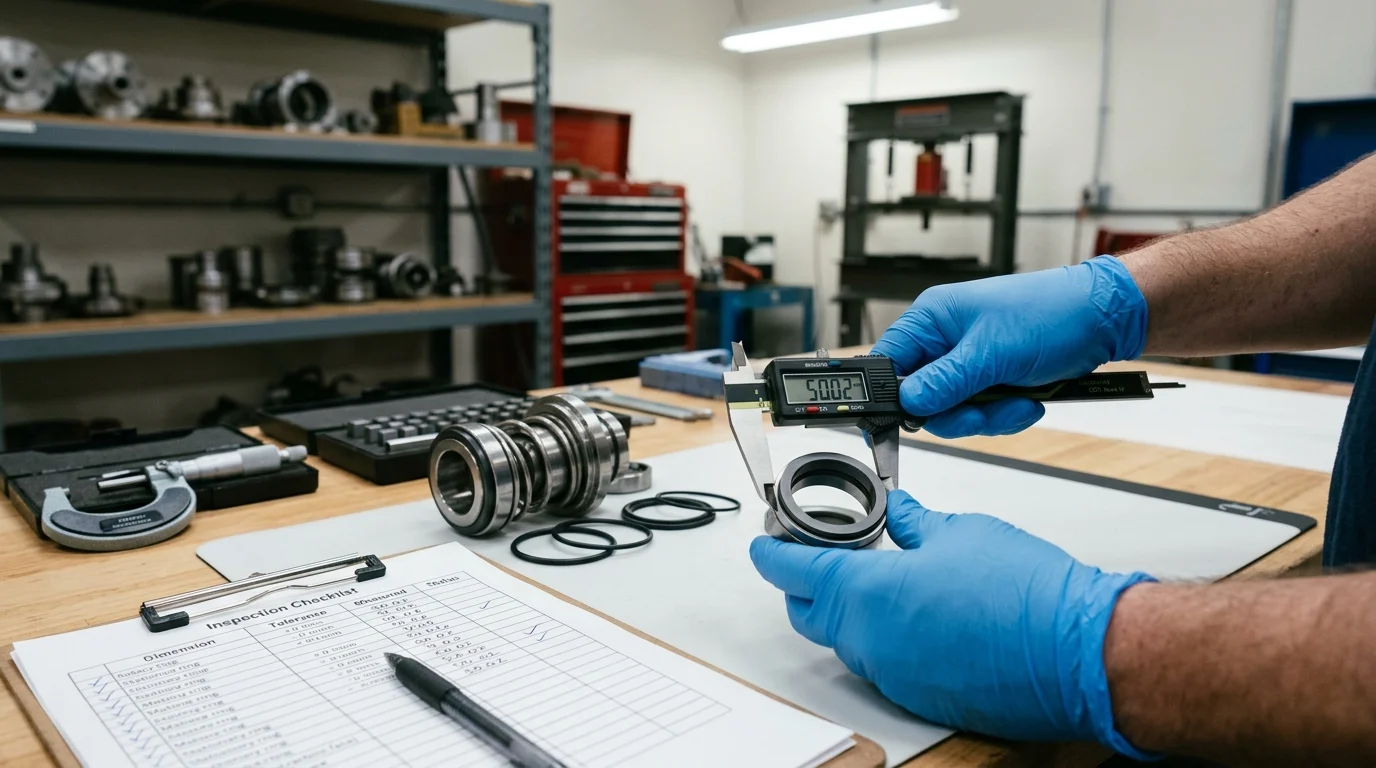
Claimed interchangeability between OEM and aftermarket seals requires rigorous validation through certified engineering drawings and exact part numbers. A dimensional deviation as minor as 0.002 inches (0.05 mm) in shaft runout tolerance can compromise the fluid film between the seal faces.
Buyers must demand dimensional verification and cross-reference the bill of materials to ensure the replacement cartridge or component identically matches the original equipment specifications, preventing costly installation delays.
How to Assess Supplier Quality and Compliance
The reliability of an OEM mechanical seal is intrinsically tied to the supplier’s Quality Management System (QMS). Evaluating a supplier requires peering beyond the product catalog to scrutinize the manufacturing controls and documented standards that guarantee consistent component integrity.
A robust QMS ensures that every seal off the production line mirrors the tested prototype, minimizing variance and protecting the end-user from hidden manufacturing defects.
Manufacturing controls, inspection records, and traceability
Advanced manufacturing controls are non-negotiable for high-performance sealing technology. Seal faces require precision lapping to achieve flatness typically measured in helium light bands; industry standards dictate a flatness of 1 to 2 light bands (approximately 0.3 to 0.6 microns) to maintain an optimal fluid film.
Procurement teams should mandate full traceability, requiring Material Test Reports (MTRs) and heat numbers for all metallic components to verify metallurgical integrity and origin. This ensures that materials like 316 Stainless Steel or Hastelloy meet exact chemical compositions.
Certifications, standards, and test documentation
Validation of a supplier’s compliance infrastructure is a critical risk mitigation strategy. For the oil and gas sector, seals must strictly adhere to API 682 standards, which mandate rigorous qualification testing including a minimum 500-hour dynamic run.
In pharmaceutical and food processing applications, FDA and USP Class VI certifications for elastomers are legally required. Furthermore, a tier-one OEM supplier should demonstrate a defect rate of less than 500 Parts Per Million (PPM), backed by ISO 9001-certified inspection documentation.
Commercial and Supply Chain Factors That Matter
Even the most technically sound mechanical seal is of little value if the supply chain fails to deliver it on time or at an economically viable price point.
Strategic procurement requires analyzing logistics, inventory protocols, and comprehensive cost structures to insulate plant operations from market volatility and supply bottlenecks.
Lead times, safety stock, and minimum order quantities
Lead times vary drastically based on the complexity and customization of the seal. Standard cartridge seals may offer a reliable 2-to-4-week lead time, whereas highly engineered, application-specific seals often require 12 to 16 weeks for manufacturing and dynamic testing.
To mitigate supply chain disruptions, buyers must negotiate safety stock agreements and clarify Minimum Order Quantities (MOQs), ensuring critical spares are held locally to support immediate plant turnarounds and emergency replacements.
Pricing structure and total landed cost
Evaluating bids solely on the ex-works unit price ignores the Total Landed Cost (TLC). Buyers must aggregate freight expenses, import duties, and inventory holding costs. For international procurement, customs tariffs based on specific Harmonized System (HS) codes can add 3% to 8% to the baseline cost.
| Cost Component | Impact on Total Landed Cost (%) | Strategic Procurement Focus |
|---|---|---|
| Base Unit Price | 70% – 80% | Volume discounts, contract pricing |
| Freight & Insurance | 5% – 10% | Consolidating shipments, INCOTERMS |
| Customs & Duties | 3% – 8% | Accurate HS code classification |
| Inventory Holding | 10% – 15% | Vendor-managed inventory (VMI) agreements |
Criteria for comparing authorized OEM seal suppliers
Comparing authorized OEM seal suppliers requires evaluating their localized service capabilities alongside their product portfolios. Key criteria include the presence of regional repair facilities and the availability of authorized technicians for installation supervision.
An optimal supplier should provide strict Service Level Agreements (SLAs), guaranteeing a technical engineering response within 24 hours to address sudden operational anomalies or complex failure analyses.
How to Finalize the Best OEM Mechanical Seal Purchase
Securing the optimal OEM mechanical seal requires synthesizing technical, commercial, and quality data into a cohesive procurement strategy.
This final phase ensures that the selected component will deliver sustained reliability under real-world plant conditions while aligning with corporate financial targets.
A step-by-step evaluation process
A rigorous evaluation process begins with a comprehensive audit of application data, ensuring the process fluid, pressure, and temperature profiles are entirely accurate. Next, engineering teams must cross-reference the proposed seal specifications against stringent industry standards.
Once technical viability is confirmed, procurement should validate the supplier’s QMS and secure at least three competitive quotes. This establishes a comparative baseline for unit cost, lifecycle projections, and delivery timelines.
Balancing performance, compliance, service, and cost
The ultimate procurement decision rests on balancing initial capital expenditure against long-term operational efficiency. Investing a 15% to 20% premium on a high-tier OEM seal is mathematically justified if it extends the Mean Time Between Failures (MTBF) from 24 months to 60 months.
By prioritizing verifiable performance metrics, strict compliance documentation, and robust after-sales service, industrial operators can finalize a purchase that minimizes total lifecycle costs and maximizes continuous production uptime.
Key Takeaways
- The most important conclusions and rationale for OEM Mechanical Seals
- Specs, compliance, and risk checks worth validating before you commit
- Practical next steps and caveats readers can apply immediately
Frequently Asked Questions
What should I verify first before buying an OEM mechanical seal?
Confirm fluid type, temperature, pressure, shaft speed, and solids content. These basics determine the right face materials, elastomers, and seal design for reliable pump operation.
Why is the lowest OEM seal price not always the best choice?
A cheaper seal can fail early and cause costly downtime, repairs, and leakage issues. Compare lifecycle cost, not just unit price, especially for critical industrial pumps.
How do I confirm an OEM seal is truly interchangeable with my pump?
Check the exact part number, pump model, dimensions, and engineering drawing. Even small fit differences can cause leakage or startup failure.
Which seal materials should I check for harsh chemical or high-speed service?
For demanding conditions, review face materials like silicon carbide or tungsten carbide and verify elastomer limits such as FKM or FFKM against your temperature and media.
Can Victor Seals help match OEM-compatible seals for major pump brands?
Yes. Victor Seals supplies OEM-compatible and replacement mechanical seals for brands like Grundfos, IMO, Alfa Laval, APV, Flygt, Lowara, Fristam, and Allweiler.

Post time: Jun-23-2026