


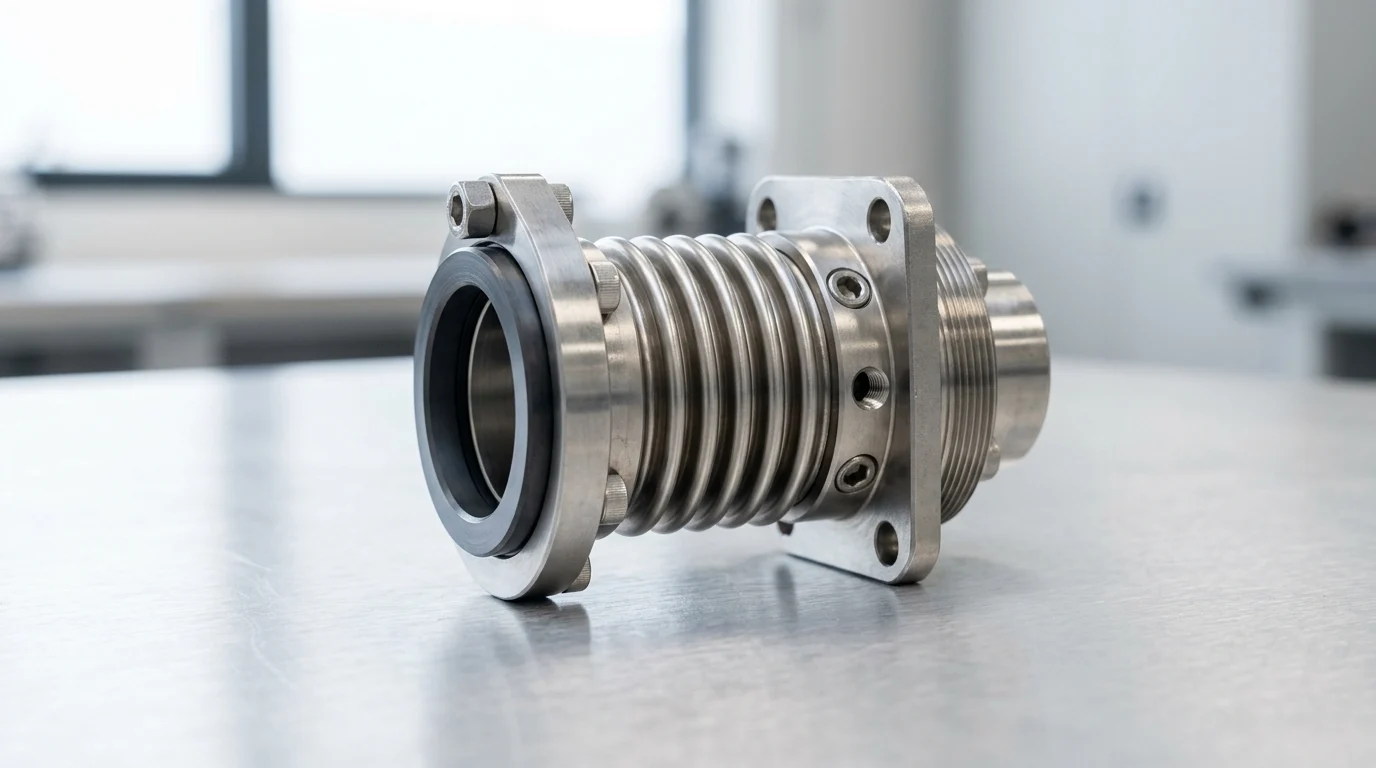
When to Select a Metal Bellows Mechanical Seal
Metal bellows mechanical seals represent a critical engineering solution for rotating equipment operating outside the standard parameters of traditional elastomer-based seals. By replacing the dynamic secondary seal and multiple coil springs with a welded metallic bellows core, these seals provide both the necessary face-loading spring force and a hermetic secondary sealing boundary. This specialized architecture fundamentally alters the operational limits of the pump, allowing for continuous operation in environments that would rapidly degrade standard sealing mechanisms.
Temperature, Pressure, and Shaft Speed
Engineers typically transition to metal bellows when process parameters exceed the safe operating limits of standard O-rings. A standard single-ply edge-welded metal bellows seal comfortably handles operating temperatures ranging from -75°C to 400°C (-100°F to 750°F), far surpassing the typical 150°C to 200°C thermal limits of Viton or Kalrez elastomers. In cryogenic applications handling liquefied gases, the metal structure maintains its flexibility where rubber would become brittle and shatter.
Pressure capabilities are equally robust. While standard edge-welded bellows operate reliably up to 20 bar (290 psi), specialized multi-ply or hydroformed bellows can withstand pressures exceeding 69 bar (1,000 psi). Furthermore, these seals maintain stable face tracking at shaft surface speeds up to 25 meters per second (5,000 feet per minute), making them highly suitable for high-speed centrifugal pumps in demanding industrial processes.
Chemical Compatibility, Solids, and Cleanliness
The static nature of the secondary seal in a bellows design inherently resolves the problem of elastomer hang-up—a primary failure mode in pusher seals where the O-ring adheres to the shaft due to chemical degradation or localized fouling. This makes metal bellows exceptionally well-suited for fluids with high chemical aggressiveness, including strong acids, solvents, and caustic solutions that attack organic compounds.
When dealing with particulate-laden media or slurries containing up to 10% solids by weight, rotating bellows designs utilize centrifugal force to constantly throw particulates away from the convolutions, preventing clogging. However, strict cleanliness during the initial system flush is required. Any solid metallic debris or pipe scale trapped between the tightly spaced bellows leaflets during startup can restrict axial movement, induce localized stress concentrations, and cause premature fatigue failure.
How a Metal Bellows Mechanical Seal Performs
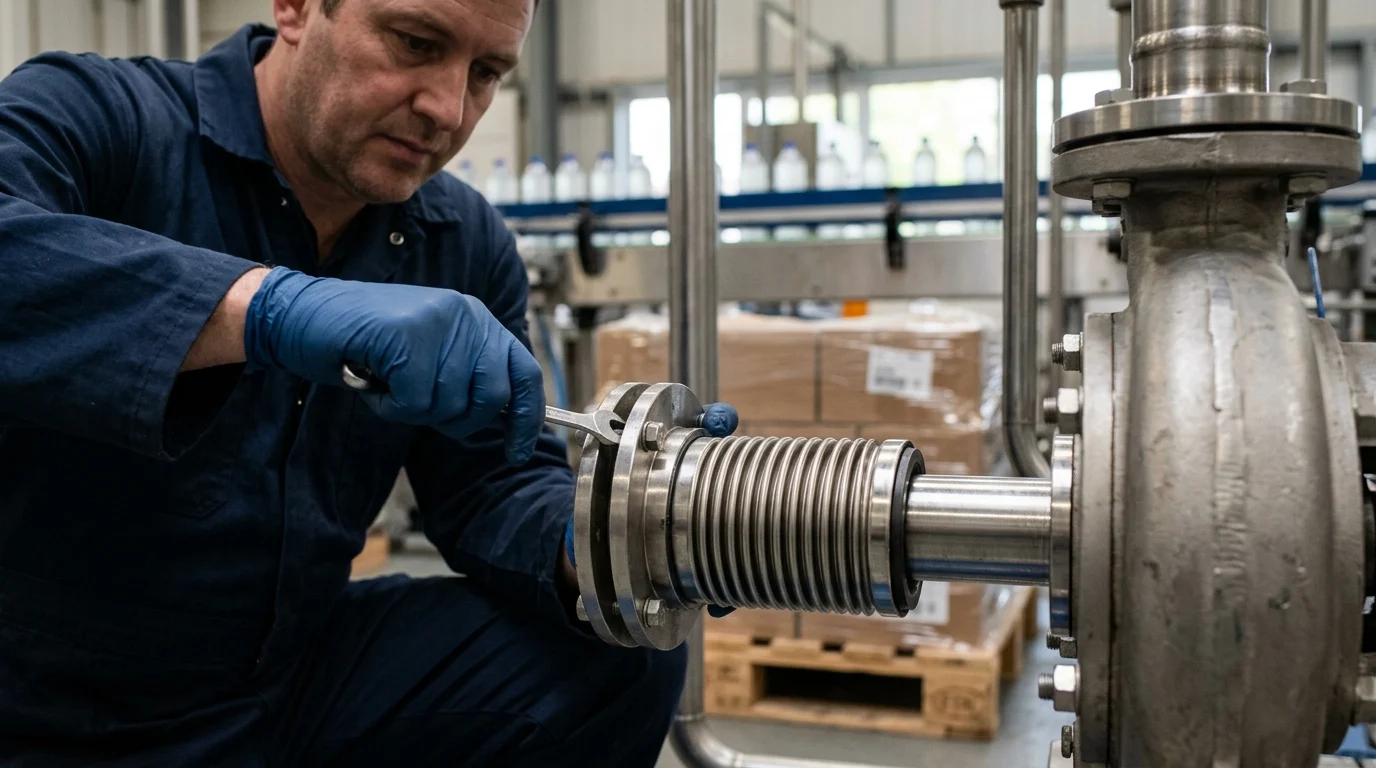
The structural mechanics of a metal bellows seal fundamentally alter how face loading and hydraulic balancing are achieved in a pump stuffing box. Unlike pusher seals that rely on discrete coil springs, the continuous bellows unit distributes the spring load uniformly across 360 degrees of the seal face, optimizing the fluid film between the rotating and stationary components.
Performance Compared with Pusher Seals
This uniform loading directly impacts the kinetic stability of the seal faces under varying hydraulic conditions. The elimination of the sliding elastomer is the most significant differentiator when evaluating performance.
| Feature | Pusher Mechanical Seal | Metal Bellows Mechanical Seal |
|---|---|---|
| Secondary Sealing Element | Dynamic Elastomer (O-ring) | Static Metallic Bellows |
| Shaft Fretting Risk | High (due to sliding O-ring) | Eliminated (no sliding parts on shaft) |
| Temperature Limit | ~200°C (Elastomer dependent) | Up to 425°C+ (Metallurgy dependent) |
| Clogging Susceptibility | High (springs and O-ring gap) | Low (rotating bellows self-clean) |
By eliminating the dynamic O-ring, the bellows seal eradicates shaft fretting. Fretting occurs when micro-movements of the elastomer gouge the pump sleeve over time, leading to costly shaft replacements and persistent leakage paths under the seal.
Leakage, Torque, and Reliability
Hydraulic balancing is inherent to the design of an edge-welded metal bellows, achieved by positioning the effective diameter of the bellows in relation to the seal face. This optimized balance ratio (typically engineered between 0.65 and 0.80) minimizes the generation of frictional heat and wear, significantly reducing leakage rates to virtually undetectable levels under normal steady-state operation.
Torque transmission is handled directly through the bellows core or via specialized drive lugs in higher-pressure applications, ensuring that startup torque does not twist and shear the metallic leaflets. In high-temperature refinery applications, replacing a failing pusher seal with a properly specified metal bellows seal frequently extends the Mean Time Between Failures (MTBF) from a historically poor 8 to 12 months to well over 36 months, delivering a profound increase in overall equipment reliability.
Operating Conditions That Justify Its Use
Selecting a metal bellows seal is rarely the default choice for benign water applications due to its higher initial capital cost. Rather, it is a strategic upgrade deployed when specific hostile operating environments render pusher seals mechanically or chemically ineffective.
High and Low Temperature, Vacuum, and Poor Lubrication
Thermal extremes are the primary driver for bellows specification. In cryogenic applications handling liquid nitrogen or LNG at temperatures down to -196°C (-320°F), elastomers fail immediately. Conversely, in heat transfer fluid systems or refinery bottoms operating continuously at 350°C to 425°C, organic elastomers melt or carbonize. Metal bellows maintain their precise mechanical spring rate and sealing integrity across this entire thermal spectrum.
Furthermore, in vacuum applications pulling down to 0.1 bar absolute, or systems suffering from intermittent dry-running and poor lubrication, the optimized, uniform face loading of the bellows helps maintain the critical fluid film. This prevents the catastrophic face damage and thermal cracking that typically occur when a pusher seal loses its lubricating barrier.
Corrosive Fluids, Coking Risk, and Shaft Movement
Fluids that polymerize or coke upon exposure to atmospheric temperatures—such as heavy hydrocarbons, asphalt, and crude oil bottoms—pose severe risks to standard seals. As these fluids leak microscopically across the seal faces and cool, they form solid carbon deposits. In a pusher seal, this coking immobilizes the dynamic O-ring, causing immediate seal failure. A metal bellows seal, devoid of sliding secondary elastomers, continues to track the seal face even when moderate coking occurs on the atmospheric side.
Additionally, the bellows can accommodate significant axial shaft movement—often up to +/- 2.0 mm—caused by thermal expansion of the pump shaft in high-temperature services. It absorbs this dimensional shift through the flexing of the welded convolutions without compromising the sealing gap or galling the shaft sleeve.
Limits, Failure Modes, and Trade-Offs
Despite their robust capabilities, metal bellows seals possess distinct operational limits and trade-offs. The primary failure mode is torsional shear; if the seal faces stick together due to product crystallization during a pump shutdown, the rotational force upon startup can instantly rip the welded convolutions.
Additionally, the thin metallic leaflets (typically 0.10 mm to 0.15 mm thick) are highly susceptible to fatigue from equipment vibration. Vibration levels exceeding 4.5 mm/s RMS can induce harmonic resonance, leading to rapid weld fractures. Finally, the capital expenditure is a significant trade-off, with edge-welded metal bellows seals typically demanding a 1.5x to 3.0x cost premium over standard pusher seals, necessitating a clear return-on-investment justification based on extended uptime.
How to Specify and Install a Metal Bellows Mechanical Seal
Successful deployment of a metal bellows mechanical seal relies heavily on rigorous specification of materials and precise installation practices. Because these seals are engineered for severe service, sub-optimal metallurgy or improper mechanical alignment will rapidly negate their inherent performance advantages.
Metallurgy, Face Materials, and Seal Configuration
The metallurgy of the bellows core must be meticulously matched to the process fluid. AM350 stainless steel is the standard for general high-temperature applications, offering excellent weldability and fatigue resistance. For highly corrosive environments involving chlorides or sour gas (H2S), engineers upgrade to Alloy C-276 (Hastelloy) or Alloy 718 (Inconel), which provide superior resistance to stress corrosion cracking and pitting.
Seal face combinations typically pair a stationary Silicon Carbide (SiC) ring against a rotating high-density Carbon Graphite ring for optimal lubricity. However, highly abrasive services may require hard-on-hard pairings like SiC versus Tungsten Carbide (TC). Configurations are dictated by API 682 standards, with Arrangement 1 (single seal) used for standard high-temperature liquids, and Arrangement 2 or 3 (dual unpressurized or pressurized seals) mandated for hazardous or volatile organic compounds (VOCs).
Installation, Alignment, Startup, and Monitoring
Cartridge seal designs have become the industry standard, encapsulating the bellows, faces, and gland plate into a single, pre-set unit that eliminates the need for manual setting measurements on the pump shaft. During installation, the pump shaft runout must be strictly verified; total indicator reading (TIR) should not exceed 0.05 mm (0.002 inches) to prevent excessive, uneven flexing of the bellows convolutions.
Startup procedures for high-temperature applications mandate a controlled pre-heating phase, often using an API Plan 32 external flush or an API Plan 62 steam quench. The pump casing and seal chamber must be heated at a maximum rate of 50°C per hour to prevent thermal shock to the brittle silicon carbide faces. Continuous monitoring of flush temperature and seal chamber pressure is critical to ensure the fluid remains at least 15°C below its vapor pressure, preventing flashing and dry-running at the seal faces.
Decision Framework for Seal Selection

Transitioning to a metal bellows mechanical seal requires a structured evaluation of process conditions, failure history, and total lifecycle costs. A standardized decision framework allows plant reliability engineers to justify the capital expenditure objectively by weighing the initial purchase price against the long-term operational savings.
Application Checklist
The following matrix serves as a primary application checklist to determine if a metal bellows seal is the necessary technical solution for a given pumping system.
| Evaluation Criteria | Threshold for Bellows Consideration | Recommended Action |
|---|---|---|
| Pumping Temperature | > 200°C (392°F) or < -40°C (-40°F) | Mandate metal bellows; specify AM350 or Alloy 718. |
| Fluid Coking / Polymerization | Moderate to High Risk | Specify rotating bellows with API Plan 62 quench. |
| Shaft Fretting History | > 1 shaft sleeve replacement per year | Upgrade to bellows to eliminate dynamic elastomer. |
| Particulate Concentration | 2% to 10% by weight | Specify rotating bellows; avoid stationary bellows. |
If any single criterion in this checklist is met, the inherent design limitations of a standard pusher seal will likely lead to premature failure, making the bellows design the technically and financially sound choice.
Risk, Compliance, Uptime, and Replacement Cost
Beyond technical specifications, the decision must encompass risk mitigation, environmental compliance, and overall plant uptime. In jurisdictions governed by strict environmental regulations, edge-welded metal bellows seals play a critical role in reducing fugitive emissions, reliably maintaining volatile organic compound (VOC) leakage rates well below the stringent 500 ppm regulatory threshold outlined by the EPA and equivalent global bodies.
While the upfront cost of a bellows cartridge may range from $2,500 to $8,000 depending on metallurgy and shaft size, the financial analysis must factor in the cost of avoided downtime. In continuous process industries like petroleum refining or petrochemical processing, a single pump failure can incur production outage costs exceeding $10,000 per hour. By eliminating elastomer degradation, preventing shaft fretting, and surviving thermal transients, the metal bellows seal drastically reduces the frequency of pump teardowns. Ultimately, when applied to the correct extreme-service environments, the total cost of ownership (TCO) for a metal bellows seal is substantially lower than that of a pusher seal over a five-year lifecycle.
Key Takeaways
- The most important conclusions and rationale for Metal Bellow Mechanical Seal
- Specs, compliance, and risk checks worth validating before you commit
- Practical next steps and caveats readers can apply immediately
Frequently Asked Questions
When should I choose a metal bellow mechanical seal?
Use it when pumps face extreme temperatures, aggressive chemicals, higher shaft speeds, or when elastomer O-rings fail from hang-up or fretting.
What temperature range can a metal bellow mechanical seal handle?
Typical single-ply edge-welded designs handle about -75°C to 400°C, making them suitable for cryogenic and high-heat services.
Are metal bellow seals better for chemical and solvent pumps?
Yes. Their static metallic secondary seal avoids elastomer attack, so they work well in acids, solvents, and caustic services.
Can metal bellow mechanical seals run in slurry or solids-containing media?
Yes, especially rotating bellows designs for media with up to about 10% solids, but startup flushing must remove metal debris and pipe scale.
Can Victor Seals supply replacement metal bellow seals for OEM pump brands?
Yes. Victor Seals provides OEM-compatible and replacement seals for brands like IMO, Alfa Laval, Grundfos, APV, Flygt, Fristam, Lowara, and Allweiler.
Post time: Jun-09-2026